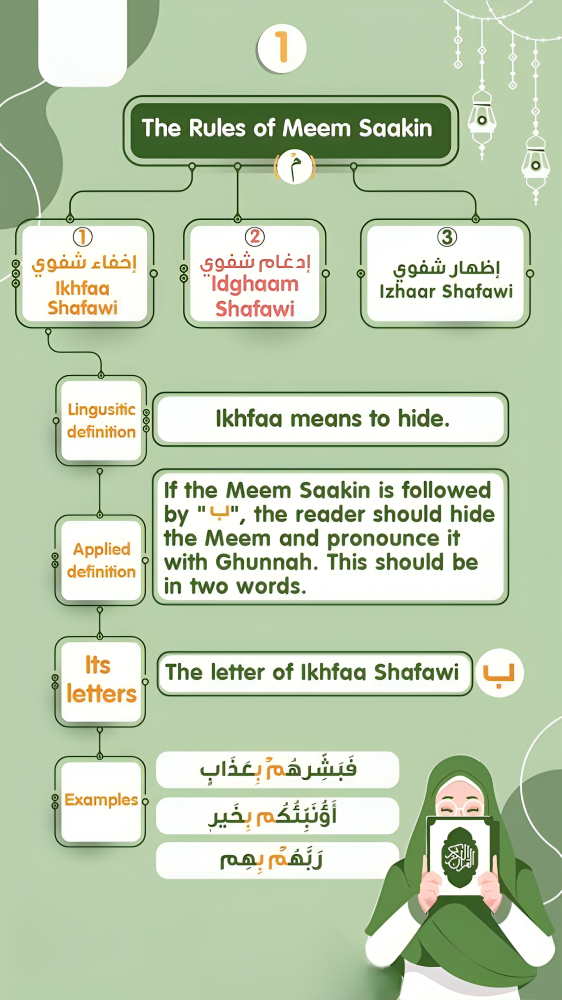
Introduction
Idgham (الإدغام), literally meaning “merging” or “assimilation,” is one of the essential rules in Tajweed science. This principle ensures the proper pronunciation of letters when they meet under specific conditions, contributing to the melodious flow and accurate recitation of the Holy Quran.
Understanding Idgham
Definition
Idgham occurs when two letters meet, and the first letter merges into the second, resulting in a stressed (mushaddad) second letter. This merging creates a seamless flow in pronunciation while maintaining the meaning and integrity of the Quranic text.
Categories of Idgham
- Based on Noon Sakin and Tanween
- Idgham with Ghunnah (with nasalization)
- Idgham without Ghunnah (without nasalization)
- Based on Letter Similarity
- Idgham Mutamathelain (identical letters)
- Idgham Mutajanisain (similar articulation points)
- Idgham Mutaqaribain (close articulation points)
Detailed Analysis of Each Type
1. Idgham with Noon Sakin and Tanween
A. Idgham with Ghunnah
Letters: يَنْمُو (Ya, Noon, Meem, Waw)
- Examples:
- مَنْ يَّقُولُ → Man Yaqulu
- مِنْ نِّعْمَةٍ → Min Ni’matin
- خَيْرٌ مِّنْ → Khairum Min
- عَذَابٌ وَّلَا → ‘Athabuw Wala
- مِنْ واقٍ → Min Waq
Duration: Hold the Ghunnah for 2 counts
B. Idgham without Ghunnah
Letters: ل، ر (Lam, Ra)
- Examples:
- مِن رَّبِّكَ → Mir Rabbika
- مِن لَّدُنْهُ → Mil Ladunhu
- هُدًى لِلْمُتَّقِينَ → Hudal Lilmuttaqeen
2. Idgham Mutamathelain (Complete Merging)
Definition: When two identical letters meet
- Examples:
- قَد دَّخَلُوا → Qad Dakhalu
- إِذْ ذَّهَبَ → Ith Thahaba
- اضْرِب بِّعَصَاكَ → Adrib Bi’asaka
3. Idgham Mutajanisain (Similar Letters)
Definition: When two letters share the same articulation point but differ in characteristics
- Examples:
- ب + م = م (Ba + Meem)
- ت + د = د (Ta + Dal)
- ت + ط = ط (Ta + Taa)
4. Idgham Mutaqaribain (Close Letters)
Definition: When two letters have close articulation points
- Examples:
- ل + ر = ر (Lam + Ra)
- ق + ك = ك (Qaf + Kaf)
5. When Idgham Does Not Apply
Idgham only occurs when the noon sakinah or tanween and the merging letter are in two separate words. If they appear within the same word, Idgham does not apply. This is called Izhar Mutlaq.
- الدُّنْيَا: the noon is followed by ya within one word, so no Idgham applies.
- مِنْ شَرِّ الْوَسْوَاسِ (Surah An-Nas 114:4): the noon sakinah is followed by Shin, which is not a letter of يرملون, so no Idgham occurs.
Practical Application
Rules for Proper Implementation
- Complete Merging
- First letter should completely merge into second
- No trace of first letter should remain
- Second letter becomes stressed
- Ghunnah Application
- Must be clear and distinct
- Maintain proper duration (2 counts)
- Avoid over-extension
- Stopping Rules
- If stopping at first letter, Idgham doesn’t apply
- Resume from second letter when continuing
Common Mistakes to Avoid
- Incomplete Merging
- Partial pronunciation of first letter
- Weak stress on second letter
- Incorrect duration of Ghunnah
- Over-application
- Applying Idgham where not needed
- Merging across word boundaries incorrectly
- Extending Ghunnah beyond 2 counts
- Technical Errors
- Incorrect articulation points
- Wrong stress placement
- Improper breath control
- Failing to distinguish between Idgham with and without ghunnah
Teaching and Learning Methods
1. Systematic Approach
- Learn rules progressively
- Practice with simple examples first
- Gradually increase complexity
- Regular revision and assessment
2. Practical Exercises
- Reading exercises
- Recording and playback
- Peer practice sessions
- Teacher supervision
3. Modern Learning Tools
- Digital Quran apps
- Audio recordings
- Online tutorials
- Practice worksheets
Benefits of Proper Idgham
- Recitation Quality
- Improved fluency
- Better pronunciation
- Enhanced rhythm
- Natural flow
- Spiritual Benefits
- Greater connection with text
- Better understanding
- More rewarding recitation
- Preservation of divine speech
- Learning Benefits
- Stronger foundation in Tajweed
- Better memorization
- Improved teaching ability
- Deeper appreciation of Quranic sciences
Advanced Topics
1. Special Cases
Most cases follow the general rules in this guide, but a few cases need extra care. The clearest exception is already given above. When the two letters fall inside one word, Idgham does not apply, and this is called Izhar Mutlaq. The same care applies when you stop. If you stop at the first letter, Idgham does not apply, and when you continue you resume from the second letter. For a rare combination, apply the same test as always. The first letter must merge fully into the second, the second letter becomes stressed, and the ghunnah, where it applies, is held for two counts. Small differences of habit between regions do not change that test, and where scholars differ on a rare case, keep to the complete merging and correct articulation points taught in this guide.
2. Regional Variations
Idgham has been passed down through different recitation styles, and this guide keeps to the rules shared across them. The first letter merges into the second, the second letter becomes stressed, and the ghunnah, where it applies, lasts two counts. Within that frame, teachers from different schools may present the same rule in a different order or with different practice examples, and that is an acceptable variation in teaching, not a change to the rule itself. What stays fixed is the sound. The merging must be complete, with no trace of the first letter left, and the stress must fall on the second letter. A student who moves between teachers should therefore check the sound against this guide, not against habit alone.
Practice Guidelines
1. Daily Practice Routine
A steady daily routine follows the same order as the teaching method in this guide. Start with basic combinations and practice with simple examples first. Repeat them regularly, because the ghunnah must be held for two counts and the second letter must carry the stress, and both points only settle with repetition. Then increase the complexity step by step, moving from the plain Noon Sakin and Tanween cases to identical letters, similar letters and close letters. End each session with review. Go back over the combinations you practiced, check the merging is complete, and check that you have not extended the ghunnah beyond two counts. Regular revision is what turns a rule you understand into a sound you produce without thinking.
2. Self-Assessment Tools
Checking your own recitation uses the same tools named in the teaching method in this guide. Record yourself and play the recording back, then listen for the three points that matter most. The first letter should leave no trace, the second letter should carry the stress, and the ghunnah should last two counts and no longer. A short checklist built from those points makes the check simple. Mark each combination as clear or in need of more practice, track your progress over days and weeks, and set a small milestone before you move on, such as reading a full set of basic combinations cleanly. When a combination still sounds unclear on playback, take it back to simple examples and to teacher supervision, which is the practical exercise named in this guide.
3. Group Learning Activities
Learning with others adds checks that practice alone cannot give. Practice with a partner and read the same combinations aloud in turn, so each of you can hear whether the first letter has fully merged and whether the stress sits on the second letter. Group recitation gives the same benefit on a larger scale, because a shared pace makes a stretched ghunnah or a weak stress easy to notice. Teaching a combination to someone else is a strong test of your own grasp, since you must explain when the ghunnah applies and when it does not. Close each session with feedback, naming one point done well and one point to fix, and carry the point to fix into your next daily routine.
Conclusion
Understanding and properly implementing Idgham is crucial for anyone serious about Quranic recitation. Through consistent practice and proper guidance, mastery of these rules becomes achievable. Remember that perfection in recitation is a journey that requires patience, dedication, and continuous learning.
About the Author
This comprehensive guide is published on Baytul Quran, dedicated to spreading authentic knowledge of Quranic sciences and proper recitation techniques.