INTRODUCTION
Ask most Quran students which letters they find easiest and they will almost always say the lip letters. After all, the lips are visible. You can watch them in a mirror. Ba sounds like B. Meem sounds like M. Waw sounds like W. Fa sounds like F. These are sounds that exist in English. How complicated can they be?
This is precisely the trap that catches so many students and parents off guard.
The lip letters of Arabic, known as Huroof Al-Shafatain, are indeed the most physically visible and initially accessible letters in the entire Arabic alphabet. But visible does not mean simple. Each of these four letters carries specific Tajweed rules and characteristics that the vast majority of students who consider them easy have never been taught. And the fifth member of this lesson, the nasal sound of Al-Khayshoom, is the quality that runs through both Meem and Noon and gives Quranic recitation one of its most recognisable and beautiful qualities.
This is Lesson 7 in our Tajweed series for Muslim families, and it completes our journey through the five main Makhaarij zones. In the previous lessons we worked through the throat letters of Al-Halq and the eighteen tongue letters of Al-Lisaan. In this lesson we complete the articulation map by covering Al-Shafatain, the lip zone, and Al-Khayshoom, the nasal passage. After this lesson, you will have a complete working knowledge of every Makhraj zone in Arabic Tajweed, which is a genuine achievement that most Quran students never reach.
Let us cover these letters properly, including the parts that most students have been getting wrong without realising it.
IN THIS ARTICLE:
- What Are Huroof Al-Shafatain and Al-Khayshoom?
- Ba (ب) —> The Bouncing Lip Letter
- Meem (م) —> The Nasal Lip Letter
- Waw (و) —> The Rounded Lip Letter
- Fa (ف) —> The Teeth and Lip Letter
- Al-Khayshoom —> Understanding the Nasal Sound in Tajweed
- The Hidden Tajweed Rules You Were Missing
- How All Five Makhaarij Zones Now Work Together
- Frequently Asked Questions
WHAT ARE HUROOF AL-SHAFATAIN AND AL-KHAYSHOOM?
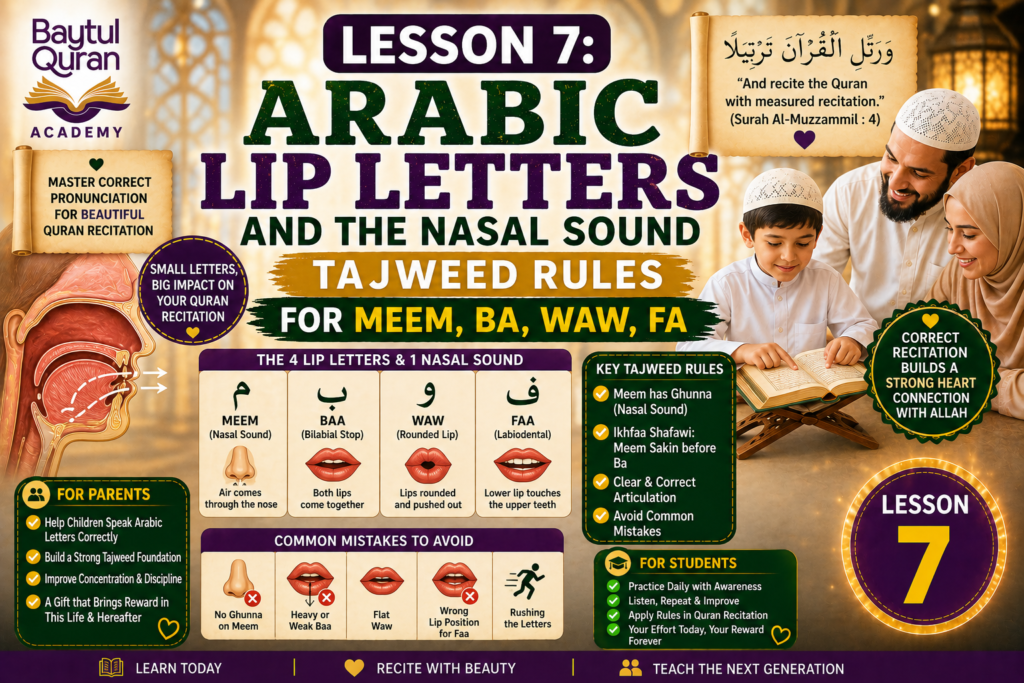
Al-Shafatain is the Arabic word for the two lips. This zone contains four Arabic letters, each produced using the lips in a different way. Three of the four letters use both lips together, while one uses the upper teeth against the lower lip. This distinction is what makes Fa technically a lip-and-teeth letter rather than a pure lip letter, though it is traditionally grouped with the lip zone.
Al-Khayshoom refers to the nasal passage, the internal nasal cavity above the back of the throat. This zone does not produce a separate Arabic letter in the way other zones do. Instead, it produces a sound quality called Ghunnah, the nasal resonance that runs through certain pronunciations of Meem and Noon. Understanding Al-Khayshoom is therefore inseparable from understanding Meem and Noon at a deep level.
Together, these five letters and the nasal quality represent the final zone in our Makhaarij study. They are also the letters that most clearly demonstrate a truth that runs through all of Tajweed: every Arabic letter has more to it than its surface appearance suggests.
BA (ب) THE BOUNCING LIP LETTER
Ba is produced when both lips come together completely, creating a total closure that stops the airflow. The voice is switched on during this closure, and when the lips release, the stored pressure produces the characteristic Ba sound.
In terms of Sifaat, Ba carries Jahr (full voicing), Shiddah (complete stop), Istifaal (tongue low), Infitaah (open), and crucially, Qalqalah. The presence of Qalqalah is the characteristic that most students do not know about Ba, and it is the one that makes the biggest difference to correct recitation.
As we learned in Lesson 4, Qalqalah is the echoing or bouncing quality that appears when any of the five Qalqalah letters, Qaaf, Taa emphatic, Ba, Jeem, and Daal, appears with a Sukoon. Ba is one of those five letters. This means that whenever Ba appears without a vowel, it must produce a clear and audible bouncing echo at the moment of lip release.
Think about the word (أَحَبّ) which means He loved and appears in several Quranic contexts. The double Ba at the end, when pausing on it, requires a firm Qalqalah. Many students produce a flat, quiet Ba in this position without any bounce at all. That is a Tajweed error.
The strength of the Qalqalah on Ba also depends on its position in the word. Ba at the end of a verse where the reader pauses requires the strongest Qalqalah. Ba with Sukoon in the middle of a word requires a lighter Qalqalah. A qualified teacher will drill both levels of strength until the student can produce them consistently and naturally.
The most common mistake with Ba beyond the missing Qalqalah is producing it without complete lip closure, allowing a slight air leak that makes the Ba sound partially breathy. The lip closure must be complete and firm before the release.
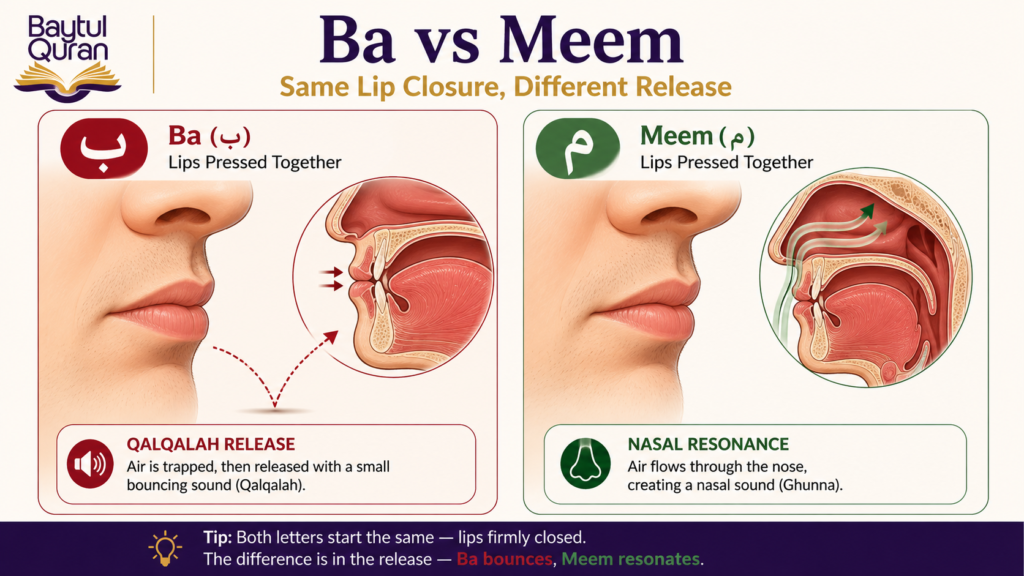
Both Ba and Meem use complete lip closure. But what happens inside during that closure is what makes them two completely different letters.
MEEM (م) THE NASAL LIP LETTER
Meem is produced from exactly the same physical position as Ba. Both lips come together completely, creating total closure. The voice is switched on during the closure. The lips then release.
If Ba and Meem are produced from exactly the same lip position, what makes them different letters?
The answer is the nasal passage.
During the production of Meem, while the lips are closed, air and sound are simultaneously redirected through the nasal passage. This creates the characteristic nasal resonance that distinguishes Meem from Ba entirely. Ba is a pure oral stop with Qalqalah. Meem is a nasal consonant where the sound resonates through the nose even while the lips are closed.
In terms of Sifaat, Meem carries Jahr (full voicing), Tawassut (middle quality between stop and flow), Istifaal, Infitaah, and the nasal quality of Ghunnah. The absence of Shiddah and Qalqalah in Meem, compared to Ba, reflects the fact that Meem does not produce a bouncing echo but instead produces a sustained nasal resonance.
This is a profoundly important distinction that many students miss entirely. If you produce Meem without engaging the nasal passage, what comes out is essentially a Ba with no Qalqalah, which means your Meem sounds like a flat, quiet Ba. That is not Meem. True Meem requires the nasal passage to be open and resonating during the lip closure.
A practical test for correct Meem is to pinch your nose closed while producing Meem. If the sound changes dramatically and feels blocked, your Meem is correctly using the nasal passage. If the sound barely changes, you are producing Meem without its nasal quality and the letter is not correct.
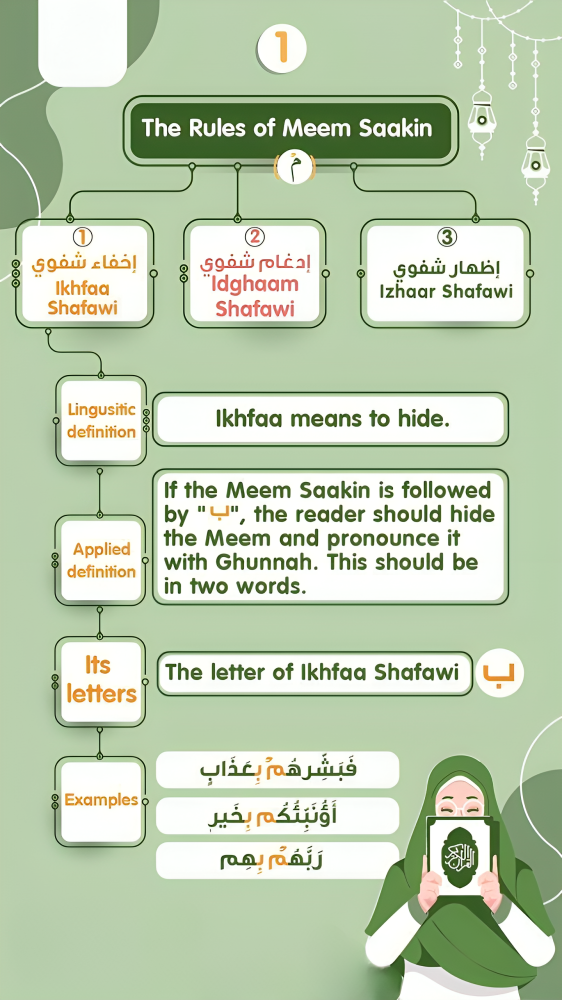
Meem also has its own set of Tajweed rules when it appears with a Sukoon, known as the Meem Sakinah rules. These include Idghaam Shafawi when followed by another Meem, Ikhfa Shafawi when followed by Ba, and Idhar Shafawi when followed by all other letters. These rules build directly on the correct baseline production of Meem that this lesson establishes, and they will be covered in detail in Lesson 9.
The most common mistake with Meem is, as described above, producing it without engaging the nasal passage. The second most common mistake is producing Meem with a Sukoon before Ba without applying Ikhfa Shafawi, which requires a specific nasal quality. Both of these errors are extremely widespread and both are easily corrected with a qualified teacher.
WAW (و) THE ROUNDED LIP LETTER
Waw as a consonant is produced with both lips rounding slightly toward each other without making complete contact. The lips form a small rounded opening and the voice flows through it freely. The key difference between Waw and Ba or Meem is that Waw does not involve complete lip closure. The lips approach each other but do not touch.
In terms of Sifaat, Waw carries Jahr (full voicing), Rakhawah (free airflow), Istifaal, Infitaah, and Idhlaq (produced easily and naturally). The Rakhawah characteristic reflects the fact that airflow is never completely stopped during Waw. It flows continuously through the rounded lip opening.
It is important to distinguish between the consonant Waw and the long vowel Waw. The long vowel Waw, which appears as a Madd letter, is produced from Al-Jawf, the open oral cavity, and creates a sustained OO sound. The consonant Waw, which is what this lesson covers, is produced from the rounded lip position and functions as a consonant at the beginning of syllables.
The English W sound is a reasonable approximation of Arabic consonant Waw. English speakers generally find this letter accessible, but there are two common mistakes worth noting.
The first mistake is producing Waw from the teeth rather than the lips, creating a sound closer to V than W. Arabic has no V sound, and any V-like quality in the production of Waw indicates the articulation is coming from the wrong place.
The second mistake is failing to maintain sufficient lip rounding, producing a flat W sound rather than the correctly rounded Arabic Waw. The lip rounding of Arabic Waw should be deliberate and consistent, giving the letter a full, round, resonant quality.
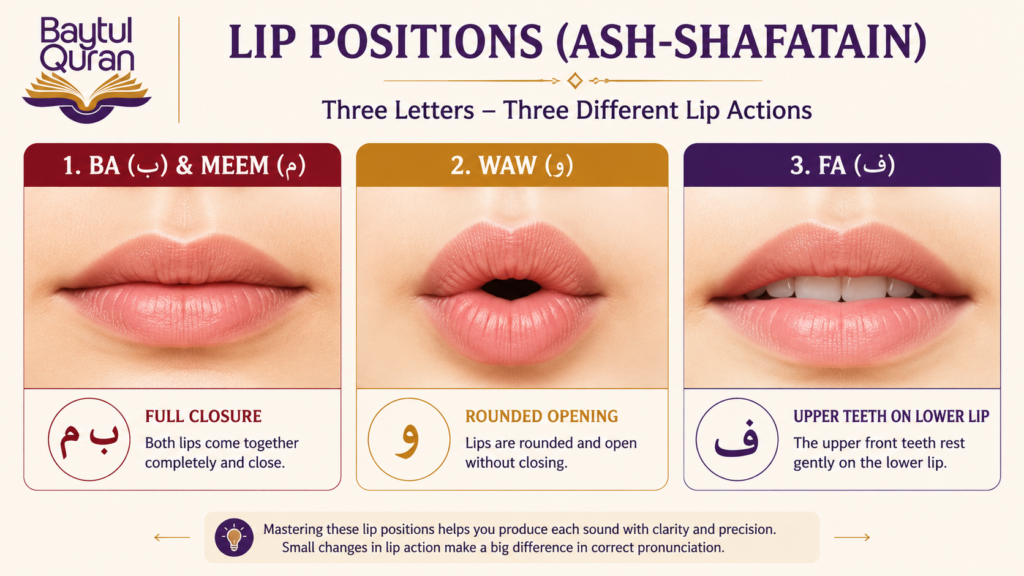
The lips do four completely different things across these four letters. That variety is what makes each letter distinct and each one worth studying carefully.
FA (ف) THE TEETH AND LIP LETTER
Fa stands apart from the other lip letters because it does not use both lips together. Instead, Fa is produced with the inner edge of the lower lip making contact with the edges of the upper front teeth. This makes Fa a labiodental consonant, meaning it uses both a lip and teeth, hence its traditional inclusion in the lip zone despite technically involving the teeth as well.
In terms of Sifaat, Fa carries Hams (voicelessness and breathiness), Rakhawah (free airflow), Istifaal, Infitaah, and Idhlaq. The Hams characteristic means Fa is a voiceless letter, meaning the vocal cords do not vibrate during its production. Air flows freely between the lower lip and upper teeth, creating a soft friction sound.
The English F sound is a very close approximation of Arabic Fa and is one of the most accessible letters in all of Arabic for English speakers. The physical production is essentially identical to English F, with the inner lower lip making light contact with the upper front teeth and air flowing freely through the contact.
However, there are two subtle points that students should be aware of.
The first point is the degree of contact. The Arabic Fa requires a light, precise contact between the inner edge of the lower lip and the upper teeth rather than the full lower lip pressing hard against the teeth. Too much pressure changes the quality of the friction and makes the letter sound heavier than it should be.
The second point is the voicelessness. Fa must be completely voiceless. Any voicing that creeps into Fa transforms it toward a V sound, which as mentioned above does not exist in Arabic. Students who speak languages with a V sound, such as Urdu speakers who sometimes produce a labiodental V, need to ensure their Fa carries no voicing whatsoever.
The most common mistake beyond these two points is simply mispositioning the contact, using the outer edge of the lower lip instead of the inner edge, or pressing the full lip against the teeth rather than the light inner-edge contact that correct Fa requires.
AL-KHAYSHOOM UNDERSTANDING THE NASAL SOUND IN TAJWEED
Al-Khayshoom is the nasal passage, and it is the fifth and final Makhaarij zone in our study. Unlike the other four zones which produce specific consonant letters, Al-Khayshoom produces a sound quality called Ghunnah rather than a standalone letter.
Ghunnah is the nasal resonance sound that is produced when air and sound are redirected through the nasal passage. It has a warm, humming, resonant quality that is one of the most immediately recognisable features of beautiful Quranic recitation. When you hear a skilled Qari and notice that certain sounds carry a warm nasal hum, that is Ghunnah coming from Al-Khayshoom.
Ghunnah is associated primarily with two letters, Noon (ن) and Meem (م), and it appears in specific Tajweed contexts rather than every time these letters are recited. The duration of Ghunnah is measured in counts called Harakaat, and correct Ghunnah lasts for two counts, which the scholars describe as approximately the time it takes to lower and raise a finger at a measured pace.
The contexts in which Ghunnah appears are as follows.
Ghunnah appears on Meem and Noon when they are mushaddad, meaning they carry a Shaddah (doubling) sign. In this context the Ghunnah is at its strongest and must be held for the full two counts.
Ghunnah also appears during the rules of Idghaam with Ghunnah, Ikhfa, and Iqlab, all of which are rules of Noon Sakinah and Tanween that will be covered in detail in the next lesson. In each of these contexts, Ghunnah plays a specific role in shaping how the Noon or Tanween sounds in connection with the following letter.
Ghunnah does not appear during Idhar, when Noon or Meem are followed by the throat letters, because in Idhar the Noon is pronounced clearly and completely without any nasal extension.
The most common mistake with Ghunnah is either producing it too short, giving it only a brief nasal quality instead of the full two-count duration, or producing it too long, extending it beyond two counts into an exaggerated nasal drone. Both errors are extremely common and both are corrected through consistent practice with a qualified teacher who can count the duration accurately.
A second common mistake is producing Ghunnah from the mouth rather than the nasal passage. Students sometimes produce a nasal-like quality by constricting the back of the throat rather than genuinely redirecting the sound through the nose. The pinch test described earlier for Meem applies equally here. If pinching the nose while producing Ghunnah does not cause the sound to change, the Ghunnah is not coming from the nasal passage correctly.
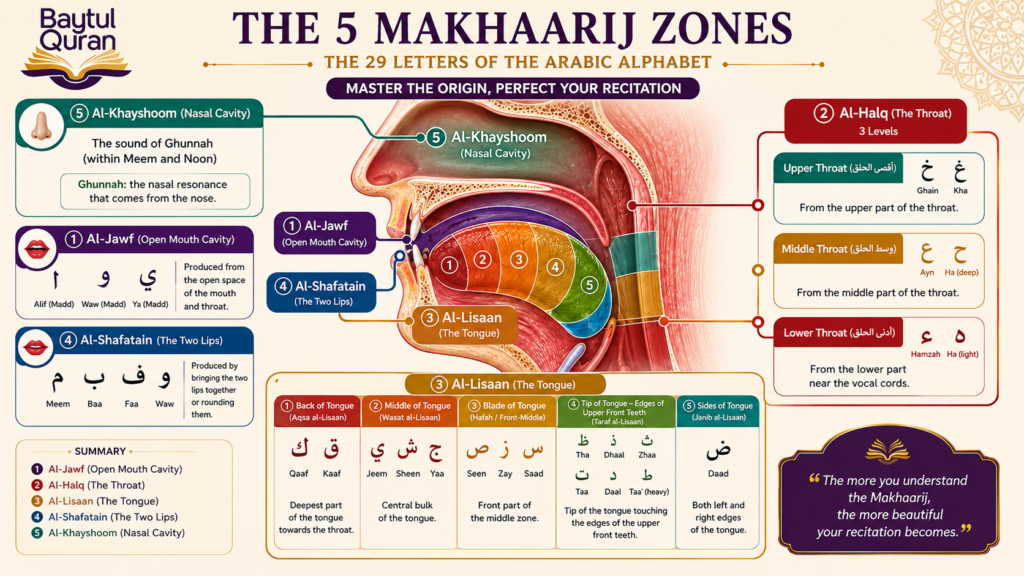
Ghunnah is not produced in the mouth. It flows through the nasal passage above the throat. Once a student feels this correctly for the first time, it changes their recitation permanently.
THE HIDDEN TAJWEED RULES YOU WERE MISSING
This section is specifically for students who considered the lip letters easy and skipped past them without careful study. Here are the specific Tajweed rules that apply to lip letters that most students are unaware of.
The first hidden rule is Qalqalah on Ba. As covered above, Ba is one of the five Qalqalah letters. When Ba appears with a Sukoon, it must produce a clear bouncing echo. This rule is consistently missed by students who learned Ba as a simple B sound and never knew about its Qalqalah characteristic.
The second hidden rule is the Ghunnah of Meem Mushaddad. Whenever Meem appears with a Shaddah sign in the Quran, it must be held with a clear Ghunnah for two full counts before releasing. Many students move quickly through mushaddad Meem without giving it its required nasal duration.
The third hidden rule is the Ikhfa Shafawi of Meem Sakinah. When Meem appears with a Sukoon and is followed by Ba, a specific rule called Ikhfa Shafawi applies. The lips close as if to produce Meem but do not fully release before the Ba. Instead, a nasal quality is maintained during the transition between the two letters. This is a subtle but important rule that most students have never been taught to apply correctly.
The fourth hidden rule is the Idghaam Shafawi. When Meem Sakinah is followed by another Meem, the first Meem is merged into the second with a clear Ghunnah. Many students produce both Meems separately without merging them or without applying the required Ghunnah during the merge.
The fifth hidden rule is the Ghunnah on Waw and Yaa during Idghaam with Ghunnah. When Noon Sakinah or Tanween is followed by Waw or Yaa, the Noon merges into those letters with a clear Ghunnah. Many students know this rule in theory but forget that Waw is a lip letter and that the Ghunnah during this merge should have the full warmth and duration of correct nasal resonance.
These five hidden rules collectively represent some of the most consistently missed Tajweed applications in everyday Quran recitation. A qualified teacher will identify which of these apply to a student’s specific recitation and work on them systematically.
Book a free trial class to have your lip letter rules checked. “If you want to find out which of these hidden rules you have been missing in your own recitation, you can book a free trial class to have your lip letter rules checked by a certified Tajweed teacher with Ijazah.”
Read our lesson on Noon Sakinah and Tanween rules. “Many of the rules mentioned in this lesson connect directly to the Noon Sakinah and Tanween rules which are coming in the next lesson in this series.”
View our complete Tajweed course details. “To see how our structured Tajweed programme covers all of these rules systematically, view our complete Tajweed course details and find the right plan for your family.”
HOW ALL FIVE MAKHAARIJ ZONES NOW WORK TOGETHER
With the completion of this lesson, you have now studied all five Makhaarij zones. This is a significant milestone that deserves a moment of reflection.
You began this journey in Lesson 3 with Al-Jawf, the open oral cavity that produces the three Madd letters. You then studied Al-Halq in Lesson 5 and worked through the six throat letters across three levels of depth. In Lessons 6 Part 1 and Part 2 you mapped all eighteen tongue letters across the full length of Al-Lisaan, from the back tongue Qaaf all the way to the whistling Saad. And in this lesson you have completed Al-Shafatain and Al-Khayshoom, understanding both the physical lip production of four letters and the nasal resonance quality that runs through Meem and Noon.
Together, these five zones contain every Arabic letter and every sound in the Quran. Every letter you encounter from this point forward in your Tajweed study has a home in one of these zones, and you now know where that home is.
This knowledge does something important. It removes the mystery from Arabic pronunciation. When a student hears an unfamiliar Arabic word, they no longer have to guess how it sounds. They can identify the letters, locate their zones, recall their Sifaat from Lesson 4, and produce a genuinely informed articulation. That is not a small skill. That is the beginning of real phonetic fluency in Arabic.
What comes next in this series is where the letter knowledge you have built becomes animated by the rules of Tajweed. The Noon Sakinah and Tanween rules, the Meem Sakinah rules, the Madd rules, and the rules of Waqf and Ibtida all take the letters you now know and govern how they interact, merge, transform, and flow in the connected recitation of the Quran.
The foundation is complete. The building begins now.
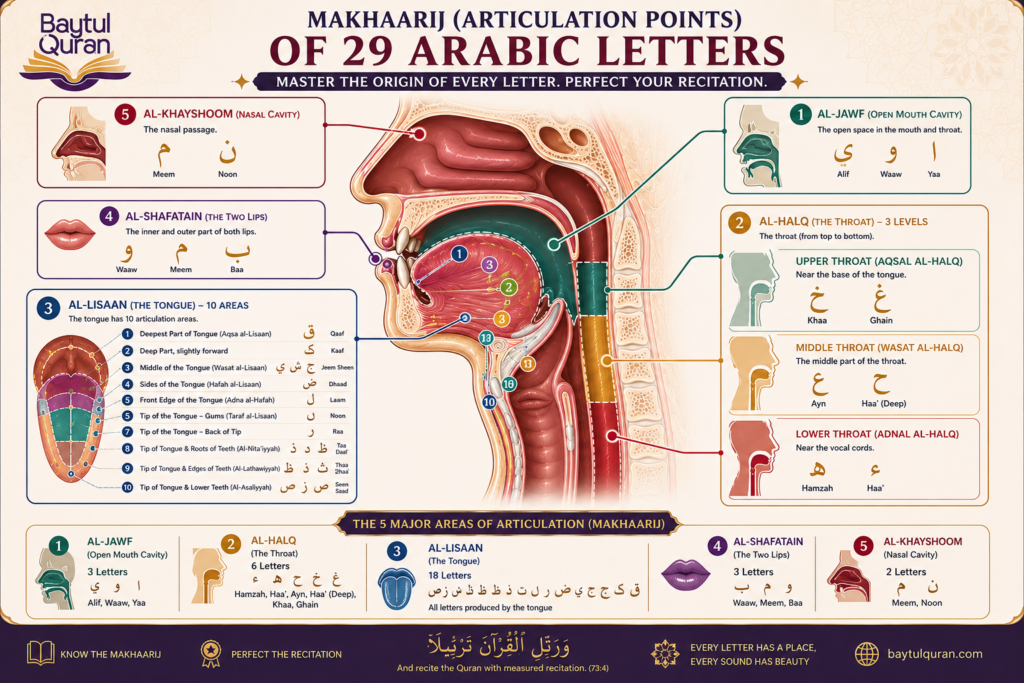
Five zones. Twenty-nine letters. One complete phonetic map of the Quran. Save this and return to it every time you practice.
🌟 READY TO START YOUR QURAN JOURNEY?
Join hundreds of students across the UK, USA and all over the world, learning Quran online with certified teachers.
✅ Free trial classes no commitment ✅ Expert teachers with Ijazah ✅ Flexible timings for your timezone
👉 Book Your Free Trial on WhatsApp
Or visit: baytulquran.com
FREQUENTLY ASKED QUESTIONS
Q: What are the Arabic lip letters in Tajweed? A: The Arabic lip letters, known as Huroof Al-Shafatain, are four letters produced using the lips as the primary articulator. They are Ba (ب), which uses complete lip closure with a Qalqalah bounce, Meem (م), which uses complete lip closure with nasal resonance, Waw (و) as a consonant, which uses rounded lips without full closure, and Fa (ف), which uses the inner lower lip against the upper front teeth. Each of these letters has specific Tajweed rules and characteristics that go beyond their simple surface appearance.
Q: What is the difference between Ba and Meem in Arabic pronunciation? A: Both Ba and Meem are produced with complete closure of both lips, which is why they can seem similar to beginners. The key difference is that Ba is a pure oral stop with the Sifah of Qalqalah, meaning it produces a bouncing echo when it appears with a Sukoon. Meem, on the other hand, redirects sound through the nasal passage during its production, giving it a warm nasal resonance. Additionally, Ba has no Ghunnah while Meem carries Ghunnah in specific Tajweed contexts. A qualified teacher can make this distinction immediately clear in a single demonstration session.
Q: What is Ghunnah in Tajweed and when does it apply? A: Ghunnah is the nasal resonance sound produced by redirecting air and sound through the nasal passage, Al-Khayshoom. It is associated with Meem and Noon and lasts for two counts in correct Tajweed recitation. Ghunnah applies when Meem or Noon appear with a Shaddah, during the rules of Idghaam with Ghunnah, Ikhfa, and Iqlab for Noon Sakinah, and during Ikhfa Shafawi for Meem Sakinah. Ghunnah does not apply during Idhar, when Noon is followed by throat letters and must be pronounced clearly. At Baytul Quran Academy, our teachers work specifically on Ghunnah quality and duration with every student.
Q: Does Waw have any special Tajweed rules? A: The consonant Waw itself does not carry the same complex rules as Ba and Meem, but it plays an important role in several Tajweed contexts. When Noon Sakinah or Tanween is followed by Waw, the rule of Idghaam with Ghunnah applies, and the Noon merges into the Waw with a full two-count Ghunnah. Students must also clearly distinguish between the consonant Waw, produced from the rounded lips, and the long vowel Waw, which is a Madd letter produced from the open oral cavity Al-Jawf.
Q: Why is Fa grouped with the lip letters if it uses the teeth? A: Fa is traditionally grouped in the lip zone Al-Shafatain because the lip is the primary active articulator in its production, even though the upper teeth provide the contact surface. The lower lip moves to touch the upper teeth, making the lip the moving part and the teeth the passive surface. This is different from the dental letters where the tongue is the active articulator touching the teeth. In Tajweed classification, the moving articulator determines the zone, which is why Fa belongs to Al-Shafatain despite involving the teeth.
Q: What are the Meem Sakinah rules mentioned in this lesson? A: When Meem appears with a Sukoon, three rules apply depending on the following letter. Idghaam Shafawi occurs when Meem Sakinah is followed by another Meem, and the two Meems merge with a clear Ghunnah. Ikhfa Shafawi occurs when Meem Sakinah is followed by Ba, and the Meem is partially hidden with a nasal quality during the transition. Idhar Shafawi occurs when Meem Sakinah is followed by any other letter, and the Meem is pronounced clearly and completely. These three rules will be covered in full detail in Lesson 9 of this series.
CONCLUSION
The lip letters and the nasal sound complete the map of Makhaarij Al-Huroof. After seven lessons and two parts of the tongue letter lesson, you now have a working knowledge of every articulation zone, every letter’s origin point, and the sound qualities that define correct Arabic pronunciation.
But the most important thing this lesson has hopefully shown you is that even the simplest-seeming letters carry depth. Ba bounces. Meem resonates. Waw rounds. Fa barely touches. And running through Meem and Noon both, invisible but unmistakable when correctly produced, is the warm nasal hum of Ghunnah flowing through Al-Khayshoom.
This is Tajweed. Not a set of complicated rules imposed on top of the Quran, but a living, breathing phonetic system that gives every letter its full identity and every recitation its full beauty. The scholars who preserved this system across fourteen centuries did not do so as an academic exercise. They did so because the Quran deserved nothing less, and because they understood that giving every letter its right in recitation is itself an act of worship.
You now have the foundation. The rules that bring these letters to life in connected recitation are coming in the lessons ahead. Insha’Allah, every lesson in this series is taking you closer to the recitation your heart has always wanted.
May Allah (SWT) grant us all the tawfeeq to complete this journey and recite His Words as they deserve to be recited. Ameen.
📖 BEGIN YOUR QURAN JOURNEY TODAY Taught Expert Teachers
✦ Tajweed
✦ Hifz
✦ Noorani Qaida
✦ Tafseer
✦ Quran Reading
All over the world
💬 WhatsApp: +44 7842 064721 || +923008737779
🌐https://baytulquran.com/ 📱 @baytulquran_1
First 3 classes are FREE. Always.