
INTRODUCTION
There is one word that every Muslim on earth pronounces more than any other word in any language. It is said in the Azaan five times a day. It opens every Surah of the Quran except one. It is the last word on the lips of the dying and the first word whispered into the ears of the newborn. It is the word every Muslim hopes will be their last word in this world.
That word is Allah.
And most Muslims have been mispronouncing the Lam inside it for their entire lives.
This is not said to cause distress. It is said because understanding this single rule, the rule of Lam Al-Jalaalah, has an immediate and profound impact on the most frequently spoken word in a Muslim’s life. When you learn this rule and apply it correctly, the Name of Allah literally changes quality in your mouth. It becomes heavier when context demands it, lighter when context requires it, and in both states it carries a phonetic precision that reflects the honour this Name deserves.
This is Lesson 9 in our Tajweed series for Muslim families. In Lesson 8 we covered Tafkheem and Tarqeeq, the rules of heavy and light letters across all of Arabic. We briefly mentioned the Lam of Allah as a special case of Tarqeeq and Tafkheem. Now we dedicate an entire lesson to it, because this rule is too important, too spiritually significant, and too practically impactful to treat as a footnote.
By the end of this lesson you will understand exactly when the Lam of Allah is heavy, exactly when it is light, how the definite article Al relates to this, and why the scholars of Tajweed have treated this rule with such reverence across fourteen centuries of scholarship.
IN THIS ARTICLE:
- What Is Lam Al-Jalaalah?
- The Two States of Lam Al-Jalaalah
- When the Lam of Allah Is Heavy — Examples from Daily Recitation
- When the Lam of Allah Is Light — Examples from Daily Recitation
- The Definite Article Al — Always Light, Always Different
- The Spiritual Significance of This Rule
- Common Mistakes Every Muslim Should Know
- How to Apply This Rule in Connected Recitation
- Frequently Asked Questions
WHAT IS LAM AL-JALAALAH?
The word Jalaalah in Arabic comes from the root j-l-l, meaning greatness, majesty, and transcendence. Al-Jalaalah is a title referring specifically to the Majestic Name of Allah, the Name that belongs exclusively to the Creator and is not shared by any created being.
Lam Al-Jalaalah therefore means the Lam of Majesty, which is the specific letter Lam (ل) that appears within the word الله (Allah). This is not just any Lam in Arabic. It is the Lam that sits at the heart of the most exalted Name in existence, and the scholars of Tajweed have given it its own dedicated chapter precisely because of its unique and context-dependent behaviour.
What makes Lam Al-Jalaalah special is that it is the only Lam in the entire Arabic language that ever carries Tafkheem. In all other words in the Quran and in all other contexts, Lam is a permanently light letter carrying Tarqeeq without exception. But the Lam in the Name of Allah is different. It switches between heavy and light depending on the vowel that precedes it in connected recitation.
This switching behaviour is what the scholars called a conditional rule, and it applies specifically and exclusively to the word الله. No other word in Arabic has a Lam that becomes heavy under any condition. This uniqueness is itself significant, and it is something that the scholars noted with admiration and reverence.
Before we study the rule in detail, it is important to understand one technical point. The word الله has a specific internal structure. It consists of the definite article ال followed by the word لاه with its special letters. The Lam that carries the Jalaalah rule is the second Lam in the word, the one immediately before the elongated vowel. This is the Lam that becomes heavy or light. The first Lam, which is the Lam of the definite article, merges into the second Lam through the doubling indicated by the Shaddah sign on the Lam of Allah.
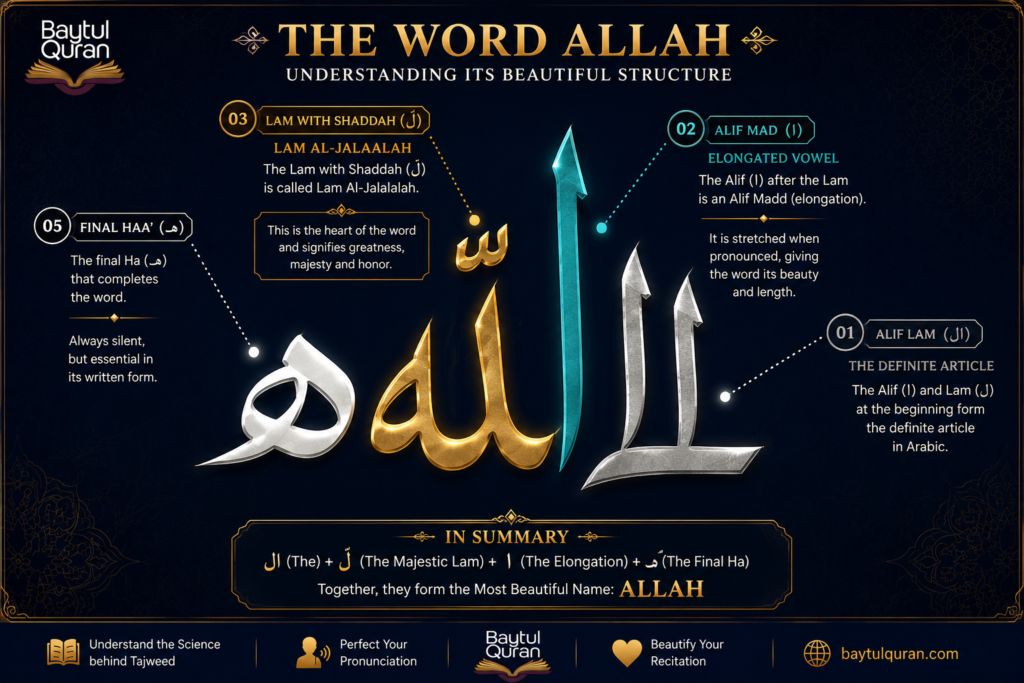
The word الله has a specific internal structure. The Lam Al-Jalaalah is the Lam with the Shaddah, immediately before the elongated vowel.
THE TWO STATES OF LAM AL-JALAALAH
The rule of Lam Al-Jalaalah is beautifully simple once stated clearly. The Lam in the word Allah has two possible states, heavy and light, and which state applies depends entirely on the vowel of the letter that immediately precedes the word Allah in connected recitation.
The rule is as follows.
If the letter before Allah carries a Fathah or a Dammah, the Lam of Allah is heavy, pronounced with full Tafkheem.
If the letter before Allah carries a Kasrah, the Lam of Allah is light, pronounced with Tarqeeq.
That is the complete rule. Two conditions. Two outcomes. One word. And yet the impact of applying it correctly is extraordinary.
The heaviness of the Lam when preceded by Fathah or Dammah gives the Name of Allah a deep, resonant, full quality that fills the mouth. The Lam feels weighty and significant. The entire Name sounds majestic and powerful.
The lightness of the Lam when preceded by Kasrah gives the Name a cleaner, more refined quality. The Lam flows easily and clearly. The Name sounds precise and pure.
Both states are correct. Both states are intentional. And both states together create a natural phonetic variation in how the Name of Allah sounds across different Quranic contexts that reflects the richness of the Quran’s linguistic design.
WHEN THE LAM OF ALLAH IS HEAVY EXAMPLES FROM DAILY RECITATION
The heavy Lam of Allah appears across the Quran in hundreds of places. The following examples are drawn from the most frequently recited and most familiar contexts in a Muslim’s daily life.
The first and most important example is the Shahadah itself. In the phrase أَشْهَدُ أَنْ لَا إِلَٰهَ إِلَّا اللهُ, the word Allah ends with a Dammah on the preceding context. When the word Allah is recited here, the Lam carries full Tafkheem. Every Muslim who recites the Shahadah has the obligation to give the Name of Allah its correct heavy Lam in this context.
The second example is the Takbeer. In أَللهُ أَكْبَر, the word Allah is preceded by a Fathah context in connected speech. The Lam of Allah here is heavy. When you say Allahu Akbar correctly, the Lam should carry a clear heaviness that gives the Name its full resonant quality before the Akbar that follows.
The third example is the end of Ayat Al-Kursi, one of the greatest verses in the Quran. The phrase وَهُوَ الْعَلِيُّ الْعَظِيم is followed in context by recitation where Allah’s Name often precedes with Dammah or Fathah contexts. Students should identify where the word Allah appears in Ayat Al-Kursi and verify the preceding vowel to apply the rule correctly.
The fourth example is from the most frequently recited phrase in all of Islamic practice. In الْحَمْدُ لِلَّٰهِ the Lam before الله carries a Kasrah, but the Lam within الله itself behaves according to what precedes the word. In لِلَّٰهِ the Lam of the preposition carries Kasrah, which means the Lam Al-Jalaalah is light here, not heavy. This example actually belongs in the next section, and it is included here precisely to demonstrate how critical it is to identify the correct preceding letter and its vowel.
The fifth example is قُلْ هُوَ اللهُ أَحَدٌ, the opening of Surah Al-Ikhlas. Here اللهُ is preceded by هُوَ, and the last letter of هُوَ carries a Dammah vowel in connected speech. Therefore the Lam of Allah in this verse is heavy. Every Muslim who recites Surah Al-Ikhlas, which is recommended to be read daily, should feel the heavy Lam in this opening verse.
The sixth example is اللهُ لَا إِلَٰهَ إِلَّا هُوَ, the opening of Ayat Al-Kursi. Here the word Allah begins the verse and is not preceded by a connected letter with a vowel. In this case, when beginning a verse with Allah, the Lam is heavy by default, as the initial Hamzah of the word carries a Fathah that effectively establishes the Tafkheem condition.
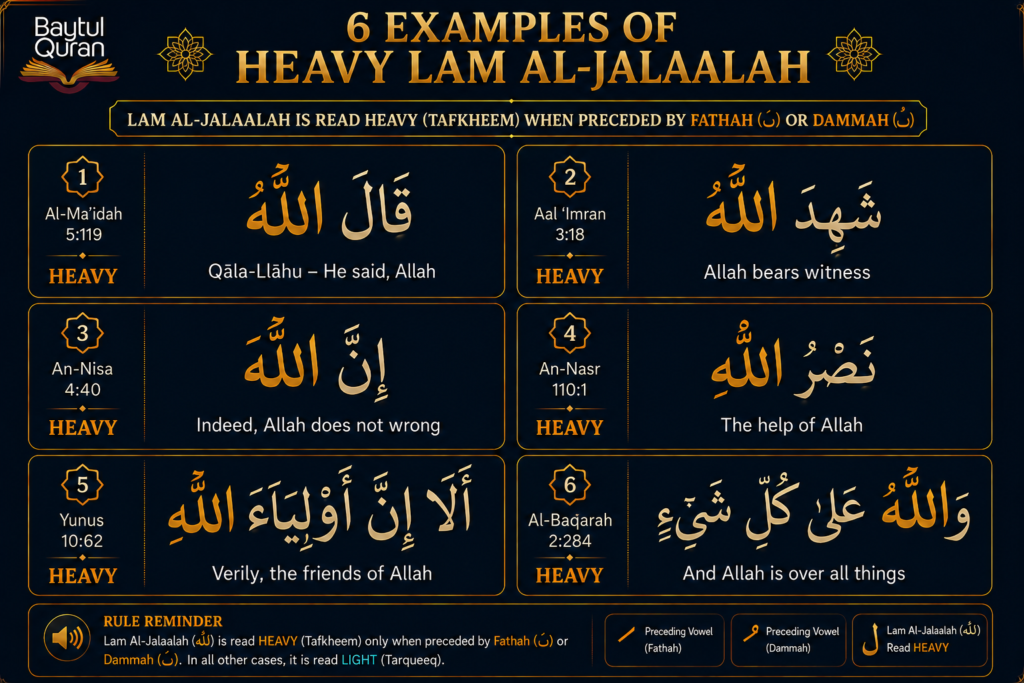
These phrases appear in every Muslim’s daily recitation. In every one of them, the Lam of Allah carries full Tafkheem. Check your own recitation against each one.
WHEN THE LAM OF ALLAH IS LIGHT EXAMPLES FROM DAILY RECITATION
The light Lam of Allah appears whenever the word Allah is immediately preceded by a letter carrying a Kasrah vowel. In this condition, regardless of how heavy and majestic the Name of Allah is, the Lam flows lightly and cleanly, and this lightness is itself a form of correct Tajweed honouring the Name.
The most important and most frequently recited example is Bismillah. In بِسْمِ اللهِ الرَّحْمَٰنِ الرَّحِيمِ, the word Allah is preceded by بِسْمِ, and the Meem of Bismi carries a Kasrah. Therefore the Lam of Allah in Bismillah is light. This means that every Muslim who says Bismillah before eating, before beginning any action, and at the opening of Surah Al-Fatiha in their Salah, should be producing a light Lam in the Name of Allah.
This surprises many students. Bismillah is one of the most sacred phrases in Islam and most people assume the Name of Allah within it should carry the heaviest, most majestic quality possible. But the rule is clear. The Kasrah on the Meem before Allah makes the Lam light. This is not a diminishment of the Name. It is the Quran’s own phonetic design, and it is as beautiful and intentional as the heavy Lam in other contexts.
The second important example is the phrase لِلَّٰهِ which appears throughout the Quran, including in الْحَمْدُ لِلَّٰهِ رَبِّ الْعَالَمِين from Surah Al-Fatiha. The Lam preposition before Allah carries a Kasrah, making the Lam of Allah in لِلَّٰهِ light. Every Muslim who recites Al-Fatiha recites this phrase multiple times in every prayer. The Lam of لِلَّٰهِ must be light.
The third example is the phrase فِي سَبِيلِ اللهِ, which appears in multiple Quranic contexts. The word before Allah ends with a Kasrah on the Lam of Sabeeli, making the Lam of Allah light here.
The fourth example is وَعَبْدُ اللهِ, the phrase meaning servant of Allah that forms part of many names. The Daal of Abdi carries a Kasrah in genitive contexts, making the Lam of Allah light.
The fifth example is رَسُولُ اللهِ, the phrase meaning Messenger of Allah. The Lam of Rasool carries a Dammah, which means the Lam of Allah here is actually heavy, making this an important contrast example. Students who know the rule can immediately identify that رَسُولُ اللهِ has a heavy Lam while بِسْمِ اللهِ has a light Lam, and they can feel and hear the difference in their own recitation.
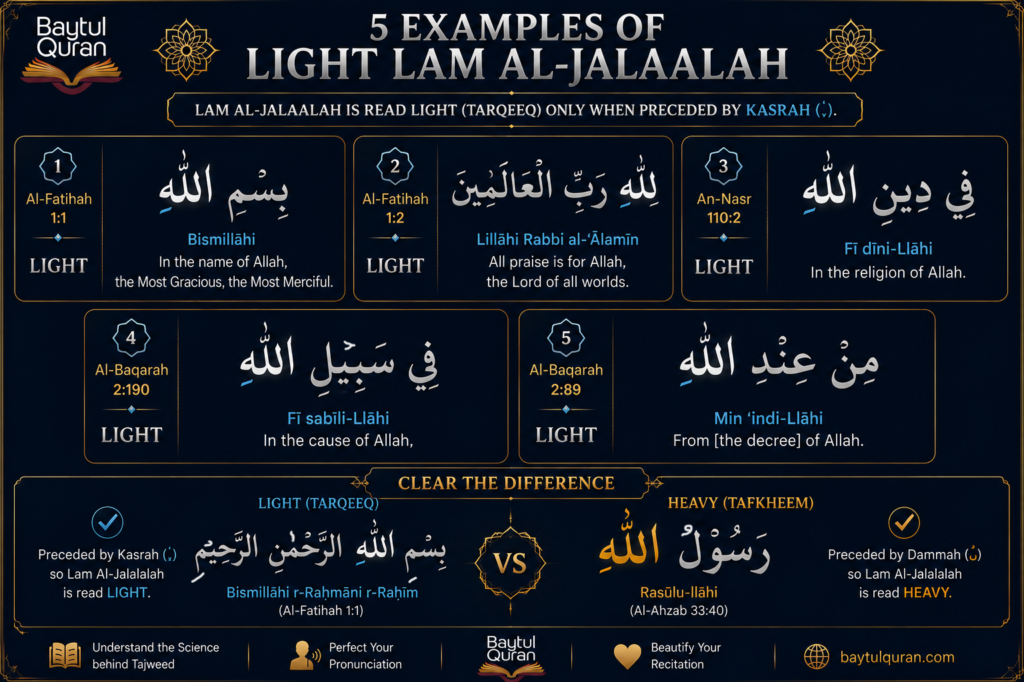
Bismillah has a light Lam. Rasoolullah has a heavy Lam. The rule is simple but its impact on daily recitation is profound.
THE DEFINITE ARTICLE AL ALWAYS LIGHT, ALWAYS DIFFERENT
Now that we understand Lam Al-Jalaalah, we can address a related but completely distinct topic that students frequently confuse: the definite article Al (ال).
The definite article Al is the equivalent of the English word “the.” It appears at the beginning of thousands of Arabic words in the Quran, making them definite. Examples include الْكِتَاب (the Book), الرَّحْمَٰن (the Most Merciful), الصِّرَاط (the path), and الْمُسْلِمِين (the Muslims).
The Lam of the definite article Al is completely and permanently light. It always carries Tarqeeq without any exception and without any conditions. The Lam Al-Taareef, as scholars call it, the Lam of definition, never becomes heavy regardless of what precedes it, what follows it, or what vowels surround it.
This is the critical distinction between Lam Al-Jalaalah and Lam Al-Taareef. The Lam of Allah can be either heavy or light depending on conditions. The Lam of Al (the definite article) is always and permanently light.
However, the definite article Al does have its own set of rules that determine whether the Lam is pronounced clearly or becomes silent through a process called Idghaam Shamsiyyah, solar letter assimilation. But that is a topic for a future lesson. For now, the essential point is that whenever the Lam appears as a definite article rather than as part of the word Allah, it is always light.
Students sometimes wonder how to distinguish the Lam of the definite article from the Lam Al-Jalaalah in the Quran. The answer is straightforward. Lam Al-Jalaalah appears only in the word الله, the Name that belongs exclusively to Allah. In every other word, any Lam is either a definite article Lam, a root letter Lam, or a preposition Lam, and none of these ever carry Tafkheem.
A useful mental checkpoint is to ask whenever you see a Lam: is this inside the word Allah? If yes, apply the Jalaalah rule. If no, the Lam is light.
The definite article Al also has the additional complexity of the solar and lunar letter distinction. When the definite article precedes a solar letter, the Lam is assimilated into that letter through Idghaam and the Shaddah appears on the following letter. When it precedes a lunar letter, the Lam is pronounced clearly. These are covered separately in a dedicated lesson. For the purposes of this lesson, the key principle is simply that all these cases of the definite article Al always carry a light Lam.
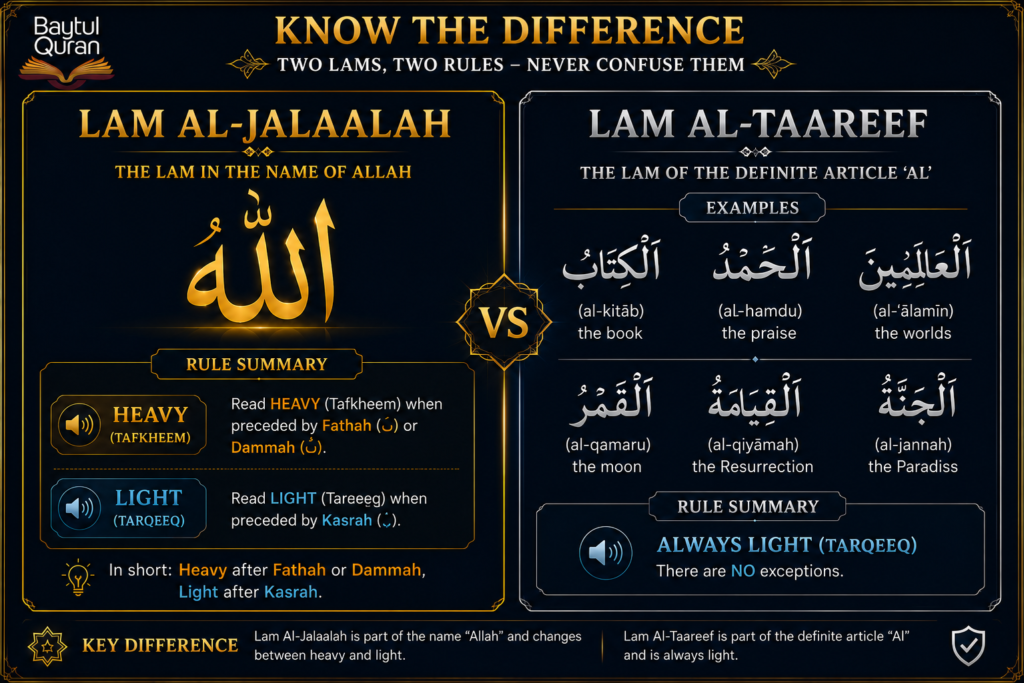
Two different types of Lam. Two completely different rules. Knowing which type you are looking at is the first step to applying the correct rule.
THE SPIRITUAL SIGNIFICANCE OF THIS RULE
No discussion of Lam Al-Jalaalah is complete without stepping back from the phonetic details and reflecting on what this rule actually means at a deeper level.
Every rule in Tajweed exists to preserve the integrity of the Quran as it was revealed. But Lam Al-Jalaalah carries an additional dimension that goes beyond phonetic preservation into something that touches the heart.
The Name of Allah is the Name by which Allah (SWT) has identified Himself in His own revelation. It is not a title, not a description, and not a category. It is a proper Name, unique in all existence, shared by no created being. When the Quran recites this Name in different contexts, connected to different words, surrounded by different vowels, the phonetic quality of the Lam changes. Sometimes it is heavy and majestic. Sometimes it is light and pure. But in both states it is precisely what the text demands, and in both states it sounds unmistakably like the Name of Allah.
Scholars have noted that the heavy Lam of Allah gives the Name a quality of weight and authority, as if the Name itself is making its presence felt in the recitation. The light Lam gives it a quality of clarity and purity, as if the Name flows without obstruction. Together, the two states create a phonetic portrait of the Name that is richer and more nuanced than either state alone could produce.
For the student of Tajweed, learning this rule is therefore not merely a technical exercise. It is an act of attentiveness to the Name of Allah in a way that most Muslims have never practiced. When you consciously apply Lam Al-Jalaalah correctly in your recitation, you are paying a specific and deliberate form of honour to the Name of your Creator every single time you recite it.
Imam Ibn Al-Jazari and the scholars who came after him did not preserve this rule because they were linguists. They preserved it because they understood that every quality in the Quran, including the weight or lightness of a single Lam in the Name of Allah, deserves to be given its full right.
revisit our lesson on Tafkheem and Tarqeeq for the complete heaviness framework https://baytulquran.com/tafkheem-tarqeeq-tajweed/ “The Lam Al-Jalaalah rule makes most sense when understood within the complete Tafkheem and Tarqeeq framework. If you have not yet studied Lesson 8, revisit our lesson on Tafkheem and Tarqeeq for the complete heaviness framework before continuing.”
Book a free trial class to have your Allah pronunciation assessed “The fastest way to know whether you are applying Lam Al-Jalaalah correctly in your recitation is to book a free trial class to have your Allah pronunciation assessed by a certified Tajweed teacher.”
View our complete Tajweed series and course fees “To see how our complete Tajweed series is structured and how our certified teachers guide students through every rule from Makhaarij to Waqf, view our complete Tajweed series and course fees.”
COMMON MISTAKES EVERY MUSLIM SHOULD KNOW
The following are the most frequently occurring Lam Al-Jalaalah errors in the recitation of non-Arab Muslims, based on the teaching experience of our certified teachers at Baytul Quran Academy.
The first and most widespread mistake is applying heavy Lam to the word Allah in all contexts regardless of the preceding vowel. Students who have heard that the Name of Allah should sound heavy and majestic apply Tafkheem universally, including in Bismillah where the Kasrah on the preceding Meem requires a light Lam. This single error affects Bismillah, Alhamdulillah’s لِلَّٰهِ, and hundreds of other Quranic occurrences.
The second common mistake is applying light Lam to the word Allah in all contexts. Students who have never been taught the heavy Lam condition produce a uniform light Lam in every occurrence, including contexts like قُلْ هُوَ اللهُ أَحَدٌ and the Takbeer where Tafkheem is required.
The third mistake is confusing the Lam of the definite article Al with the Lam Al-Jalaalah. Students sometimes attempt to apply Jalaalah rules to the Lam in words like الرَّحْمَٰن or الرَّحِيم, which are qualities and names of Allah but not the word Allah itself. The Jalaalah rule applies only to the word الله, not to other Divine Names or attributes.
The fourth mistake is not carrying the heavy Lam quality through to the following vowel. As we discussed in Lesson 8, Tafkheem colours the vowels that follow a heavy letter. When the Lam of Allah is heavy, the Alif elongation that follows it should also carry the heaviness, giving the full Name of Allah a rounded, resonant quality throughout. Students who produce the heavy Lam correctly but then thin out the following vowel are applying the rule incompletely.
The fifth mistake is not recognising connected speech contexts. Students sometimes apply the Jalaalah rule correctly when reciting slowly but lose track of the preceding vowel when reciting at a natural pace. A word that ends with a Kasrah in isolation might behave differently in connected speech if the Kasrah changes due to grammatical context. A qualified teacher will train students to identify the relevant preceding vowel reliably at all recitation speeds.
HOW TO APPLY THIS RULE IN CONNECTED RECITATION
Knowing the rule theoretically is the first step. Applying it consistently in actual recitation requires a practical approach that our teachers at Baytul Quran Academy teach through a three-stage method.
The first stage is identification. When you encounter the word Allah in any Quranic phrase, pause mentally and identify the letter immediately before it. What vowel does that letter carry? If the answer is Fathah or Dammah, the Lam is heavy. If the answer is Kasrah, the Lam is light. Practice this identification consciously and repeatedly until it becomes automatic.
The second stage is physical application. The heavy Lam requires the back of the tongue to rise toward the soft palate, as we learned in the Tafkheem lesson. The light Lam requires the tongue to remain flat and forward. Practice switching between the two states deliberately, alternating between Bismillah with its light Lam and a Fathah-preceded Allah phrase with its heavy Lam, feeling the tongue position change between the two.
The third stage is ear training. Listen to a certified Qari reciting Surah Al-Fatiha and Surah Al-Ikhlas together and focus specifically on every occurrence of the word Allah. Notice how the quality of the Name changes between لِلَّٰهِ in Al-Fatiha, which is light, and اللهُ أَحَدٌ in Al-Ikhlas, which is heavy. Training the ear to hear this distinction is as important as training the tongue to produce it.
The combination of these three stages, identification, physical application, and ear training, practiced consistently with the correction of a qualified teacher, is what transforms the rule from something known in theory into something felt naturally in recitation.
🌟 READY TO START YOUR QURAN JOURNEY?
Join hundreds of students across the UK, USA and all over the world, learning Quran online with certified teachers.
✅ Free trial classes no commitment ✅ Expert teachers with Ijazah ✅ Flexible timings for your timezone
👉 Book Your Free Trial on WhatsApp
Or visit: baytulquran.com
FREQUENTLY ASKED QUESTIONS
Q: What is Lam Al-Jalaalah in Tajweed? A: Lam Al-Jalaalah is the special Lam that appears in the word الله, the Name of Allah. Unlike all other Lams in Arabic, which are permanently light, the Lam Al-Jalaalah switches between heavy and light depending on the vowel of the letter that immediately precedes it in connected recitation. When preceded by a Fathah or Dammah, it is heavy. When preceded by a Kasrah, it is light. This is one of the most spiritually significant and practically impactful rules in all of Tajweed because it affects the most frequently recited word in a Muslim’s life.
Q: Is the Lam in Bismillah heavy or light? A: The Lam in Bismillah is light. In بِسْمِ اللهِ the Meem of Bismi carries a Kasrah vowel, and because the word Allah is preceded by this Kasrah, the Lam Al-Jalaalah takes Tarqeeq and is pronounced lightly. This surprises many students who assume the Name of Allah should always sound heavy. But the rule is clear, and the light Lam in Bismillah is the correct, precise, and intended Tajweed pronunciation. At Baytul Quran Academy, our teachers address this specific example in the very first session on Lam Al-Jalaalah.
Q: Is the Lam in Allahu Akbar heavy or light? A: The Lam in Allahu Akbar is heavy. The word Allah in this phrase is not preceded by a connected letter with a Kasrah, and the Hamzah of Allah’s beginning carries a Fathah context that establishes the Tafkheem condition. Therefore the Lam in the Takbeer carries full Tafkheem. Every Muslim who says Allahu Akbar in Salah should feel the heavy Lam resonating fully in the Name of Allah before the word Akbar.
Q: What is the difference between Lam Al-Jalaalah and the definite article Al? A: Lam Al-Jalaalah is the Lam specifically within the word الله and it follows conditional rules, being heavy after Fathah or Dammah and light after Kasrah. The definite article Al (ال) appears in thousands of other Arabic words and its Lam is always and permanently light without any conditions or exceptions. The Jalaalah rule applies only to the word Allah. No other word in the Quran has a Lam that ever becomes heavy.
Q: Does this rule apply when Allah’s Name appears at the beginning of a verse? A: When the word Allah begins a verse or appears after a pause, the Lam is heavy by default, as there is no preceding letter with a Kasrah to trigger the light condition. The initial Hamzah of Allah carries a Fathah, which establishes the Tafkheem condition. Examples include the opening of Ayat Al-Kursi, اللهُ لَا إِلَٰهَ إِلَّا هُوَ, where the word Allah begins the verse with a heavy Lam.
Q: How can I practice Lam Al-Jalaalah to apply it correctly in Salah? A: Begin by memorising the simple rule: heavy after Fathah or Dammah, light after Kasrah. Then go through the phrases you recite in every Salah and identify the preceding vowel for each occurrence of Allah. Bismillah has a light Lam. Alhamdulillah’s لِلَّٰهِ has a light Lam. Allahu Akbar has a heavy Lam. Qul huwa Allahu Ahad has a heavy Lam. Practice each phrase slowly, feeling the tongue position change between heavy and light contexts. Then book a free trial class at Baytul Quran Academy to have a certified teacher confirm you are applying the rule correctly.
CONCLUSION
The Lam Al-Jalaalah rule is small in its technical complexity but enormous in its daily impact. It affects the most important word in a Muslim’s life, the Name of Allah, in the most frequently recited phrases in Islamic practice, from Bismillah to the Takbeer to the Shahadah.
When you apply this rule correctly, something genuinely shifts in your recitation. You begin to hear the Name of Allah differently. You notice the weight in contexts where it should be heavy. You notice the clarity in contexts where it should be light. And both of these qualities, the weight and the clarity, begin to feel like two faces of the same profound truth about the Name you are reciting.
The scholars of Tajweed preserved this rule across fourteen centuries not because they were perfectionists but because they were believers who understood that the Name of Allah deserves every possible form of honour that a human being can give it. Including the precise quality of a single Lam.
Give the Name of Allah its right. Make the Lam heavy when it should be heavy. Make it light when it should be light. And know that in doing so, you are reciting the Name of your Creator with a precision and a care that reflects what that Name truly deserves.
May Allah (SWT) grant us all the honour of pronouncing His Name correctly for the rest of our lives. Ameen.
📖 BEGIN YOUR QURAN JOURNEY TODAY Taught Expert Teachers
✦ Tajweed
✦ Hifz
✦ Noorani Qaida
✦ Tafseer
✦ Quran Reading
All over the world
💬 WhatsApp: +44 7842 064721 || +923008737779
🌐https://baytulquran.com/ 📱 @baytulquran_1
First 3 classes are FREE. Always.