
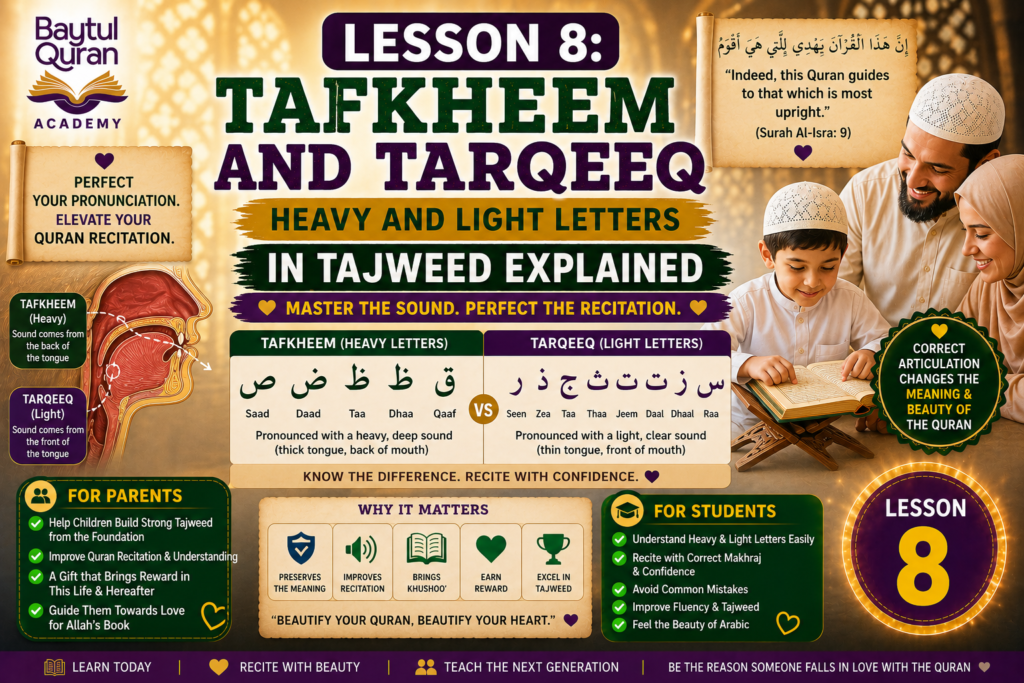
INTRODUCTION
There is a moment in every serious Tajweed student’s journey when they listen back to a recording of their own recitation and feel something is not quite right, even though they cannot identify exactly what. The letters are there. The words are correct. But compared to a skilled Qari, their recitation sounds flat, thin, or somehow lacking in dimension.
In the vast majority of cases, what is missing is Tafkheem and Tarqeeq.
Of all the Tajweed rules a student encounters, Tafkheem and Tarqeeq, the rules governing the heaviness and lightness of Arabic letters, have perhaps the single most immediate and dramatic impact on the overall quality of recitation. When these rules are applied correctly, the Quran comes alive with a depth and richness that transforms how it sounds and how it feels. When they are missing or applied incorrectly, even technically accurate recitation carries a flatness that the trained ear immediately recognises.
This is Lesson 8 in our Tajweed series for Muslim families. In the previous lessons we built a complete map of Makhaarij and began understanding the Sifaat that give Arabic letters their character. Tafkheem and Tarqeeq sit squarely within the world of Sifaat, specifically the Sifaat of Isti’la and Itbaaq that we introduced in Lesson 4. Now we bring those concepts to life practically, with clear explanations, real Quranic examples, and the specific error patterns that most students are carrying without realising it.
By the end of this lesson, your ear will hear Arabic differently. And your recitation will sound better than it ever has before.
IN THIS ARTICLE:
- What Is Tafkheem —> The Heavy Tongue
- What Is Tarqeeq —> The Light Tongue
- The Seven Permanently Heavy Letters
- Letters That Are Always Light
- The Complex Letters —> Raa and Laam
- How Tafkheem and Tarqeeq Change Word Meaning
- The Most Common Mistakes in Everyday Recitation
- How to Train Your Ear and Tongue Together
- Frequently Asked Questions
WHAT IS TAFKHEEM THE HEAVY TONGUE
The word Tafkheem comes from the Arabic root f-kh-m, which means to make thick, full, or heavy. In Tajweed, Tafkheem refers to the quality of heaviness or fullness that certain Arabic letters carry in their pronunciation. A letter pronounced with Tafkheem sounds deep, rounded, full, and resonant. The entire mouth feels fuller when a heavy letter is produced correctly.
The physical mechanism behind Tafkheem is precisely the Sifaat of Isti’la and Itbaaq that we studied in Lesson 4. Recall that Isti’la means the back of the tongue rises toward the soft palate during the production of certain letters. Itbaaq means the tongue presses up toward the roof of the mouth in a sealing action. When either or both of these Sifaat are present, the shape of the oral resonance chamber changes. The space at the front of the mouth becomes relatively smaller while the space at the back becomes larger and more rounded. This change in oral shape is what produces the heavy, deep, full sound quality of Tafkheem.
Think of it this way. Imagine speaking into a large cave versus speaking into a narrow corridor. The cave produces a deep, resonant, full sound. The corridor produces a thinner, more focused sound. When the back of the tongue rises during Tafkheem, the mouth effectively becomes more like the cave, producing the fuller and deeper quality that heavy letters carry.
This is not a subtle or minor difference. The distinction between a heavy and light letter is immediately audible even to untrained ears, which is precisely why incorrect Tafkheem produces recitation that sounds wrong to people even when they cannot explain why.
Tafkheem letters are sometimes called Mufakhkham letters, meaning fattened or thickened letters, reflecting the physical fullness that their production creates in the mouth.
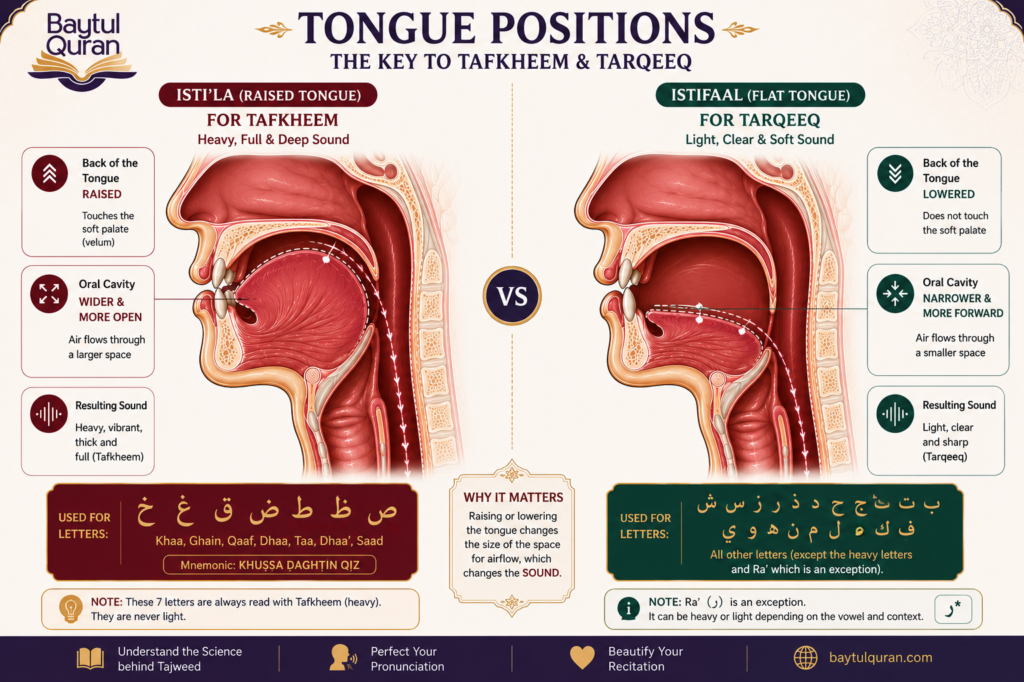
Tafkheem and Tarqeeq are not just sound qualities. They are physical tongue states that change the shape of the entire oral resonance chamber.
WHAT IS TARQEEQ THE LIGHT TONGUE
Tarqeeq comes from the Arabic root r-q-q, meaning to make thin, fine, or light. In Tajweed, Tarqeeq refers to the quality of lightness and clarity that certain Arabic letters carry in their pronunciation. A letter pronounced with Tarqeeq sounds clean, bright, forward, and precise. There is no heaviness or roundness to the sound. The tongue remains flat and low, the front of the mouth carries the resonance, and the overall quality is sharp and clear.
The physical mechanism of Tarqeeq is the Sifah of Istifaal, which means the tongue remains low and flat during production. When the tongue does not rise at the back, the oral cavity maintains its natural forward shape and the sound resonates primarily in the front of the mouth rather than in the rounded back chamber that Tafkheem creates.
The distinction is immediately practical. The letter Seen (س), which we studied in Lesson 6 Part 2 as a Tarqeeq letter, sounds crisp, bright, and thin. The letter Saad (ص), which is a Tafkheem letter produced from a similar position, sounds deep, full, and rounded. Both use a similar tongue tip position near the teeth area. The entire difference in sound quality comes from the Isti’la and Itbaaq of Saad versus the Istifaal of Seen.
Understanding Tarqeeq is just as important as understanding Tafkheem, because the lightness of Tarqeeq letters is not a passive absence of heaviness. It is an active quality that must be maintained. A student who allows even a slight unintentional heaviness to creep into Tarqeeq letters is making a Tajweed error just as surely as one who fails to apply Tafkheem to heavy letters.
THE SEVEN PERMANENTLY HEAVY LETTERS
The scholars of Tajweed identified seven letters that are permanently heavy, meaning they always carry Tafkheem in every single context, every time they appear in the Quran, regardless of vowels, position, or surrounding letters. These are the core Tafkheem letters, and every student must memorise them.
The seven permanently heavy letters are collected in the famous phrase used by Tajweed scholars to remember them:
خُصَّ ضَغْطٍ قِظْ
The letters within this phrase are: Kha (خ), Saad (ص), Daad (ض), Ghain (غ), Taa emphatic (ط), Qaaf (ق), and Dha (ظ).
Let us examine each briefly.
KHA (خ) Kha is the voiceless uvular letter we studied in Lesson 5. It carries Isti’la as a permanent Sifah, giving it a raspy, deep, heavy quality. In words like خَيْر (goodness) and خَالِق (Creator), the Kha must carry this fullness in every recitation.
SAAD (ص) Saad is the emphatic Safeer letter we studied in Lesson 6 Part 2. Its combination of Isti’la and Itbaaq gives it the heaviest, deepest quality of the sibilant letters. In words like الصَّلَاة (prayer) and الصِّرَاطَ (the path) in Surah Al-Fatiha, the Saad must be clearly heavy and distinct from Seen.
DAAD (ض) Daad is the most uniquely Arabic letter we studied in Lesson 6 Part 1. It carries Isti’la and Itbaaq along with the unique Istitaalah quality. In words like الضَّالِّين (those who go astray) at the end of Surah Al-Fatiha, correct Daad with full Tafkheem is essential. Thousands of Muslims recite this word daily in every Salah and produce the Daad without its required heaviness.
GHAIN (غ) Ghain is the voiced uvular letter from Lesson 5. Its Isti’la gives it a deep gargling quality. In words like الْغَيْبِ (the unseen) in Surah Al-Baqarah, the Ghain must carry its full heavy quality.
TAA EMPHATIC (ط) The emphatic Taa from Lesson 6 Part 1 carries both Isti’la and Itbaaq along with Qalqalah. In words like الطَّرِيق (the path) and يَطْغَى (transgresses), the emphatic Taa must sound completely different from the regular Taa (ت), and that difference is entirely a matter of Tafkheem.
QAAF (ق) Qaaf is the deep back tongue letter from Lesson 6 Part 1. Its Isti’la and back tongue position give it a naturally heavy resonant quality. In words like الْقُرْآن (the Quran) itself and قُلْ (say), which opens many of the most frequently recited Surahs, the Qaaf must carry its full depth.
DHA (ظ) Dha is the emphatic dental letter from Lesson 6 Part 1, combining tongue tip dental position with Isti’la and Itbaaq. In words like الظَّالِمِين (the wrongdoers) and يَظُنُّون (they think), the Dha must carry full Tafkheem and be clearly distinct from plain Dhaal (ذ).
These seven letters are heavy always. There are no exceptions, no conditions, and no contexts in which any of these seven letters becomes light. Every time you recite any of these seven letters in any Quranic word, full Tafkheem must be present.
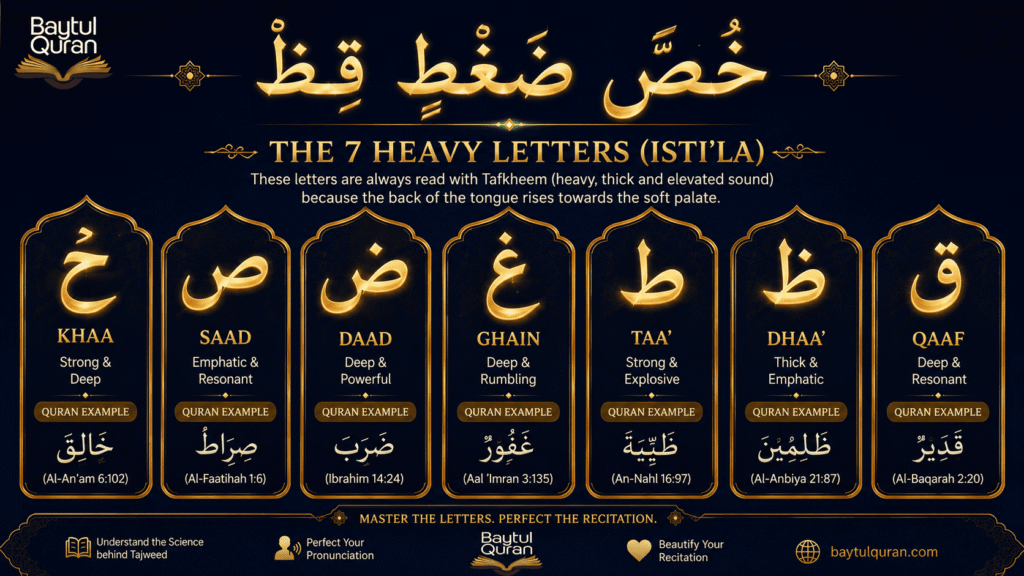
Memorise these seven letters. They are always heavy, in every word, in every recitation, without exception. Master them and half your Tafkheem work is done.
LETTERS THAT ARE ALWAYS LIGHT
While the seven heavy letters are permanently Mufakhkham, the majority of Arabic letters are permanently Muraqqaq, meaning they always carry Tarqeeq. These letters never become heavy regardless of their position, vowels, or surrounding letters.
The permanently light letters include all the letters not in the seven heavy group and not in the conditional categories of Raa and Laam. This means letters such as Ba, Ta regular, Thaa, Jeem, Ha deep, Kha is actually heavy, Daal, Dhaal, Zay, Sheen, Seen, Ayn, Fa, Qaaf is heavy, Kaaf, Laam in most cases, Meem, Noon, Ha light, Waw, and Yaa.
For the permanently light letters, the rule is simple and requires only consistency. Maintain Tarqeeq in all conditions. Do not allow unintentional heaviness to creep into these letters, which can happen when they appear near heavy letters in a word. This phenomenon, where a light letter absorbs heaviness from adjacent heavy letters, is one of the most subtle and most common Tajweed errors in everyday recitation.
For example, in the word الصِّرَاطَ from Surah Al-Fatiha, the Saad is heavy. But the Raa and the Taa regular that follow it in connected recitation must maintain their own correct quality and not absorb the heaviness of the Saad. This requires conscious maintenance of the correct tongue position for each letter independently.
THE COMPLEX LETTERS RAA AND LAAM
If the seven permanently heavy letters and the permanently light letters were the whole story, Tafkheem and Tarqeeq would be relatively straightforward to learn. What makes this rule genuinely complex is the existence of two letters that switch between heavy and light depending on specific conditions. These two letters are Raa (ر) and Laam (ل).
We introduced both of these in Lesson 6 Part 2, but now we study their heavy-light conditions in full detail.
RAA THE SWITCHING LETTER
Raa is the letter that switches most frequently and in the most complex conditions. Students sometimes feel overwhelmed by the number of rules for Raa, but the underlying principle is consistent throughout: heavy Raa sounds deeper and fuller, light Raa sounds brighter and thinner, and the conditions determine which quality applies.
Raa is recited with Tafkheem, meaning heavy, in the following conditions.
First, when Raa carries a Fathah vowel. Examples include رَبّ in بِسْمِ اللهِ الرَّحْمَٰنِ الرَّحِيمِ and رَسُول throughout the Quran.
Second, when Raa carries a Dammah vowel. Examples include رُسُل and رُوح.
Third, when Raa carries a Sukoon and the letter before it has a Fathah. Examples include مَرْيَم and فَرْعَوْن.
Fourth, when Raa carries a Sukoon and the letter before it has a Dammah. Examples include نُور and قُرْآن.
Fifth, when Raa carries a Sukoon and is followed by an emphatic letter in the same word, even if preceded by a Kasrah. This is the most nuanced Tafkheem condition for Raa and requires careful attention to the following letter.
Raa is recited with Tarqeeq, meaning light, in the following conditions.
First, when Raa carries a Kasrah vowel. Examples include رِزْق and رِجَال.
Second, when Raa carries a Sukoon and the letter before it has a Kasrah, provided there is no emphatic letter following in the same word. Examples include فِرْعَوْن when the preceding vowel context is Kasrah.
Third, when Raa appears as a Madd letter, a long vowel position, following a Kasrah context.
The most common Raa mistake among non-Arab students is applying heavy Raa universally, treating all Raa letters the same regardless of vowels. This eliminates all the variation and beauty that the heavy-light Raa distinction creates and produces a uniform heaviness that is not correct Tajweed.
LAAM THE SPECIAL CASE OF ALLAH
Laam is significantly simpler than Raa in its Tafkheem conditions because it carries Tafkheem in only one specific and well-known context.
Laam is heavy only in the word Allah (الله) when it is preceded by a Fathah or Dammah vowel. In this context the Laam of Allah is pronounced with full Tafkheem, giving the Blessed Name its characteristic deep, resonant, full quality in Quranic recitation.
When the word Allah is preceded by a Kasrah vowel, such as in بِسْمِ اللهِ, the Laam of Allah is light. In all other words in the Quran, Laam is always light without exception.
This single rule makes an enormous difference to how the Name of Allah sounds in recitation. Students who have never been taught this rule produce the Name of Allah with a flat, uniform Laam in all contexts. Students who apply this rule correctly will immediately notice the deep, weighty quality that the heavy Laam gives to the Name of Allah when preceded by a Fathah or Dammah, and the contrast with the lighter Laam when preceded by a Kasrah.
Many scholars have commented that this rule is itself a form of phonetic honour given to the Name of Allah in the Quran. The Name changes quality depending on how it is connected to what precedes it, as if the recitation itself is responding to the context in which Allah’s Name appears.
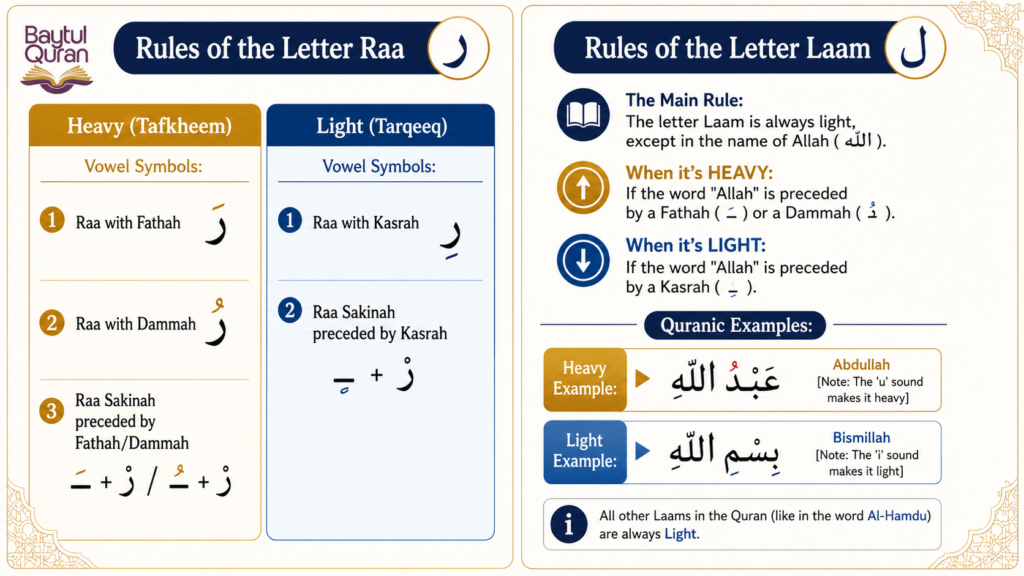
Raa is the most complex letter in Tafkheem study. Laam has only one heavy context. But both must be correct for your recitation to sound genuinely right.
HOW TAFKHEEM AND TARQEEQ CHANGE WORD MEANING
Students sometimes ask whether Tafkheem errors are really significant enough to warrant the effort of correcting them. The answer becomes immediately clear when we look at how heaviness versus lightness changes the actual meaning of Arabic words.
The clearest example in daily recitation is Surah Al-Fatiha, the Surah that every Muslim recites in every unit of every prayer, multiple times every day.
The word الصِّرَاطَ appears in verse six of Surah Al-Fatiha. The Saad (ص) in this word is one of the seven permanently heavy letters. If a student replaces the heavy Saad with a light Seen, the word changes. الصِّرَاطَ with heavy Saad means the straight path. If the Saad is replaced with a light Seen, the word would no longer be the correct Quranic word.
The word الضَّالِّين appears at the very end of Surah Al-Fatiha. The Daad (ض) is another of the seven permanently heavy letters. Producing Daad without Tafkheem, or replacing it with a Daal, changes the word entirely.
Beyond meaning changes, Tafkheem errors affect the overall quality and authenticity of recitation even in cases where meaning is not technically altered. When a skilled Qaris recites the Quran, the alternation between heavy and light letters creates a natural musical depth and variety that is a fundamental part of the beauty of Quranic recitation. When that alternation is absent, the recitation loses a dimension that listeners feel even if they cannot name it.
This is why Tafkheem and Tarqeeq are not peripheral rules. They are at the heart of what makes Arabic sound like Arabic, and what makes Quranic recitation sound like the Word of Allah deserves to sound.
THE MOST COMMON MISTAKES IN EVERYDAY RECITATION
Based on the teaching experience at Baytul Quran Academy, these are the Tafkheem and Tarqeeq errors that appear most frequently in the recitation of non-Arab students.
The first and most widespread error is applying insufficient Tafkheem to Saad and Daad. These two letters, despite being permanently heavy, are consistently produced too lightly by students who substitute Seen and Daal respectively. As discussed above, this error appears in Surah Al-Fatiha in every single prayer.
The second common error is applying uniform heaviness to all Raa letters, whether their condition calls for Tafkheem or Tarqeeq. Students who have not been taught the Raa conditions produce all Raa letters with the same weight, eliminating the natural variation that correct Tajweed requires.
The third common error is applying Tafkheem to letters that appear near heavy letters but are themselves light. When a light letter follows a heavy letter in the same word, students sometimes unconsciously carry the heaviness over from the heavy letter into the light one. This is called contamination by proximity and is subtle enough that most students never notice it without a teacher pointing it out.
The fourth common error is neglecting the Laam of Allah distinction. Students who have never been taught the Tafkheem of Allah’s Laam recite the Name with the same flat Laam in all contexts, losing the phonetic honour that the Quran gives to the Blessed Name.
The fifth common error is applying Tarqeeq to Qaaf. Many students from Urdu-speaking backgrounds are accustomed to a lighter Q sound in Urdu pronunciation and unconsciously carry that lighter quality into Arabic Qaaf, removing its required Tafkheem.
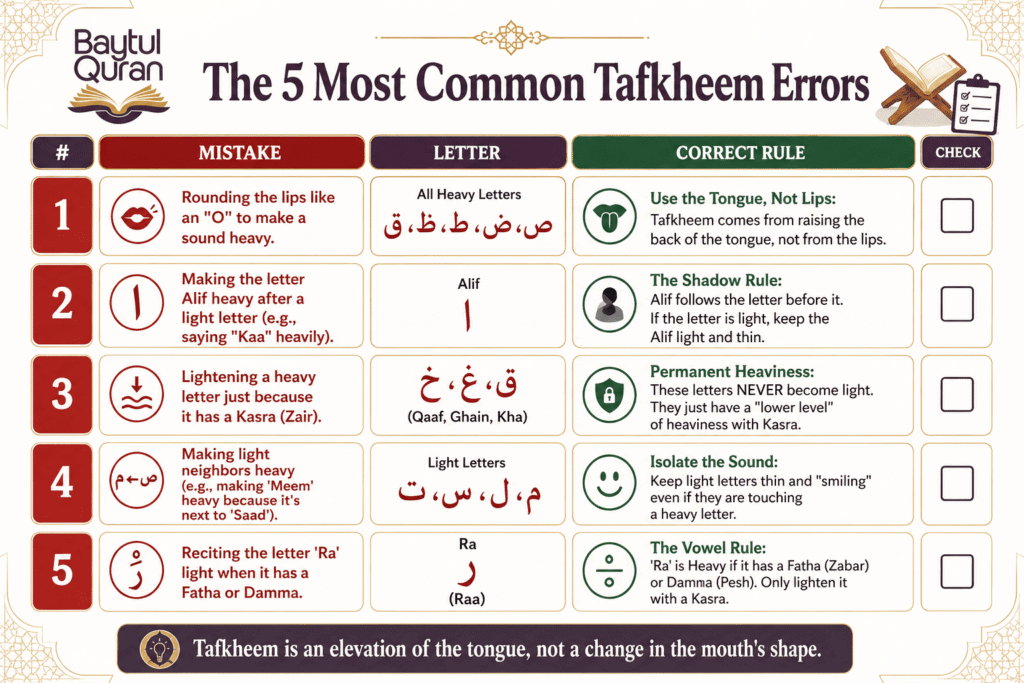
These five errors appear in the recitation of the majority of non-Arab Muslims. Check your own recitation honestly against each one.
HOW TO TRAIN YOUR EAR AND TONGUE TOGETHER
Tafkheem and Tarqeeq cannot be learned by reading about them alone. The distinction is primarily an auditory and physical one, and training both the ear and the tongue simultaneously is the most effective approach.
The first exercise is the Seen-Saad comparison drill. Alternate slowly between Seen (س) and Saad (ص) with a long vowel after each, holding the vowel sound for three counts. Listen carefully to how the vowel sounds different after each letter. After Seen, the following vowel sounds bright and forward. After Saad, the following vowel sounds deep and rounded. This difference in vowel colouring is the clearest indicator of whether Tafkheem is present or absent.
The reason following vowels change quality is important to understand. When a heavy letter is produced with correct Tafkheem, the raised back tongue position does not instantly lower for the following vowel. It carries over briefly, colouring the vowel with the same heaviness. This is entirely correct and expected. The vowels following heavy letters should sound heavier than the same vowels following light letters.
The second exercise is reading Surah Al-Fatiha slowly and deliberately with full attention to every heavy letter. Mark the seven heavy letters in your copy of the Quran, then read the Surah tracking each one consciously. Feel the back tongue rising for each heavy letter. Feel it remaining low for the light letters around them.
The third exercise is listening to Qari Al-Husary recite Surah Al-Fatiha and focusing specifically on the Saad in Al-Siraat and the Daad in Al-Daallin. These two letters in this single Surah are the clearest and most important Tafkheem demonstration in everyday recitation.
Book a free trial class to have your Tafkheem assessed. “The most effective way to know whether you are applying Tafkheem and Tarqeeq correctly is to book a free trial class to have your Tafkheem assessed by a certified teacher with Ijazah.”
Revisit our lesson on Sifaat Al-Huroof for the foundation of Tafkheem https://baytulquran.com/sifaat-al-huroof-tajweed-guide/ “If you want to understand the Sifaat foundation that makes Tafkheem work, revisit our lesson on Sifaat Al-Huroof where Isti’la and Itbaaq are covered in detail.”
View our complete Tajweed programme and fees. “To see how our structured Tajweed programme covers Tafkheem, Tarqeeq, and all the connected rules in a systematic progression, view our complete Tajweed programme and fees.”
🌟 READY TO START YOUR QURAN JOURNEY?
Join hundreds of students across the UK, USA and all over the world, learning Quran online with certified teachers.
✅ Free trial classes no commitment ✅ Expert teachers with Ijazah ✅ Flexible timings for your timezone
👉 Book Your Free Trial on WhatsApp
Or visit: baytulquran.com
FREQUENTLY ASKED QUESTIONS
Q: What is Tafkheem in Tajweed? A: Tafkheem means heaviness or fullness in the pronunciation of certain Arabic letters. It is produced when the back of the tongue rises toward the soft palate during the articulation of a letter, creating a fuller, deeper, more rounded sound quality. In Tajweed, seven letters are permanently heavy and always require Tafkheem, while two letters, Raa and Laam, carry Tafkheem only in specific conditions. Getting Tafkheem right is one of the single most impactful improvements a student can make to their Quran recitation.
Q: What are the seven permanently heavy letters in Arabic Tajweed? A: The seven permanently heavy letters are Kha (خ), Saad (ص), Daad (ض), Ghain (غ), emphatic Taa (ط), Qaaf (ق), and Dha (ظ), remembered through the mnemonic phrase خُصَّ ضَغْطٍ قِظْ. These letters always carry Tafkheem in every context, every vowel, and every position in the Quran without any exception. Many of these letters appear in the most frequently recited verses in Islam, including Surah Al-Fatiha, which is why mastering their heaviness is an urgent priority for every Muslim who prays.
Q: When is Raa pronounced heavy and when is it light? A: Raa is heavy when it carries a Fathah or Dammah vowel, when it carries a Sukoon preceded by a Fathah or Dammah, and when it carries a Sukoon and is followed by an emphatic letter in the same word. Raa is light when it carries a Kasrah vowel and when it carries a Sukoon preceded by a Kasrah without an emphatic letter following. This is one of the more complex rules in Tajweed and is best learned through live sessions with a qualified teacher rather than memorising conditions from a list. You can begin with a free trial class at Baytul Quran Academy.
Q: When is the Laam of Allah pronounced heavy? A: The Laam of Allah is pronounced heavy only when the word Allah is preceded by a Fathah or Dammah vowel, as in قَالَ اللهُ or رَسُولُ اللهِ. When the word Allah is preceded by a Kasrah, as in بِسْمِ اللهِ, the Laam is light. In every other word in the Quran, Laam is always light. This rule gives the Name of Allah a distinctive phonetic quality in recitation that cannot be produced without knowing and applying this specific ruling.
Q: Does incorrect Tafkheem affect the meaning of the Quran? A: In some cases yes, particularly when a heavy letter is replaced with its light equivalent or vice versa. The most significant examples occur in Surah Al-Fatiha, which every Muslim recites multiple times daily. Producing the Daad in Al-Daallin without Tafkheem, or producing the Saad in Al-Siraat as a Seen, changes the phonetic identity of these letters. Beyond meaning, incorrect Tafkheem consistently removes the richness and depth from recitation that makes the Quran sound as it was intended to sound. This is why the scholars include Tafkheem among the most important rules of Tajweed.
Q: How can I practice Tafkheem at home without a teacher? A: Begin with the Seen-Saad comparison drill, alternating between these two letters with a following vowel and listening carefully to how the vowel sounds different after each letter. Then read Surah Al-Fatiha slowly and deliberately, marking every heavy letter and consciously feeling the back tongue rise for each one. Listen regularly to Qari Al-Husary’s recitation and focus specifically on the heavy letters. However, home practice has limits without correction, and the most effective progress comes from regular sessions with a certified Tajweed teacher who can hear your specific errors and guide your tongue to the correct position. A free trial class at Baytul Quran Academy is the most practical first step.
CONCLUSION
Tafkheem and Tarqeeq are not advanced Tajweed rules reserved for scholars. They are foundational rules that shape the sound of every single verse of the Quran that every Muslim recites every day.
When the seven heavy letters carry their full Tafkheem, when Raa switches correctly between heavy and light across its conditions, and when the Laam of Allah resonates with its distinctive depth in the right contexts, the Quran sounds the way it was meant to sound since it was first revealed. Deep where it should be deep. Light where it should be light. Rich, varied, and alive with the phonetic beauty that Allah (SWT) placed within His Words.
The students who master Tafkheem and Tarqeeq describe the experience consistently in the same way. They say their recitation went from feeling like reading to feeling like truly reciting. That distinction is real, it is audible, and it is available to every Muslim who commits to learning it correctly.
Your recitation of Surah Al-Fatiha in every prayer deserves this quality. Your relationship with the Quran deserves this quality. And insha’Allah, with the right teacher and consistent practice, this quality is closer than you think.
May Allah (SWT) grant us all recitation that is heavy where His Words command heaviness and light where His Words command lightness. Ameen.
📖 BEGIN YOUR QURAN JOURNEY TODAY Taught Expert Teachers
✦ Tajweed
✦ Hifz
✦ Noorani Qaida
✦ Tafseer
✦ Quran Reading
All over the world
💬 WhatsApp: +44 7842 064721 || +923008737779
🌐https://baytulquran.com/ 📱 @baytulquran_1
First 3 classes are FREE. Always.

One Response