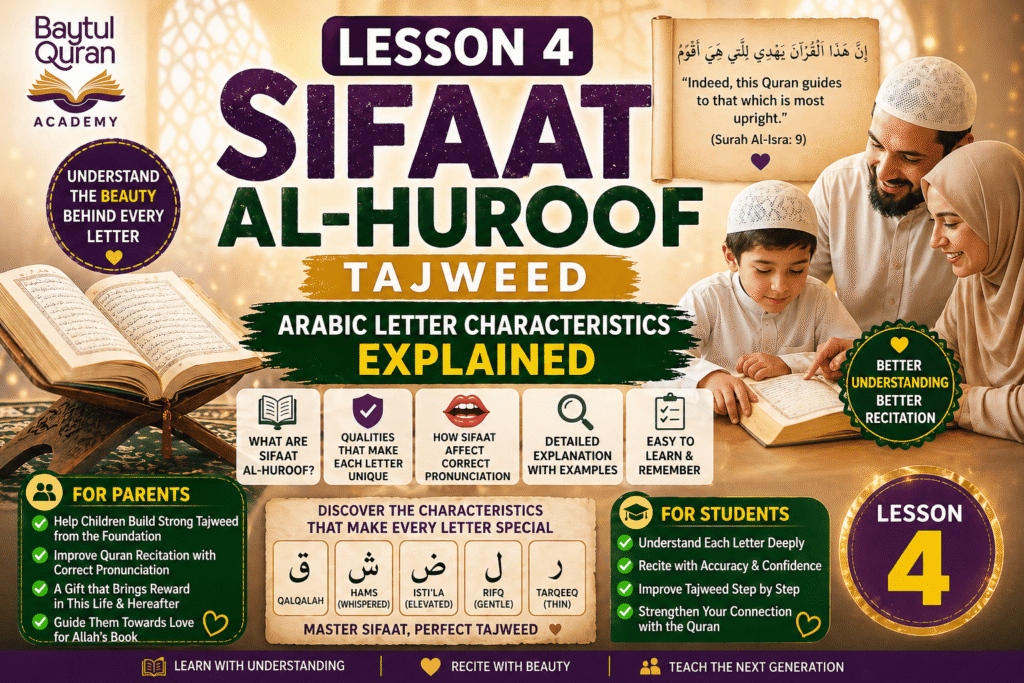
Series Navigation: Lesson 1: What Is Tajweed? —> https://baytulquran.com/what-is-tajweed/ Lesson 2: Is Tajweed Obligatory in Islam? —> https://baytulquran.com/is-tajweed-obligatory-in-islam/ Lesson 3: Makhaarij Al-Huroof —> https://baytulquran.com/makhaarij-al-huroof-for-beginners/ Lesson 4: You are here —> Sifaat Al-Huroof Tajweed
INTRODUCTION
Have you ever listened to two different Qaris recite the same verse of the Quran and noticed that even though they are both reciting correctly, something about the texture and feel of each letter sounds subtly different from a regular person reading Arabic?
That difference has a name. It is called Sifaat.
In Lesson 3, we explored Makhaarij Al-Huroof, the precise exit points of Arabic letters. We learned that every Arabic letter comes from a specific location in the mouth, throat, or nasal passage. That knowledge answered the question of where each letter comes from. But there is a second question that every serious Tajweed student must answer, and that question is this: once a letter leaves its exit point, what qualities does it carry with it?
Think of it this way. Two people might live in the same house, the same address, the same location. But they have completely different personalities, different voices, different ways of moving through the world. Arabic letters work in a similar way. Two letters might share a Makhraj or come from very nearby articulation points, and yet they sound and feel completely different because their Sifaat, their characteristics, are different.
This is exactly what Lesson 4 is about. Sifaat Al-Huroof are the inherent qualities and characteristics of Arabic letters that determine how each letter sounds, how it resonates, how much air it carries, how heavily or lightly it sits in the mouth, and whether it echoes, whistles, flows, or stops sharply.
Understanding Sifaat Al-Huroof is the step that takes a student from technically correct recitation to genuinely beautiful recitation. And that distinction matters more than most beginners realise.
Let us walk through it together.
IN THIS ARTICLE:
- What Are Sifaat Al-Huroof and Why Do They Matter?
- Laazimah vs Aaridah —> The Two Types of Sifaat
- The Sifaat With Opposites —> Pairs That Define Arabic Letters
- The Sifaat Without Opposites —> Unique Individual Qualities
- How Sifaat and Makhaarij Work Together
- Why This Changes Everything About Your Recitation
- Frequently Asked Questions
WHAT ARE SIFAAT AL-HUROOF AND WHY DO THEY MATTER?
The word Sifaat is the plural of Sifah, which simply means characteristic or quality in Arabic. Al-Huroof means the letters. So Sifaat Al-Huroof translates as the characteristics of the letters, or the qualities of the letters.
In Tajweed, the Sifaat are the specific sound properties that each Arabic letter carries as part of its identity. These are not rules that are applied to letters in certain contexts. They are permanent or semi-permanent qualities that define what a letter fundamentally is and how it should always sound.
To understand why Sifaat matter so deeply, consider the following. In English, the letter S always makes a hissing sound and the letter B always makes a voiced stopped sound. These are their characteristics. You would never say the letter S softly without its hiss or produce the letter B without closing both lips. The characteristic is inseparable from the letter itself.
Arabic is far more precise about this than English. Every Arabic letter has a defined set of qualities that must be present every time that letter is recited. If those qualities are missing or weakened, the letter loses part of its identity, even if it is coming from the correct Makhraj. A perfectly located letter without its Sifaat is like a person with the right name but the wrong personality. Something essential is missing.
This is why Imam Ibn Al-Jazari, in his foundational Al-Muqaddimah Al-Jazariyyah text, gave Sifaat almost as much attention as Makhaarij. He understood that knowing where a letter comes from is only half the knowledge. The other half is knowing what that letter sounds like, feels like, and resonates like when it is produced correctly.
For students and parents, the practical implication is significant. A child who has learned Makhaarij correctly but has not been taught Sifaat will produce letters from the right place but without their full character. Their recitation will be technically acceptable but will lack the richness, depth, and beauty that Sifaat training produces. At Baytul Quran Academy, Sifaat study always follows Makhaarij study directly, because together they form the complete picture of what an Arabic letter truly is.
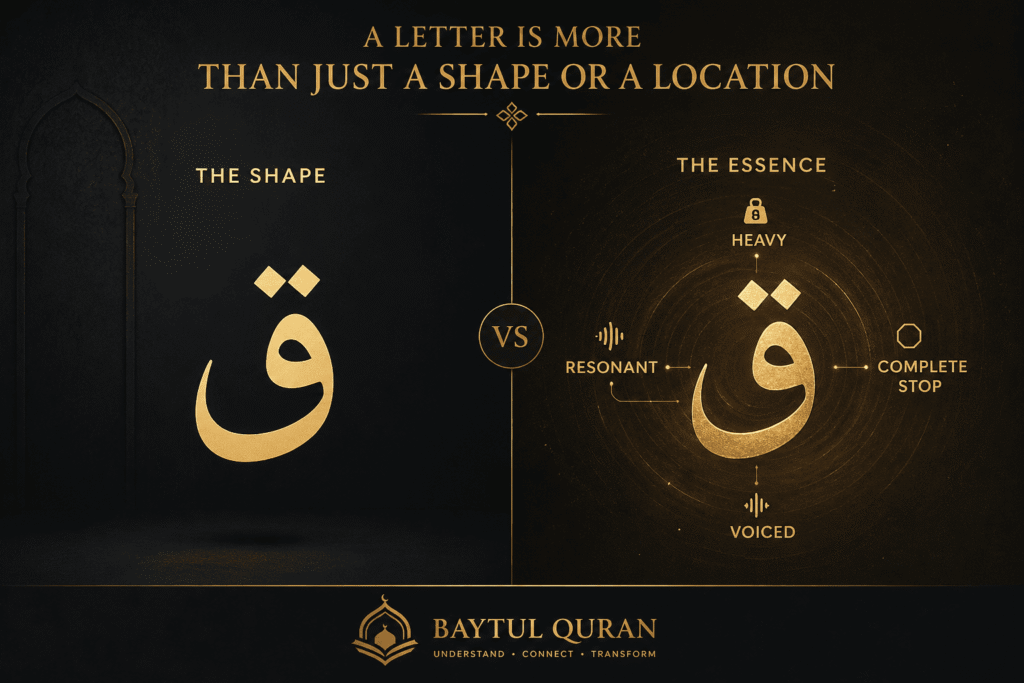
A letter without its Sifaat is like a word without its meaning. The characteristics are what make each Arabic letter complete.
LAAZIMAH VS AARIDAH THE TWO TYPES OF SIFAAT
Before diving into the individual characteristics, every student needs to understand one foundational distinction that organises all of Sifaat study. The scholars divide all Sifaat into two clear categories.
The first category is Laazimah, which means permanent. A Laazimah Sifah is a characteristic that belongs to a letter permanently and unconditionally. It is present every single time that letter is recited, regardless of what comes before or after it, regardless of vowel markings, and regardless of position in the word. You cannot recite that letter correctly without this quality being present. It is part of the letter’s identity in the same way that being human is part of your identity. You carry it everywhere, always.
For example, the letter Qaaf (ق) always carries the characteristic of Isti’la, which means elevation. The back of the tongue rises toward the roof of the mouth every time Qaaf is produced. This is not a contextual rule. It is simply what Qaaf is. Remove the elevation and you no longer have a true Qaaf.
The second category is Aaridah, which means temporary or accidental. An Aaridah Sifah is a characteristic that appears in certain recitation contexts but not in others. It comes and goes depending on the position of the letter in the word, the vowelling, or the surrounding letters. These are characteristics that a skilled reciter applies with awareness and understanding, not automatically.
The most well-known Aaridah Sifaat include qualities like Tafkheem (heaviness) and Tarqeeq (lightness) in certain contexts, and the various states of letters like Laam and Raa that change depending on the surrounding vowels and letters.
Understanding this distinction immediately simplifies Sifaat study for beginners. When you learn a Laazimah characteristic, you apply it every single time without exception. When you learn an Aaridah characteristic, you learn the specific conditions under which it appears. Both are important, but they require different types of awareness from the student.
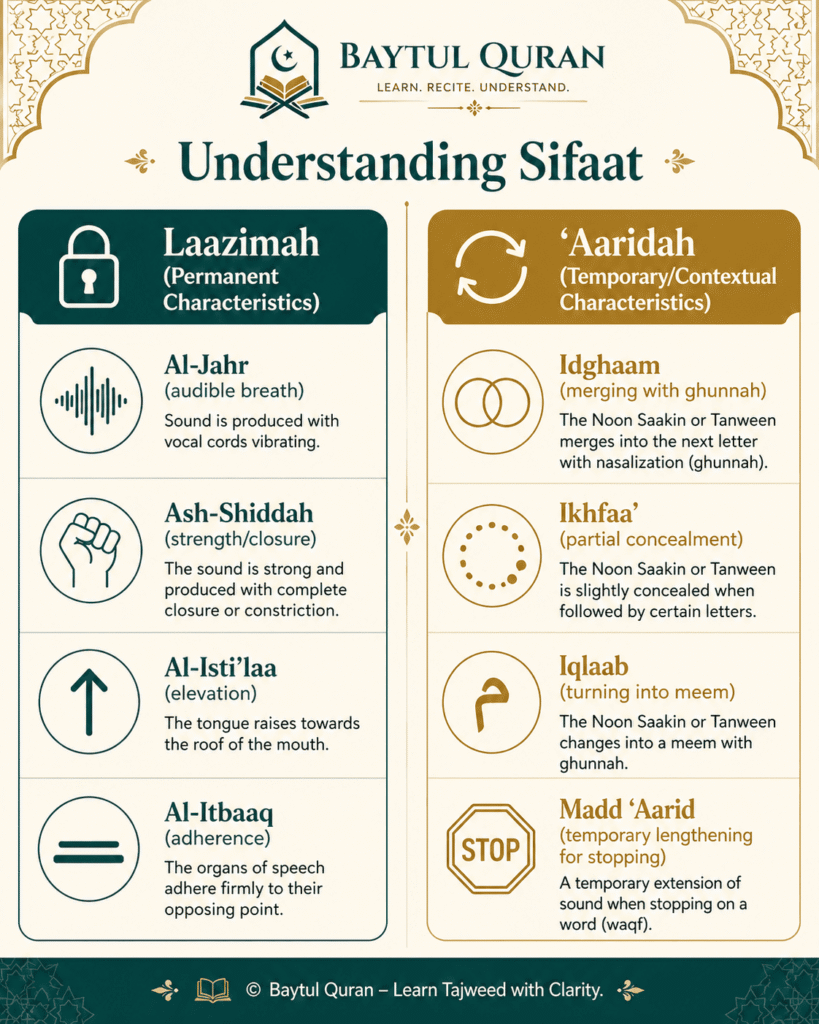
Permanent characteristics define what a letter is. Temporary characteristics define how it behaves in context. Both must be mastered.
THE SIFAAT WITH OPPOSITES PAIRS THAT DEFINE ARABIC LETTERS
The scholars of Tajweed organised the Laazimah Sifaat into two groups. The first group consists of characteristics that come in opposite pairs. Every letter in Arabic possesses one quality from each pair, never both. This means that by knowing which side of each pair a letter sits on, you build a complete profile of its sound character.
There are five opposite pairs that every beginner must understand.
The first pair is Jahr and Hams. Jahr means voicing, and it refers to letters that are produced with the voice fully switched on and the breath flow completely held back. When you say a Jahr letter, your vocal cords are vibrating fully and there is no leakage of air. Hams is the opposite and means breathiness or whispering. Letters of Hams are produced with a partial release of breath alongside the sound, giving them a lighter, airier quality. There are ten letters of Hams in Arabic, often remembered through the phrase: سَكَتَ فَحَثَّهُ شَخْصٌ. All remaining letters are Jahr.
The second pair is Shiddah and Rakhawah, with a middle category called Bayniyyah. Shiddah means strength or complete obstruction. A Shiddah letter completely stops the flow of sound at its articulation point, like a door shutting suddenly. Think of the letter Ba (ب) where both lips close completely and the sound is stopped before being released. Rakhawah is the opposite and means softness or free flow. A Rakhawah letter allows sound to flow continuously through and past its articulation point without complete obstruction. Bayniyyah refers to letters that sit between these two extremes, allowing partial sound flow. This characteristic is why certain letters in Tajweed feel stopped and punchy while others feel smooth and flowing.
The third pair is Isti’la and Istifaal. Isti’la means elevation and refers to letters during whose production the back of the tongue rises toward the upper palate, creating a heavier, fuller sound. There are seven letters of Isti’la in Arabic, often remembered through the phrase: خُصَّ ضَغْطٍ قِظْ. These are known as the heavy letters or emphatic letters. Istifaal is the opposite and means lowering. During Istifaal letters, the tongue remains low, producing lighter, cleaner sounds. This pair is critically important because Isti’la letters cause the surrounding vowels to sound fuller and heavier, which is why reading them with Tarqeeq (lightness) is a significant Tajweed error.
The fourth pair is Itbaaq and Infitaah. Itbaaq means closing or sealing and refers to letters during whose production the tongue presses up toward the roof of the mouth, sealing the oral cavity in a characteristic way that produces the distinctive emphatic quality of these letters. There are only four Itbaaq letters in Arabic: Saad (ص), Daad (ض), Taa (ط), and Dha (ظ). These are among the most difficult letters for non-Arab learners precisely because Itbaaq is a quality absent from almost all non-Semitic languages. Infitaah is the opposite and means openness, with the tongue remaining away from the palate.
The fifth pair is Idhlaq and Ismaat. Idhlaq refers to letters that are produced easily and quickly from the tip of the tongue or the lips, giving them a natural fluency in speech. There are six Idhlaq letters, remembered through the phrase: فَرَّ مِنْ لُبّ. Ismaat refers to letters that require more deliberate effort to produce and therefore feel slightly heavier and more measured. This characteristic explains why certain letters in Arabic flow naturally in rapid speech while others require careful articulation.
THE SIFAAT WITHOUT OPPOSITES UNIQUE INDIVIDUAL QUALITIES
Beyond the five opposite pairs, the scholars identified a further set of Sifaat that belong to specific letters individually rather than existing on a spectrum with an opposite. These are often referred to as the Sifaat without opposites, and there are seven of them. Each one gives a specific group of Arabic letters a unique and distinctive quality that no other letters share.
The first is Safeer, which means whistling. Three letters carry this quality: Seen (س), Saad (ص), and Zay (ز). When these letters are produced correctly, there is a thin, penetrating whistling quality to the sound that comes from the narrow channel of air passing between the tongue and the teeth. This is why these letters, particularly Seen, have such a distinctive sharp quality in Quran recitation.
The second is Qalqalah, which means echoing or bouncing. This quality belongs to five letters collected in the phrase قُطْبُ جَدّ: Qaaf (ق), Taa (ط), Ba (ب), Jeem (ج), and Daal (د). When any of these letters appears with a Sukoon (no vowel) it produces a slight echoing vibration or bounce at the point of articulation. Qalqalah is one of the most immediately recognisable qualities of beautiful Quran recitation. Beginners often hear it in skilled recitation before they know its name, because the echoing quality of these letters is genuinely striking and beautiful.
The third is Leen, which means softness or ease. This quality belongs to Waaw (و) and Yaa (ي) when they appear with a Sukoon after a Fathah vowel. These letters in this condition produce a smooth, easy gliding sound that flows without any hardness or abruptness.
The fourth is Inhiraaf, which means inclining or diverting. This belongs to Laam (ل) and Raa (ر), whose sounds divert or incline from the centre of the tongue toward the sides during production, giving them their characteristic flowing quality.
The fifth is Takreer, which means repetition, and it belongs exclusively to Raa (ر). This characteristic refers to the potential for the tongue tip to vibrate or trill during the production of Raa. Importantly, the scholars warn that while Takreer is the inherent characteristic of Raa, it should not be exaggerated in recitation. The Raa should have a subtle quality of its potential vibration without becoming an obvious trill, which would be an error.
The sixth is Tafashshi, which means spreading. This belongs to Sheen (ش) and refers to how the sound of Sheen spreads widely across the mouth during its production, filling the oral cavity with a diffuse rushing sound. This spreading quality is what gives Sheen its characteristic fullness compared to Seen.
The seventh is Istitaalah, which means elongation along the articulation point, and it belongs exclusively to Daad (ض). This is the characteristic that makes Daad one of the most unique and technically demanding letters in all of Arabic. The sound of Daad elongates along one side of the tongue during production, which is why mastering this letter is considered a mark of advanced Tajweed skill. The Prophet ﷺ is reported to have said that the Arabs are distinguished by their ability to produce the Daad correctly, which is why Arabic is sometimes called Lughat Al-Daad, the language of the Daad.
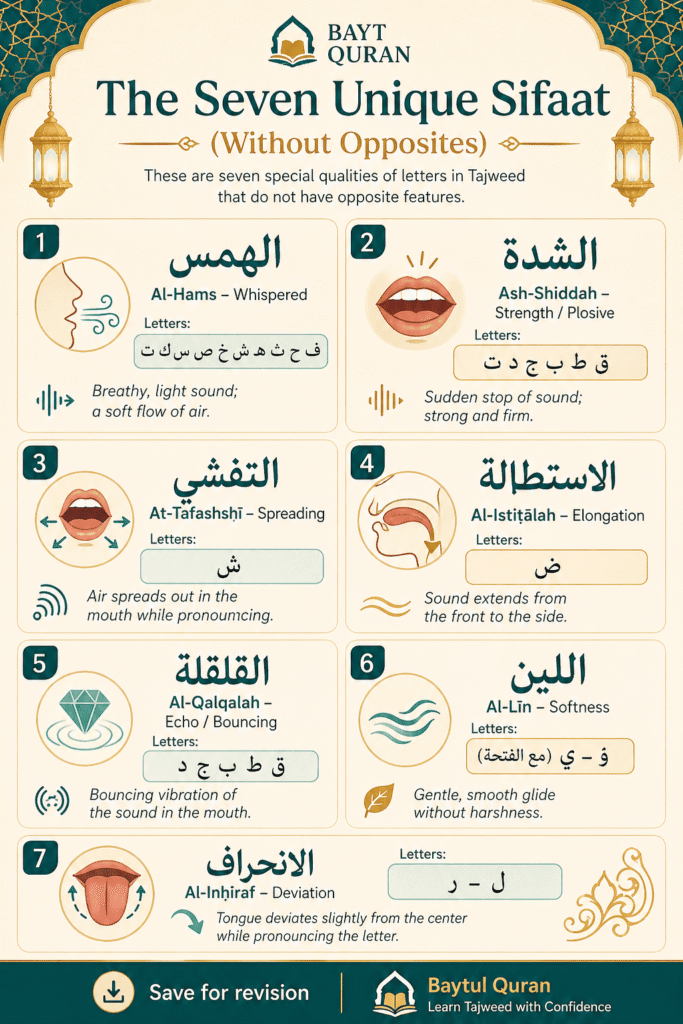
These seven unique qualities are what give certain Arabic letters their unmistakable character. Once you can hear them, your relationship with Quran recitation changes forever.
HOW SIFAAT AND MAKHAARIJ WORK TOGETHER
At this point in the lesson, some students feel a little overwhelmed. There are seventeen characteristics to understand, five opposite pairs, seven individual qualities, two categories of permanent and temporary. It can feel like a lot to hold at once.
So let us step back and look at the bigger picture, because when you understand how Makhaarij and Sifaat work together, everything clicks into place.
Makhaarij tells you where a letter comes from. Sifaat tells you what that letter sounds like. Together, they give you the complete identity of every Arabic letter. Makhaarij is the address. Sifaat is the personality. You need both to truly know the letter.
Think about the letters Seen (س) and Saad (ص). Both come from a very similar Makhraj, the tip of the tongue area near the upper front teeth. If you only knew their Makhraj, you might struggle to distinguish them clearly. But their Sifaat are completely different. Seen has the characteristics of Hams (breathiness), Rakhawah (flowing), Istifaal (lowered tongue), Infitaah (open), and Safeer (whistling). Saad has Hams and Rakhawah too, but it also carries Isti’la (elevation), Itbaaq (sealing), and Safeer. The presence of Isti’la and Itbaaq in Saad is what gives it its heavy, full, emphatic quality compared to the light, clean Seen. Without understanding Sifaat, a student will always confuse these two letters at some level, no matter how well they know the Makhraj.
This is the exact moment in a student’s Tajweed journey when recitation starts to feel different. When Makhaarij gives the letter its correct origin and Sifaat gives it its correct qualities, the letter comes alive in a way it never did before. Experienced Tajweed teachers describe this moment as the student finding the letter, because for the first time the letter is fully present in the recitation rather than just approximately correct.
Our structured Tajweed programme for all levels. “If you would like your child or yourself assessed on both Makhaarij and Sifaat by a certified teacher, our structured Tajweed programme for all levels starts with a completely free first classes.”
WHY THIS CHANGES EVERYTHING ABOUT YOUR RECITATION
Let us be honest about something that most Tajweed resources do not say clearly enough. The majority of Muslims who recite the Quran regularly, including those who have been reciting for decades, have never been taught Sifaat properly. They have learned to read Arabic. They may have learned some Tajweed rules. But the deep letter-level quality that Sifaat produces is simply missing from their recitation.
This is not a criticism. It is simply the reality of how Quran education has worked in most Muslim communities in the West, where access to properly qualified teachers has historically been limited. The good news is that this has changed dramatically with the rise of quality online Tajweed education.
When a student who has been reciting without Sifaat begins working with a teacher who understands and teaches these characteristics, the transformation in recitation quality is often described as stunning, even by the student themselves. Letters that felt flat suddenly have depth. Letters that felt all the same suddenly feel distinct and alive. The Quran begins to sound the way it was meant to sound.
For children especially, learning Sifaat early is one of the greatest gifts a parent can give them. A child who internalises the correct Sifaat of Arabic letters before the age of ten will carry that quality of recitation for the rest of their life. It becomes natural, effortless, and deeply beautiful in a way that adult learners work much harder to achieve.
For adult learners, the journey through Sifaat requires patience and consistent practice, but the rewards are equally profound. Many adult students report that learning Sifaat gave them a completely new relationship with the Quran, because for the first time they felt they were truly reciting the letters rather than approximating them.
🌟 READY TO START YOUR QURAN JOURNEY?
Join hundreds of students across the UK, USA and all over the world, learning Quran online with certified teachers.
✅ Free trial classes no commitment ✅ Expert teachers with Ijazah ✅ Flexible timings for your timezone
👉 Book Your Free Trial on WhatsApp
Or visit: baytulquran.com
There is a moment when correct Tajweed stops being technical and starts being transcendent. Sifaat is often what triggers that moment.
FREQUENTLY ASKED QUESTIONS
Q: What are Sifaat Al-Huroof in Tajweed? A: Sifaat Al-Huroof are the characteristics or qualities of Arabic letters that define how each letter sounds beyond just where it comes from. While Makhaarij tells you the exit point of a letter, Sifaat tells you the sound qualities that letter carries, such as whether it is heavy or light, voiced or breathy, echoing or flowing. There are 17 Sifaat in total, divided into permanent characteristics that belong to a letter always, and temporary characteristics that appear in specific contexts.
Q: What is the difference between Laazimah and Aaridah Sifaat? A: Laazimah means permanent. A Laazimah Sifah is a characteristic that belongs to a letter unconditionally, every time it is recited, regardless of context. Aaridah means temporary. An Aaridah Sifah appears only in certain recitation conditions, such as specific vowelling or surrounding letters. Understanding this distinction helps students know which qualities to apply automatically and which to apply with contextual awareness. At Baytul Quran Academy, our teachers introduce this distinction in the earliest stages of Sifaat study so students always have a clear framework.
Q: What is Qalqalah and which letters carry it? A: Qalqalah is the echoing or bouncing quality that appears when five specific letters are recited with a Sukoon. The five Qalqalah letters are Qaaf, Taa, Ba, Jeem, and Daal, collected in the phrase Qutb Jad. When these letters appear without a vowel, they produce a distinctive vibrating echo at the point of articulation that is one of the most recognisable and beautiful qualities in Quran recitation. Qalqalah has three degrees of strength depending on the position of the letter in the word, and a qualified teacher trains students to apply each degree correctly.
Q: Why are Sifaat important if I already know Makhaarij? A: Makhaarij and Sifaat are two halves of the same complete picture. Knowing the Makhraj of a letter tells you where it comes from. Knowing its Sifaat tells you what it truly sounds like. Two letters can share a similar Makhraj but sound completely different because their Sifaat differ. For example, Seen and Saad both come from a similar tongue-teeth area but their characteristics of heaviness, elevation, and sealing make Saad sound completely different from Seen. Without Sifaat knowledge, a student will never fully distinguish or correctly produce all 29 Arabic letters. You can begin studying both with a certified teacher through a free trial class at Baytul Quran Academy.
Q: How long does it take to learn Sifaat Al-Huroof? A: Learning the theory of all 17 Sifaat typically takes one to two months of structured study. However, internalising them into your actual recitation, meaning producing every letter with its correct qualities automatically and naturally, takes considerably longer and requires consistent practice and correction from a qualified teacher. Children who begin young can develop correct Sifaat habits very naturally through repetition. Adult learners typically need six months to a year of focused work to fully integrate Sifaat into their recitation. The transformation in recitation quality during this period is genuinely remarkable.
Q: Do I need to memorise all 17 Sifaat before I can recite the Quran correctly? A: No. You do not need to memorise all 17 Sifaat theoretically before your recitation improves. A good Tajweed teacher will introduce Sifaat gradually, connecting each characteristic to real letters and real recitation practice from the very first lesson. You learn by hearing, practicing, and being corrected in real time, not by memorising lists. The theoretical knowledge builds alongside the practical skill, and the combination of both is what produces genuinely correct and beautiful recitation, insha’Allah.
CONCLUSION
Sifaat Al-Huroof is the lesson that changes how you hear the Quran forever.
Before learning Sifaat, most students hear the Quran as a beautiful sound. After learning Sifaat, they begin to hear the individual character of each letter, the weight of the heavy letters, the airiness of the Hams letters, the echo of Qalqalah, the whistle of Safeer, the spreading fullness of Sheen. The Quran does not become more complex. It becomes more alive.
This is the gift that the scholars of Tajweed gave the Muslim Ummah when they catalogued and preserved these characteristics over fourteen centuries. Every quality they described, every pair they defined, every unique Sifah they named is a doorway into a deeper relationship with the Words of Allah (SWT).
For your children, learning Sifaat Al-Huroof early means they will grow up hearing and producing the Quran with a richness that most Muslims never experience. For you as an adult learner, committing to this study means that every Salah you pray, every Surah you recite, every moment you spend with the Quran will carry a quality and a correctness that draws you closer to the Book itself.
Alhamdulillah for the science of Tajweed. And alhamdulillah that this knowledge is still alive, still being taught, and still transforming recitations one student at a time. May Allah (SWT) make us among those who give His Book the right it deserves. Ameen.
📖 BEGIN YOUR QURAN JOURNEY TODAY Taught Expert Teachers
✦ Tajweed
✦ Hifz
✦ Noorani Qaida
✦ Tafseer
✦ Quran Reading
All over the world
💬 WhatsApp: +44 7842 064721 || +923008737779
🌐https://baytulquran.com/ 📱 @baytulquran_1
First 3 classes are FREE. Always.

One Response