INTRODUCTION
In Part 1 of this lesson, we worked through twelve of the eighteen Arabic tongue letters. We covered the back tongue letters Qaaf and Kaaf, the middle tongue letters Jeem, Sheen, and consonant Yaa, the unique and complex Daad, the tongue blade letters emphatic Taa, Daal, and regular Taa, and the three dental letters Thaa, Dhaal, and Dha.
If you worked through all of those carefully, you have already covered the most challenging group within Huroof Al-Lisaan. The six letters we are covering today in Part 2 are not necessarily easier, but they are different in character. Where Part 1 dealt with complete stops, emphatic consonants, and interdental positions, Part 2 deals with letters that flow, vibrate, whistle, and spread. These are the letters that give Quranic recitation much of its characteristic melody and texture.
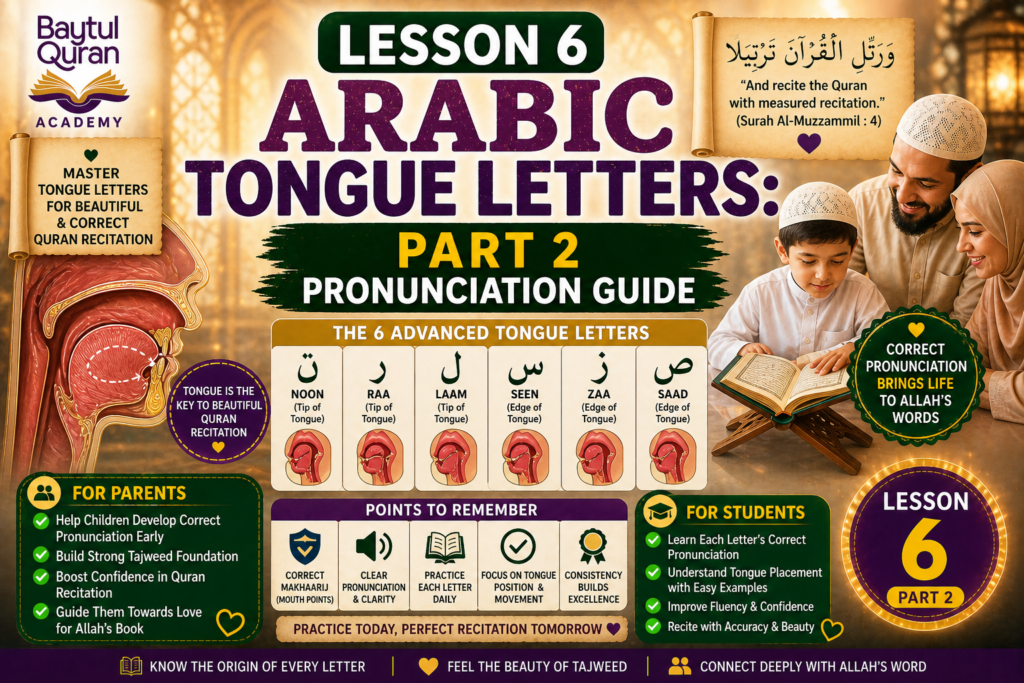
The six letters we are completing today are Noon (ن), Raa (ر), Laam (ل), Seen (س), Zay (ز), and Saad (ص).
Each of these letters carries distinctive Sifaat that we studied in Lesson 4, and in this lesson those characteristics come to life practically. The whistling trio of Safeer letters, the vibrating potential of Raa, the lateral flow of Laam, the nasal resonance of Noon, and the emphatic depth of Saad are all concepts you have encountered before. Now we connect them to physical articulation, practical exercises, and real Quranic application.
By the end of this lesson you will have a complete working knowledge of all 18 Arabic tongue letters. That is a significant milestone in any student’s Tajweed journey, and it is one that directly transforms the quality and confidence of your Quran recitation.
Let us finish what we started.
IN THIS ARTICLE:
- Quick Recap —> The 12 Letters Covered in Part 1
- The Articulation Zone for Today’s Six Letters
- Noon (ن) —> The Nasal Tongue Letter
- Raa (ر) —> The Letter of Subtle Vibration
- Laam (ل) —> The Lateral Letter
- The Safeer Trio —> Seen (س), Zay (ز), and Saad (ص)
- Complete Summary of All 18 Tongue Letters
- Common Mistakes That Combine Multiple Tongue Letters
- Frequently Asked Questions
QUICK RECAP THE 12 LETTERS COVERED IN PART 1
Before moving to the six remaining letters, a brief recap of Part 1 grounds everything that follows.
In Part 1 we established that Al-Lisaan, the tongue, is divided into multiple articulation zones across its length. Working from back to front, we covered the back tongue letters Qaaf and Kaaf, noting their different depths of contact with the palate and their completely different Sifaat. We then covered the middle tongue letters Jeem, Sheen, and consonant Yaa, paying attention to the decreasing degree of tongue-to-palate contact across those three letters.
We dedicated significant attention to Daad, the most uniquely Arabic letter, produced from the lateral edge of the tongue and carrying the rare Sifah of Istitaalah. We then worked through the three tongue blade letters Taa, Daal, and Taa, noting the critical distinction between emphatic and non-emphatic versions. Finally, we covered the three dental letters Thaa, Dhaal, and Dha, all produced with the tongue tip at the upper front teeth, distinguishing voiceless, voiced, and emphatic variants.
If any of those letters still feel unclear, we recommend revisiting Part 1 before continuing, because the complete picture of tongue letter articulation only makes full sense when all 18 letters are understood together.
You can find Part 1 here: https://baytulquran.com/arabic-tongue-letters-pronunciation-part-1/
THE ARTICULATION ZONE FOR TODAY’S SIX LETTERS
All six letters in today’s lesson are produced from the tongue tip and the area just behind the upper front teeth, specifically the alveolar ridge and the gum area immediately behind it. This is the same general zone as the tongue blade letters from Part 1, but with important positional distinctions.
Noon and Raa are produced with the tongue tip making contact with the gum ridge behind the upper teeth, but at different degrees and with different sound qualities. Laam is produced with the sides of the tongue tip area touching the gum ridge, creating a lateral sound that is quite different from Noon and Raa despite the proximity.
Seen, Zaa, and Saad are all produced with the tongue tip approaching but not quite touching the area behind the upper teeth, creating a narrow channel through which air flows to produce their characteristic friction and whistling quality.
Understanding this shared zone helps students practice these six letters as a connected group rather than six isolated sounds. The tongue barely moves between some of these letters. The differences lie almost entirely in the Sifaat, the sound qualities they carry.
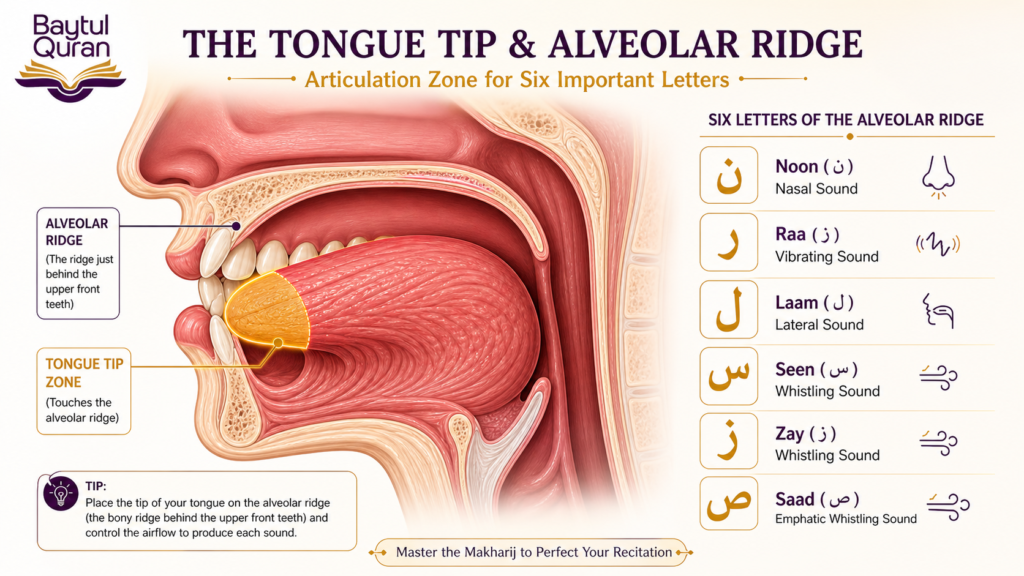
Six letters, one zone, six completely different sound personalities. This is the precision of Tajweed at its finest.
NOON (ن) THE NASAL TONGUE LETTER
Noon is one of the most important letters in all of Tajweed study, not just because of its Makhraj but because it appears in a remarkable number of Tajweed rules. The rules of Noon Sakinah and Tanween, which we will cover in detail in the next lesson, are built entirely around what happens to Noon in different contexts. Before understanding those rules, a student must first understand the letter itself.
Noon is produced with the tongue tip making contact with the gum ridge behind the upper front teeth. This is the same contact point as the letter Daal, but Noon has a critical additional quality. During the production of Noon, air is simultaneously redirected through the nasal passage, producing the nasal resonance that is Noon’s most distinctive characteristic.
In terms of Sifaat, Noon carries Jahr (full voicing), Tawassut (a middle quality between complete stop and free flow), Istifaal (tongue low), Infitaah (open), and crucially the nasal quality of Ghunnah when it appears in certain Tajweed contexts. The combination of tongue tip contact and nasal redirection is what gives Noon its characteristic warm, resonant quality.
The English N sound is a very close approximation of Arabic Noon and is one of the more accessible letters for English-speaking students. The main distinction is that Arabic Noon is produced with more deliberate precision of tongue tip placement and a more conscious engagement of the nasal passage than the casual English N.
The most important thing students must understand about Noon is that it behaves differently in different Tajweed contexts. When Noon appears with a full vowel it is pronounced clearly and completely. When it appears with a Sukoon or as Tanween before other letters, it triggers the rules of Idhar, Idghaam, Iqlab, and Ikhfa, each of which changes how Noon sounds in that context. These rules will be covered fully in the next lesson. For now, focus on establishing the correct baseline articulation of Noon itself.
A practice exercise for Noon is to alternate between Noon and Daal repeatedly, feeling the difference between the nasal quality of Noon and the clean stop quality of Daal. Both use the tongue tip at the same position. Only the nasal redirection distinguishes them. Developing awareness of that distinction is the foundation of correct Noon production.
RAA (ر) THE LETTER OF SUBTLE VIBRATION
Raa is one of the most distinctive letters in Arabic and one that students either find surprisingly accessible or surprisingly challenging, depending on their language background.
Raa is produced with the tongue tip making contact with the gum ridge behind the upper front teeth, very close to the Noon and Daal position. However, Raa carries the unique Sifah of Takreer, which we studied in Lesson 4. Takreer means repetition and refers to the potential vibrating or trilling quality of the tongue tip at its articulation point.
This is where students need careful guidance. The Takreer characteristic means that Raa has the inherent potential for a trill, but the scholars of Tajweed are very clear that this trill should NOT be exaggerated in recitation. A heavily rolled or trilled Raa is considered a Tajweed error. The correct Raa has a subtle, controlled quality of potential vibration without becoming an obvious rolling trill.
Think of the difference between a single, clean tap of the tongue on the ridge versus a prolonged rolling trill. Correct Arabic Raa is closer to the single tap, carried with the awareness of Takreer but without letting it multiply into an exaggerated roll.
Beyond Takreer, Raa also carries the Sifah of Inhiraaf, which means the sound inclines or diverts slightly as it is produced, giving it a liquid flowing quality. Raa is also one of the most complex letters in Arabic because it changes between heavy and light depending on the surrounding vowels and letters. This is an Aaridah (temporary) characteristic rather than a permanent one.
Raa is pronounced heavy in three main conditions. First, when it carries a Fathah or Dammah vowel. Second, when it carries a Sukoon and the vowel before it is a Fathah or Dammah. Third, when it carries a Sukoon and is followed by an emphatic letter. Raa is pronounced light when it carries a Kasrah, when it carries a Sukoon and the vowel before it is a Kasrah, and in several additional specific conditions.
The heavy Raa sounds fuller, rounder, and deeper. The light Raa sounds cleaner, thinner, and more forward. Getting this distinction correct is one of the marks of genuinely skilled Tajweed recitation and something that a qualified teacher will work on carefully with every student.
The most common mistakes with Raa are exaggerating the trill, failing to distinguish heavy from light Raa, and producing it from too far back on the tongue, making it sound like a retroflex R rather than the correct alveolar tap.
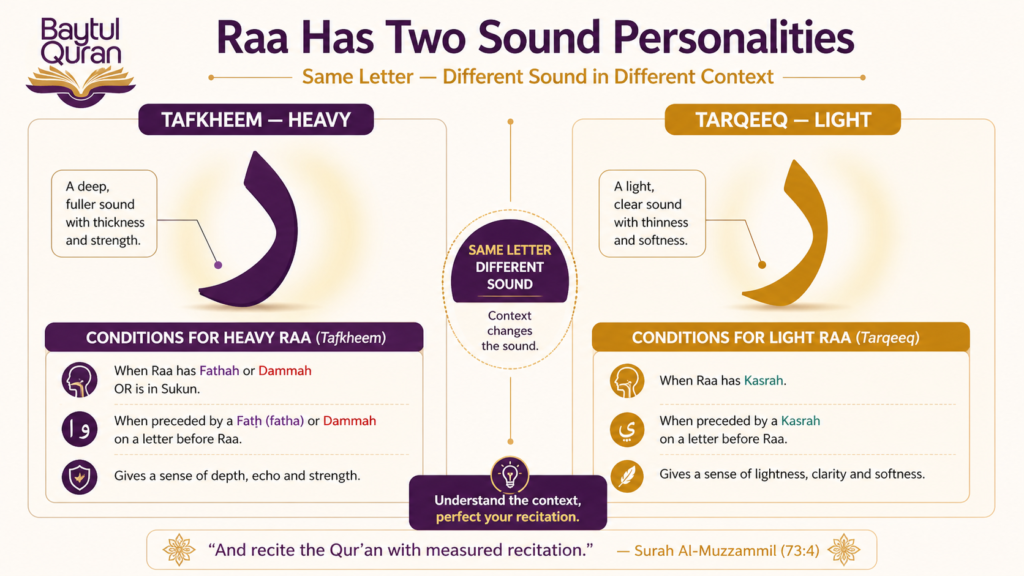
Raa is the only letter in Arabic that regularly switches between heavy and light based on its context. This is what makes it one of the most nuanced letters in Tajweed.
LAAM (ل) THE LATERAL LETTER
Laam is produced with the sides of the tongue tip area making contact with the gum ridge and the sides of the upper mouth simultaneously. This creates what is called a lateral sound, meaning the air flows around the sides of the tongue rather than over the centre of it. Laam also carries the Sifah of Inhiraaf, shared with Raa, meaning its sound diverts or flows to the sides as it is produced.
In terms of Sifaat, Laam carries Jahr (full voicing), Tawassut (middle quality), Istifaal (tongue low), Infitaah (open), and Idhlaq (produced easily from the tongue tip area). This combination gives Laam its characteristic smooth, flowing, liquid quality that makes it one of the most beautiful letters in Arabic recitation.
The English L sound is a reasonable approximation of Arabic Laam, and English speakers generally find this letter accessible. The main distinction is that Arabic Laam is produced with more deliberate lateral contact and a more precise tongue tip placement than the relatively loose English L.
However, there is a critical complexity with Laam that every Tajweed student must understand. Like Raa, Laam has both a heavy and a light version. But unlike Raa, which changes based on vowel conditions, the heavy Laam in Tajweed is restricted to a single, very specific context — the word Allah.
When the word Allah (الله) is preceded by a Fathah or Dammah vowel, the Laam of Allah is pronounced heavy, creating the deep, resonant quality that gives the Blessed Name of Allah its distinctive full sound in Quranic recitation. When the word Allah is preceded by a Kasrah vowel, the Laam is pronounced light. In all other words in the Quran, Laam is always light.
This rule is one of the most important and most beautiful in all of Tajweed. It means that the very Name of Allah is given a special phonetic treatment that distinguishes it from every other word in the Quran. When students first learn this rule and apply it correctly, many describe the experience as giving the Name of Allah a new dimension in their recitation.
The most common mistake with Laam is treating it as uniformly light in all contexts, including the heavy Laam of Allah, which removes this beautiful distinction entirely. Another common mistake is producing the lateral air flow incorrectly, directing the air over the centre of the tongue rather than around its sides.
THE SAFEER TRIO — SEEN (س), ZAY (ز), AND SAAD (ص)
We now arrive at three letters that share a remarkable quality. In Lesson 4, we introduced the Sifah of Safeer, which means whistling. All three of these letters carry Safeer, meaning they produce a thin, penetrating, whistle-like sound created by a narrow channel of air between the tongue tip and the teeth area. Understanding the Safeer quality first makes the differences between these three letters much easier to grasp.
All three letters are produced with the tongue tip approaching the area behind the upper front teeth without making complete contact, so that air is forced through a narrow channel and creates friction. The differences between them lie entirely in their Sifaat.
SEEN (س)
Seen is the voiceless, non-emphatic Safeer letter. In terms of Sifaat, Seen carries Hams (breathiness and voicelessness), Rakhawah (free airflow), Istifaal (tongue low), Infitaah (open), and Safeer (whistling). The combination of voicelessness, free airflow, and low tongue position gives Seen its characteristic clean, light, bright sibilant quality.
The English S sound in words like “sun,” “see,” and “simple” is a very close approximation of Arabic Seen. English speakers generally find Seen one of the more accessible Arabic letters. The main requirement is precision of tongue tip position and a clean, consistent Safeer quality without any heaviness or breathiness.
The most common mistake with Seen is producing it with too much breathiness or making it sound similar to the English SH, which happens when the tongue tip position is too far back. The correct Seen should be crisp, forward, and cleanly sibilant.
ZAY (ز)
Zay is the voiced partner of Seen. Where Seen is voiceless and breathy, Zay is produced from exactly the same tongue tip position but with full voicing of the vocal cords. In terms of Sifaat, Zay carries Jahr (full voicing), Rakhawah (free airflow), Istifaal, Infitaah, and Safeer. The addition of voicing gives Zay a buzzing, vibrating quality compared to the clean quietness of Seen.
The English Z sound is a very close approximation of Arabic Zay. Students who can already distinguish clearly between S and Z in English have already developed the voicing awareness needed to distinguish Seen and Zay in Arabic.
The most common mistake with Zay is producing it without sufficient voicing, making it sound like Seen. This is particularly common when Zay appears at the end of a word where students naturally devoice consonants, as English speakers do. In Arabic Tajweed, the voicing of Zay must be maintained in all positions.
SAAD (ص)
Saad is where the Safeer trio becomes genuinely challenging for non-Arab learners. Saad is the emphatic Safeer letter, produced from the same tongue tip approaching the teeth area, but with the addition of the Sifaat of Isti’la (elevation of the back tongue) and Itbaaq (sealing of the palate). It is also voiceless like Seen, carrying Hams.
The full Sifaat of Saad are Hams (voiceless), Rakhawah (free airflow), Isti’la (elevation), Itbaaq (sealing), and Safeer (whistling). The presence of Isti’la and Itbaaq is what makes Saad sound completely different from Seen despite sharing the same voicelessness and Safeer quality.
When you produce Seen and then produce Saad correctly, the difference is immediately audible. Seen is light, bright, and forward. Saad is deep, heavy, full, and rounded. The back of the tongue rising during Saad production changes the entire resonance of the mouth, making the Safeer quality of Saad sound deeper and richer than the Safeer of Seen.
The most common mistake with Saad is producing it as a plain Seen, removing all the emphatic heaviness. This is an extremely widespread error among non-Arab Muslims and represents one of the most common Tajweed mistakes in the recitation of the Quran. Words containing Saad that are mispronounced as Seen can have different meanings entirely.
A practical exercise for the Saad-Seen distinction is to alternate between the two repeatedly, consciously raising and lowering the back of the tongue between attempts. Seen with back tongue down. Saad with back tongue raised. Over time, the motor distinction becomes automatic.
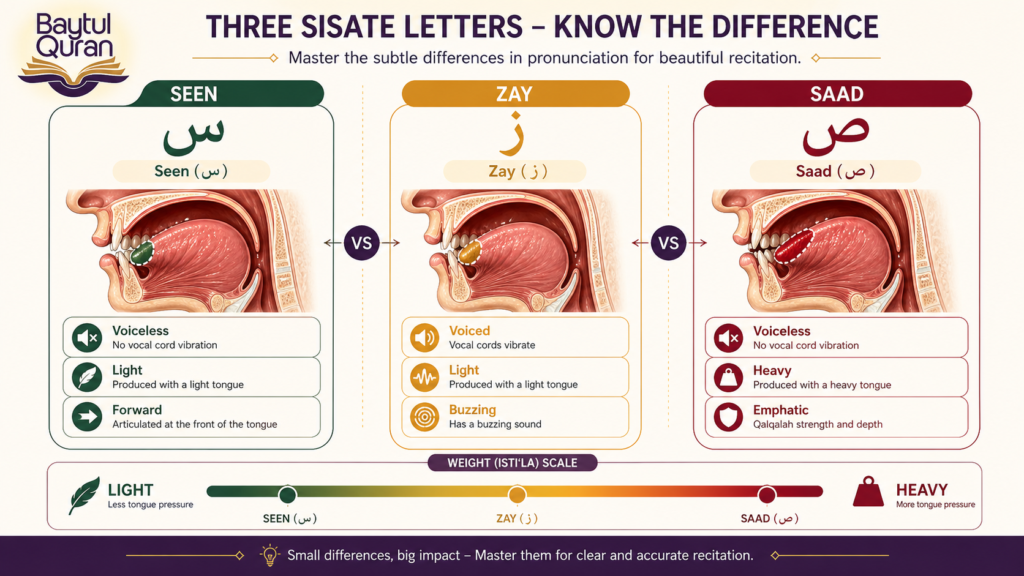
All three letters whistle. But the difference between them is the difference between light and heavy, voiced and voiceless. Get these right and your recitation transforms.
COMPLETE SUMMARY OF ALL 18 TONGUE LETTERS
Now that both parts of this lesson are complete, here is the full summary of all 18 Arabic tongue letters organised by their articulation zone from back to front. This is your complete Huroof Al-Lisaan reference.
BACK OF TONGUE SOFT PALATE AREA: Qaaf (ق) very back of tongue to soft palate, deep, heavy, Qalqalah letter Kaaf (ك) slightly forward, junction of hard and soft palate, lighter, breathy
MIDDLE OF TONGUE HARD PALATE: Jeem (ج) middle tongue to hard palate, complete stop, Qalqalah letter Sheen (ش) middle tongue near hard palate, friction, spreading Tafashshi quality Yaa (ي) as a consonant, middle tongue loosely approaching hard palate, gliding
SIDE EDGE OF TONGUE UPPER MOLARS: Daad (ض) lateral tongue edge to upper molars, emphatic, Istitaalah quality
TONGUE BLADE ALVEOLAR RIDGE: Taa (ط) tongue blade to alveolar ridge, emphatic, heavy, Qalqalah letter Daal (د) tongue blade to alveolar ridge, plain, voiced, Qalqalah letter Taa (ت) tongue blade to alveolar ridge, plain, voiceless, light
TONGUE TIP UPPER FRONT TEETH: Thaa (ث) tongue tip to upper teeth, voiceless dental friction Dhaal (ذ) tongue tip to upper teeth, voiced dental friction Dha (ظ) tongue tip to upper teeth, emphatic voiced dental friction
TONGUE TIP ALVEOLAR RIDGE: Noon (ن) tongue tip to alveolar ridge, nasal quality, Ghunnah Raa (ر) tongue tip to alveolar ridge, Takreer, Inhiraaf, heavy and light variants Laam (ل) tongue tip sides to alveolar ridge, lateral, Inhiraaf, heavy only in Allah
TONGUE TIP APPROACHING TEETH SAFEER GROUP: Seen (س) tongue tip near teeth, voiceless, light, Safeer whistling Zay (ز) tongue tip near teeth, voiced, light, Safeer whistling Saad (ص) tongue tip near teeth, voiceless, emphatic, heavy, Safeer whistling
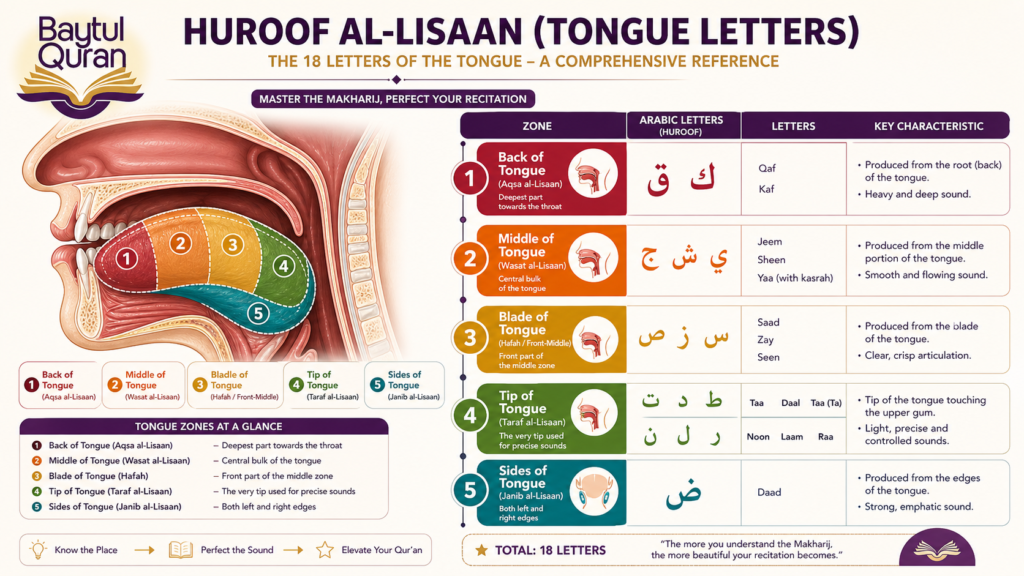
All 18 Arabic tongue letters, mapped from back to front. Print this, save it, study it, and practice it daily with your teacher.
COMMON MISTAKES THAT COMBINE MULTIPLE TONGUE LETTERS
Now that we have covered all 18 tongue letters, it is worth addressing the common error patterns that involve multiple letters together, because these are the mistakes that qualified teachers hear most frequently in recitation.
The first combined error is the Saad-Seen-Zay confusion. Many non-Arab students use Seen for all three letters, removing both the voicing of Zay and the emphatic quality of Saad entirely. This collapses three distinct letters into one and creates numerous meaning changes across Quranic vocabulary. Focused practice on the distinctions between all three Safeer letters simultaneously is the most effective correction approach.
The second combined error is the Taa confusion. Students regularly mix up the emphatic Taa (ط) and regular Taa (ت), and sometimes conflate both with the Daal (د). These three letters use the same tongue blade position but with completely different Sifaat. A teacher will work on these three as a group, drilling the emphatic-plain distinction until it becomes automatic.
The third combined error is the Noon-Laam-Raa proximity confusion. Because these three letters are all produced from very close positions on the alveolar ridge, some students produce them all from roughly the same position and rely on nasal quality alone to distinguish Noon. The distinct lateral quality of Laam and the Takreer quality of Raa must be consciously developed to keep these three letters clearly distinct.
The fourth combined error is the Daad-Dhal confusion. Both are heavy voiced letters but from completely different zones. Daad comes from the lateral tongue edge. Dha comes from the tongue tip at the teeth. Conflating them is a common mistake that a careful teacher will address specifically.
Book a free trial Tajweed class to have your tongue letters assessed. “The most effective way to identify which of these error patterns applies to your own recitation is to book a free trial Tajweed class to have your tongue letters assessed by a certified teacher with Ijazah.”
Explore the complete Tajweed series from Lesson 1. “If you are working through this series from the beginning, you can explore the complete Tajweed series from Lesson 1 to build your knowledge in the most structured way possible.”
View our Tajweed course fees and schedules. “To see how our structured Tajweed programme is organised and priced, view our Tajweed course fees and schedules and find the right option for your family.”
🌟 READY TO START YOUR QURAN JOURNEY?
Join hundreds of students across the UK, USA and all over the world, learning Quran online with certified teachers.
✅ Free trial classes no commitment ✅ Expert teachers with Ijazah ✅ Flexible timings for your timezone
👉 Book Your Free Trial on WhatsApp
Or visit: baytulquran.com
FREQUENTLY ASKED QUESTIONS
Q: What is the correct way to pronounce Raa in Arabic Tajweed? A: Raa is produced with the tongue tip making contact with the gum ridge behind the upper front teeth, carrying the unique Sifah of Takreer, which gives it a subtle vibrational quality. The key rule is that this vibrational quality must not be exaggerated into a heavy trill or roll. Correct Arabic Raa is a controlled, clean sound with a subtle liquid quality. Raa also has heavy and light variants depending on surrounding vowels and letters, and a qualified teacher will work on both variants with every student. You can begin this work with a free trial class at Baytul Quran Academy.
Q: What is the difference between Seen (س) and Saad (ص) in Arabic? A: Both Seen and Saad are voiceless Safeer letters produced with the tongue tip near the upper teeth area, and both carry the whistling quality of Safeer. The critical difference is that Saad carries the additional Sifaat of Isti’la (back tongue elevation) and Itbaaq (palate sealing), making it a heavy emphatic letter. Seen has none of these emphatic qualities and is a light, clean, forward sibilant. When produced correctly, Seen sounds bright and thin while Saad sounds deep, full, and rounded. Confusing them changes the meaning of Quranic words and is one of the most common Tajweed errors among non-Arab Muslims.
Q: Why does the Laam of Allah sound different from other Laams? A: The Laam of Allah is given a special ruling in Tajweed. When the word Allah is preceded by a Fathah or Dammah vowel, the Laam is pronounced heavy, with the back of the tongue raised to give it a fuller, deeper quality. When preceded by a Kasrah, it is light. In all other words in the Quran, Laam is always light. This special treatment of the Laam in the Name of Allah gives the Blessed Name a distinctive phonetic presence in Quranic recitation that is unlike any other word.
Q: What is Safeer in Tajweed and which letters carry it? A: Safeer is the Sifah of whistling or a sharp penetrating sibilant quality produced by forcing air through a narrow channel between the tongue tip and the teeth area. Three Arabic letters carry Safeer: Seen (س), Zay (ز), and Saad (ص). They differ in that Seen is voiceless and light, Zay is voiced and light, and Saad is voiceless and emphatic. All three should carry the clear Safeer quality in recitation, meaning the whistling sibilant character should be audible and consistent.
Q: What is the heavy and light rule for Raa in Tajweed? A: Raa changes between heavy and light based on specific conditions. Raa is heavy when it carries a Fathah or Dammah vowel, when it carries a Sukoon and the preceding vowel is a Fathah or Dammah, and when it carries a Sukoon and is followed by an emphatic letter in the same word. Raa is light when it carries a Kasrah, when it carries a Sukoon and the preceding vowel is a Kasrah, and in several additional specific conditions. This rule is one of the more nuanced aspects of Tajweed and is best learned through live correction with a qualified teacher rather than from rules alone.
Q: Now that I have finished the tongue letters, what should I study next? A: Completing the tongue letters is a significant milestone in your Tajweed journey. The natural next step is the Noon Sakinah and Tanween rules, which build directly on your correct Noon articulation and cover the four rules of Idhar, Idghaam, Iqlab, and Ikhfa. After that, the Meem Sakinah rules follow naturally. These rule-based lessons are where students begin to see how the letter knowledge from the Makhaarij lessons applies directly to the connected flow of Quranic recitation. At Baytul Quran Academy, our teachers guide students through this progression systematically so that every lesson builds on the last.
CONCLUSION
With the completion of Part 2, you now have a working knowledge of all 18 Arabic tongue letters. From the deep back tongue of Qaaf all the way to the whistling forward tongue of Saad, you have mapped the most complex and productive articulation zone in the entire Arabic phonetic system.
This is not a small achievement. Most Muslims who recite the Quran regularly have never had this knowledge presented to them clearly and completely. You now have something that very few beginners receive at the start of their journey, which is a thorough, practical understanding of what every tongue letter is, where it comes from, what qualities it carries, and how it differs from the letters produced nearby.
What comes next is where this knowledge transforms into something living and beautiful. In the coming lessons we will begin studying the rules of Tajweed that govern how these letters interact with each other in the connected flow of Quranic recitation. The Noon Sakinah rules, the Meem Sakinah rules, the rules of Madd and elongation, and the rules of stopping and pausing will all build directly on the letter knowledge you now carry.
Every letter you have learned, every articulation point you have practiced, and every Sifah you have internalised is a brick in the foundation of genuinely beautiful Quran recitation. That foundation is now more complete than it has ever been.
Keep practicing. Keep listening to skilled recitation. Keep returning to your teacher for correction. And remember that every moment spent working on the correct pronunciation of Allah’s Words is a moment of worship that is seen, recorded, and rewarded.
May Allah (SWT) perfect our recitation and make the Quran a light in our hearts, our homes, and our families. Ameen.
📖 BEGIN YOUR QURAN JOURNEY TODAY Taught Expert Teachers
✦ Tajweed
✦ Hifz
✦ Noorani Qaida
✦ Tafseer
✦ Quran Reading
All over the world
💬 WhatsApp: +44 7842 064721 || +923008737779
🌐https://baytulquran.com/ 📱 @baytulquran_1
First 3 classes are FREE. Always.