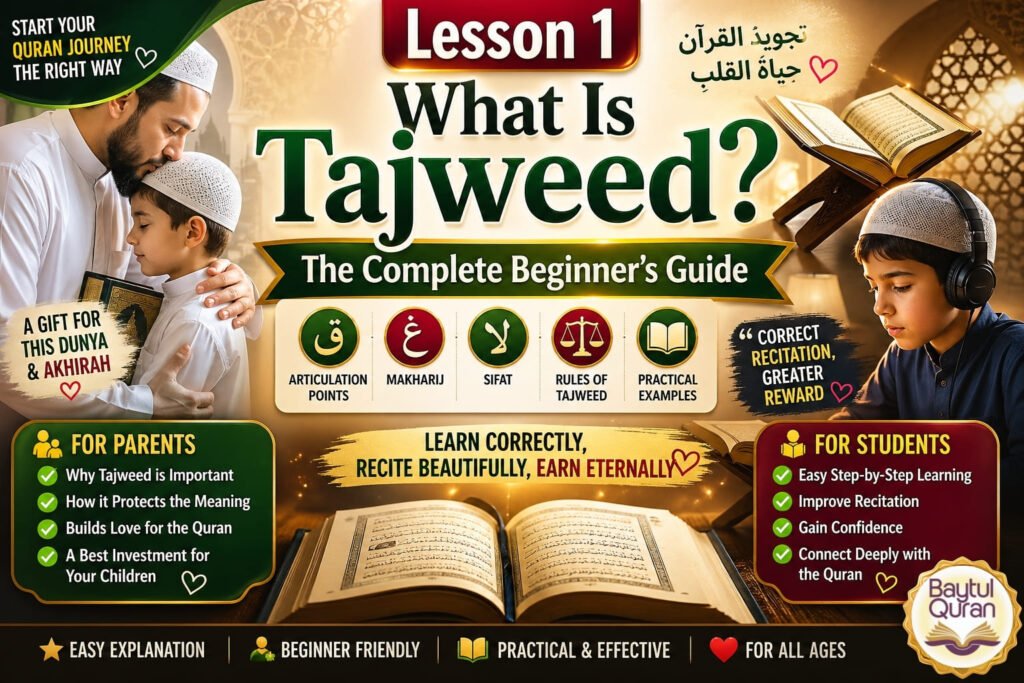
Introduction
Every parent has heard the word “Tajweed” but most have never had someone sit down and explain what it actually means, why it matters, and what happens when it’s missing from your child’s Quran recitation.
Here’s the truth: millions of Muslims around the world recite the Quran daily with love, with devotion, with the best of intentions but with errors they don’t even know they’re making. Not because they don’t care. But because nobody ever properly taught them what Tajweed is, or why Allah (SWT) made it obligatory.
This guide changes that.
Whether you’re a parent looking to enrol your child in Quran classes, an adult wanting to correct your own recitation, or simply someone who wants to understand this beautiful science you’ll find everything you need right here. We’ll cover what Tajweed means, why it’s a religious obligation, the key rules every beginner should know, and how your family can start learning today, insha’Allah.
Let’s begin.
📋 IN THIS ARTICLE:
- What Does Tajweed Mean?
- Why Is Tajweed Obligatory in Islam?
- What Happens If You Recite Without Tajweed?
- The Key Tajweed Rules Every Beginner Should Know
- What Age Should Children Start Learning Tajweed?
- How Long Does It Take to Learn Tajweed?
- How to Choose the Right Tajweed Teacher
- Frequently Asked Questions
- Conclusion
What Does Tajweed Mean?
The word Tajweed (تجويد) comes from the Arabic root j-w-d meaning to improve, to make better, to do something with excellence.
In the context of the Quran, Tajweed is the complete set of rules that govern how every letter, word, and verse of the Quran should be correctly pronounced and recited. It covers everything from where a sound originates in the mouth and throat, to how long a vowel is held, to when a letter is merged, softened, or made to vibrate.
In simple terms: Tajweed is the science of reciting the Quran exactly as the Prophet Muhammad ﷺ recited it the way it was revealed by Allah (SWT) through Jibreel (AS).
It is not an optional extra. It is not just for scholars or Huffaz. It is the standard of recitation that every Muslim is expected to strive toward.
📖 QURAN
“And recite the Quran with measured recitation.” = Surah Al-Muzzammil, 73:4
The Arabic word used in this verse is tarteel which the scholars of Quran unanimously explain as reciting with Tajweed: slow, precise, and with each letter given its full right.
This single verse is the foundation of the entire science of Tajweed.
The Meaning of Tajweed in Practice
When we say someone recites “with Tajweed,” we mean they are:
- Pronouncing every Arabic letter from its correct point of articulation (Makhraj)
- Giving each letter its essential characteristics (Sifaat)
- Applying rules of nasalisation (Ghunnah), elongation (Madd), and merging (Idghaam) correctly
- Maintaining the natural rhythm and flow of the Quranic text
This is not just a technical exercise. When you hear a skilled Qari recite the Quran with full Tajweed, you feel it. There is a beauty, a precision, and a presence in the recitation that moves the heart in a way that nothing else can.
Why Is Tajweed Obligatory in Islam?
This is one of the most important questions a Muslim can ask and the answer is clear.
The scholars of Islam are in unanimous agreement: applying Tajweed to the recitation of the Quran is a religious obligation (Fard). Not a recommendation. Not a preference. An obligation.
Imam Ibn Al-Jazari, one of the greatest Quran scholars in Islamic history, wrote in his famous poem on Tajweed:
“Applying Tajweed is an issue of absolute necessity whoever does not apply Tajweed to the Quran has sinned.”
This is a powerful statement. But it comes with an important nuance that every beginner needs to understand.
💡 DID YOU KNOW?
There are two levels of Tajweed obligation. Knowing the rules theoretically is Fard Kifayah (communal duty). Applying them in recitation is Fard Ayn obligatory on every single Muslim.
Why Did Allah Preserve Tajweed?
The Quran is the literal Word of Allah (SWT). Every letter carries meaning. Every sound was chosen deliberately. The rules of Tajweed exist to protect that meaning to ensure that what you recite is exactly what was revealed, and that no error in pronunciation changes or distorts the intended message.
Arabic is a language where a single mispronounced letter can change the meaning of a word entirely. Tajweed is the shield that protects the Quran from that distortion.
This is why the science of Tajweed has been preserved in an unbroken chain of transmission from the Prophet ﷺ, through the Sahabah, through generations of scholars, all the way to the certified teachers teaching your children today.
What Happens If You Recite Without Tajweed?
Many Muslims feel anxious when they first learn that Tajweed is obligatory. If you’ve been reciting without proper Tajweed for years or if your child has please read this section carefully.
There is a crucial distinction in Islamic scholarship between two types of recitation errors:
1. Al-Lahn Al-Jali Clear, Obvious Error This is a mistake that changes the meaning of the Quran, such as mispronouncing a letter so severely that one Arabic letter sounds like a completely different one. Scholars agree this type of error is forbidden and must be corrected.
2. Al-Lahn Al-Khafi Hidden, Subtle Error This is a mistake in applying the finer rules of Tajweed such as not fully applying Ghunnah or slightly shortening a Madd. This is disliked but does not change meaning.
⚠️ COMMON MISTAKE
Many parents assume their child is “reading fine” because they can get through the Quran. But reading without Tajweed and reading correctly are two very different things. A qualified teacher can identify errors that untrained ears will completely miss.
The good news? Allah (SWT) rewards the effort. The Prophet ﷺ said:
“The one who recites the Quran proficiently will be with the noble, righteous angels. And the one who recites it with difficulty, stammering through it, will have two rewards.” Sahih Muslim
No Muslim who sincerely tries to improve their recitation is left without reward. The obligation is to try, to learn, and to keep improving not to be perfect from day one.
Book a free Tajweed trial class “If you’re not sure about the level of your child’s recitation, the best first step is to book a free Tajweed trial class with one of our certified teachers.”
The Key Tajweed Rules Every Beginner Should Know
You don’t need to memorise every rule before you start. But having a basic map of what Tajweed covers helps you understand what you or your child will be learning. Here are the foundational areas:
1. Makharij Al-Huruf Points of Articulation
Every Arabic letter has a specific place in the mouth, throat, or lips where it is produced. This is called its Makhraj (plural: Makharij).
There are 17 articulation points across 5 main areas: the throat (Halq), the tongue (Lisaan), the lips (Shafataan), the nasal passage (Khayshoom), and the oral cavity (Jawf).
Many pronunciation errors especially for non-native Arabic speakers come from producing letters from the wrong place entirely. For example, the Arabic letter ع (Ayn) has no equivalent in English. Without a teacher demonstrating the correct Makhraj, most students will approximate it incorrectly for years.
2. Noon Sakinah and Tanween Rules
When the letter Noon (ن) appears without a vowel (Noon Sakinah), or when Tanween (double vowel ending) appears, four different rules can apply depending on the letter that follows:
- Idhar — clear pronunciation (6 throat letters follow)
- Idghaam — merging into the next letter (6 letters follow)
- Iqlab — converting the Noon into a Meem sound (only ب follows)
- Ikhfa — partial hiding with nasalisation (15 remaining letters)
This is one of the first major rule sets students learn and one of the most satisfying to master.
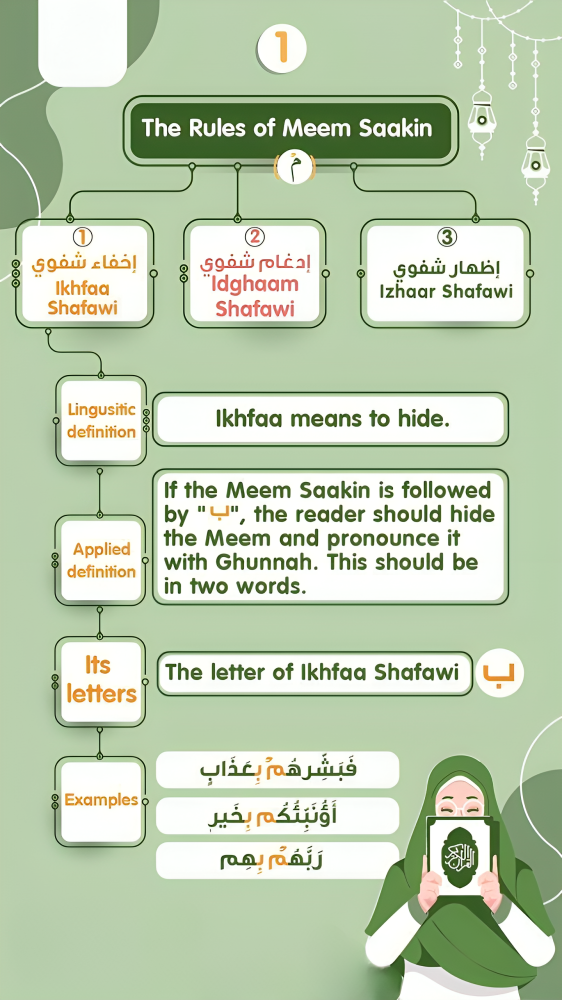
3. Meem Sakinah Rules
Similar to Noon Sakinah, the letter Meem (م) without a vowel also has three rules:
- Idghaam Shafawi — merging when followed by another Meem
- Ikhfa Shafawi — hiding when followed by ب
- Idhar Shafawi — clear pronunciation before all other letters
4. Madd — Rules of Elongation
Madd refers to the elongation (stretching) of vowel sounds in the Quran. There are multiple types of Madd some mandatory, some permissible and each has a specific duration measured in Harakaat (counts).
Getting Madd wrong is one of the most common errors in amateur recitation. Some students stretch vowels for too long; others cut them short. A qualified teacher trains the ear and voice together until the correct length becomes natural.
⚡ QUICK TIP
When you first start learning Tajweed, focus on Makharij first. Correct letter origins make every other rule easier to build on top of.
5. Qalqalah — The Echo Letters
Qalqalah refers to a slight bouncing or echoing sound produced when certain letters appear with a Sukoon (no vowel). The five Qalqalah letters are collected in the phrase: ق ط ب ج د (Qutb Jad).
This is one of the most recognisable features of beautiful Quran recitation and one that even beginner students can hear clearly once they know what to listen for.
6. Ghunnah — Nasalisation
Ghunnah is the nasal sound produced through the nasal passage, lasting approximately two counts. It applies to the letters Noon (ن) and Meem (م) in specific situations and it is one of the defining sounds of Quranic recitation that gives it that unmistakable resonance.
International Quran recitation standards Adds credibility by linking to an established Quran learning resource that supports the importance of Tajweed rules
🌟 READY TO START YOUR QURAN JOURNEY?
Join hundreds of students across all over the world learning Quran online with certified teachers.
✅ Free trial class no commitmen
✅ Expert teachers with Ijazah
✅ Flexible timings for your timezone
👉 Book Your Free Trial on WhatsApp
Message us : +92 300 8737779 Or visit: baytulquran.com
What Age Should Children Start Learning Tajweed?
This is one of the questions we hear most often from parents and the answer may surprise you.
Children can begin their Tajweed journey as early as age 4 or 5. At this stage, they won’t be studying rules formally. Instead, they learn through repetition, listening, and imitation which is actually the most powerful way the human brain acquires correct pronunciation.
Young children’s ears and tongues are extraordinarily receptive. A 5-year-old who hears correct Makharij modelled by a skilled teacher will naturally begin to reproduce those sounds often more accurately than adults who have to consciously unlearn years of incorrect habits.
Here’s a general age roadmap:
Ages 4–6: Begin with Noorani Qaida learning Arabic letters, their sounds, and basic joining rules. This is the essential foundation before any Tajweed work begins.
Ages 7–10: Begin structured Tajweed rules Noon Sakinah, Meem Sakinah, Madd, Qalqalah alongside continued Quran reading practice.
Ages 11+: Deeper Tajweed study, working toward fluent recitation of the entire Quran with full Tajweed applied.
Adults: It is never too late. Thousands of adults learn Tajweed from scratch every year and reach a beautiful standard of recitation. The journey is longer than starting young, but every step is immensely rewarding.
💡 DID YOU KNOW?
Research in linguistics shows that children who are exposed to correct pronunciation before age 7 develop a near-native accuracy that is very difficult to achieve if learning begins in adolescence or adulthood.
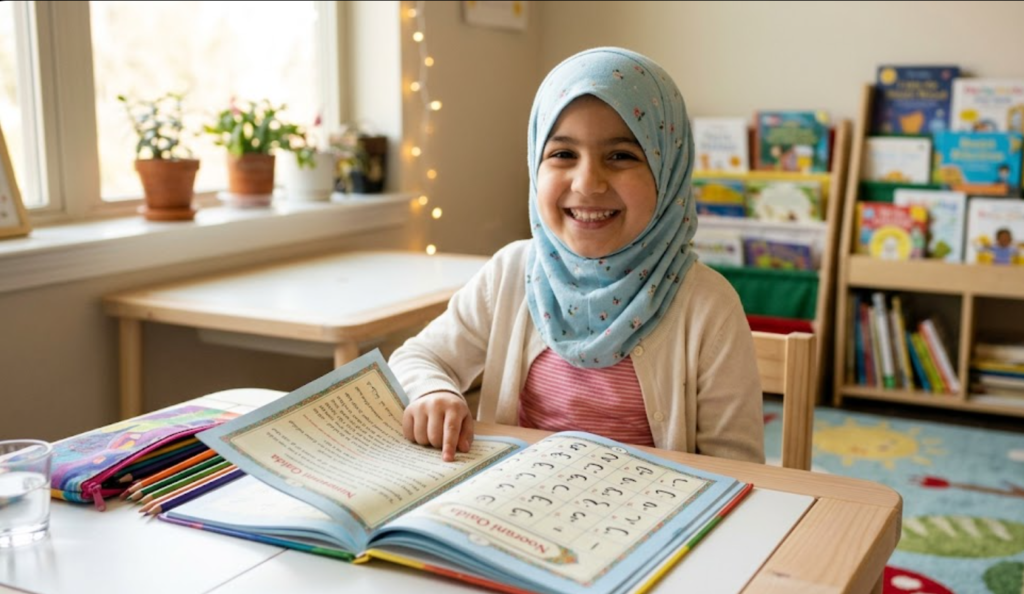
Starting early with Noorani Qaida gives children the strongest foundation for lifelong Tajweed.
Noorani Qaida course for young beginners Baytul Quran Academy, our Noorani Qaida course for young beginners is specifically designed to prepare children for Tajweed study in the most gentle and effective way possible.”
How Long Does It Take to Learn Tajweed?
There is no single answer because Tajweed is not a destination. It is a lifelong practice of refinement and beautification. But here are realistic timelines for different goals:
To learn the core rules (theory): 3–6 months of consistent study
To apply rules correctly in recitation (practice): 1–2 years of regular classes and practice
To recite the full Quran with Tajweed fluently: 2–4 years depending on starting level, age, and practice consistency
To reach the level of Ijazah (certified transmission): Several years of intensive study under a qualified Shaykh
The most important factor is not talent it is consistency. Two 30-minute sessions per week with a qualified teacher, combined with daily personal practice, will transform a student’s recitation beyond recognition within a year.
⚡ QUICK TIP
The single biggest mistake students make is practising incorrectly between classes. A few minutes of supervised, correct practice beats hours of unsupervised repetition of the same errors.
How to Choose the Right Tajweed Teacher
Not all Quran teachers are equal and when it comes to Tajweed specifically, the qualifications of your teacher matter enormously.
Here is what to look for:
✅ Ijazah — The Gold Standard
An Ijazah is a formal certification that grants a teacher the authority to teach the Quran. It represents an unbroken chain of transmission going back to the Prophet ﷺ himself. A teacher with Ijazah has not just studied Tajweed they have been examined, corrected, and certified by a qualified scholar in a chain that connects to the original source.
When choosing a Quran teacher for your child or yourself, always ask: Do you hold an Ijazah?
✅ Teaching Experience With Children
Teaching Tajweed to adults is very different from teaching it to children. Look for a teacher who has specific experience working with young learners someone who knows how to keep children engaged, patient, and motivated through the early stages.
✅ A Structured Curriculum
A good Tajweed teacher follows a structured progression from Makharij to basic rules to applied recitation. Avoid teachers who jump between topics randomly or have no clear syllabus.
✅ Regular Feedback and Progress Reports
Parents should receive regular updates on their child’s progress. If you don’t know what your child is learning week to week, something is missing.
“At Baytul Quran Academy, all our teachers are certified with Ijazah and trained by award-winning Qari Muhammad Abdullah so you can be completely confident in the quality of your child’s education.”
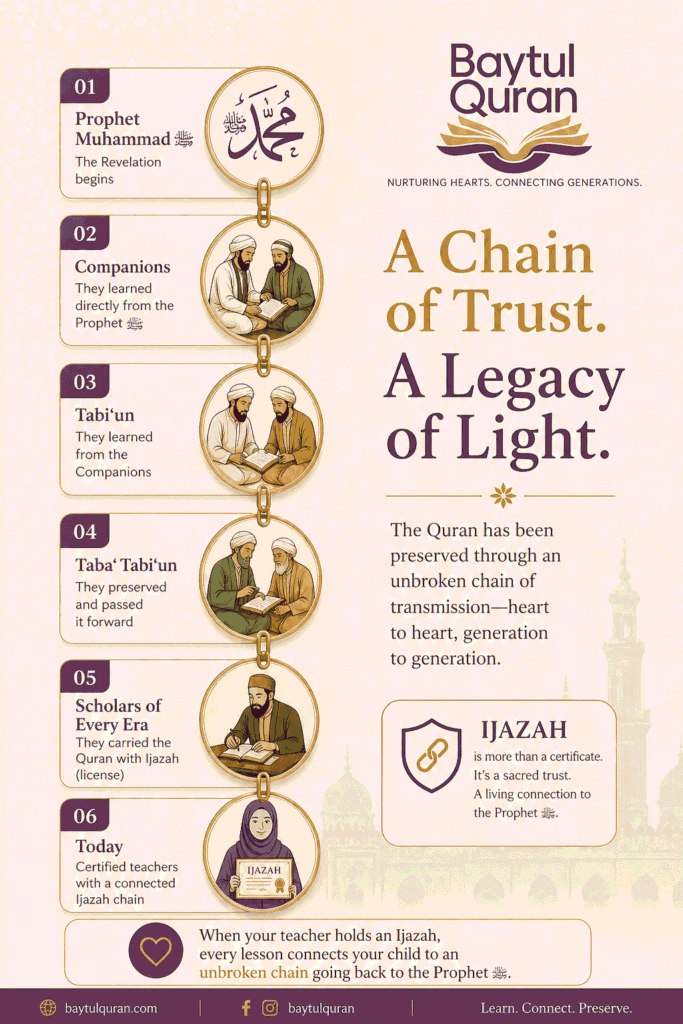
Hadith on the rewards of Quran recitation
Frequently Asked Questions
Q: What is Tajweed in simple words? A: Tajweed is the set of rules that govern the correct pronunciation and recitation of the Quran. The word itself means “to do something with excellence” in Arabic. In practice, Tajweed ensures that every letter of the Quran is pronounced from the right place, held for the right duration, and recited in the way the Prophet Muhammad ﷺ recited it. You can explore this in detail with a certified teacher at Baytul Quran Academy your first class is completely free.
Q: Is learning Tajweed obligatory for all Muslims? A: Yes the scholars of Islam are unanimous that applying Tajweed to your Quran recitation is an obligation (Fard Ayn) on every Muslim. This doesn’t mean you must be perfect immediately; it means you are required to make a genuine effort to learn and improve. Allah rewards the sincere effort, and the Prophet ﷺ told us that even the one who struggles with recitation receives a double reward.
Q: What age should my child start learning Tajweed? A: Children can begin their Quran journey as early as age 4 with Noorani Qaida, which builds the foundation for Tajweed. Formal Tajweed rule study typically begins around age 7. Starting young gives children a significant advantage their ears and tongues are naturally receptive to correct Arabic pronunciation at this stage. At Baytul Quran Academy, we offer classes tailored to every age group.
Q: How long does it take to learn Tajweed? A: Most students learn the core Tajweed rules within 3–6 months. Applying those rules fluently during Quran recitation typically takes 1–2 years of regular practice. The timeline varies depending on age, starting level, and how consistently the student practises between classes. With dedicated teachers and regular sessions, progress at Baytul Quran Academy is structured and measurable.
Q: Can adults learn Tajweed if they’ve been reciting incorrectly for years? A: Absolutely and this is more common than you might think. Many adult Muslims come to us having recited for decades without proper Tajweed. With a qualified teacher, a structured approach, and consistent practice, adults make remarkable progress. It takes patience to unlearn old habits, but the transformation in recitation quality is genuinely life-changing. Book your free trial class and see for yourself.
Q: How much do online Tajweed classes cost? A: At Baytul Quran Academy, we offer flexible and affordable online Tajweed classes for both children and adults. The best way to understand our pricing and find the right plan for your family is to visit our fees page or reach out directly on WhatsApp. And remember your very first 3 classes are always free, with no commitment required.
Conclusion
Tajweed is not just a set of rules it is your connection to the Quran as it was meant to be recited. It is the science that has preserved the Word of Allah (SWT) in its purest form across fourteen centuries. And it is one of the most profound gifts you can give your child, or yourself.
Whether you’re just beginning to understand what Tajweed is, or you’ve known for years that your recitation needs work the most important step is the next one. Find a qualified teacher. Commit to the journey. Trust that every moment spent learning to recite the Quran correctly is an investment that pays rewards in this life and the next.
At Baytul Quran Academy, we make that journey accessible, structured, and genuinely joyful for students of all ages from young children taking their first steps with Noorani Qaida, to adults ready to finally recite with the Tajweed they always wished they had.
JazakAllah Khair for reading. Your first class is waiting and it’s free.
📖 BEGIN YOUR QURAN JOURNEY TODAY Taught Expert Teachers
✦ Tajweed
✦ Hifz
✦ Noorani Qaida
✦ Tafseer
✦ Quran Reading
All over the world
💬 WhatsApp: +44 7842 064721 || +923008737779
🌐https://baytulquran.com/ 📱 @baytulquran_1
First 3 classes are FREE. Always.

One Response