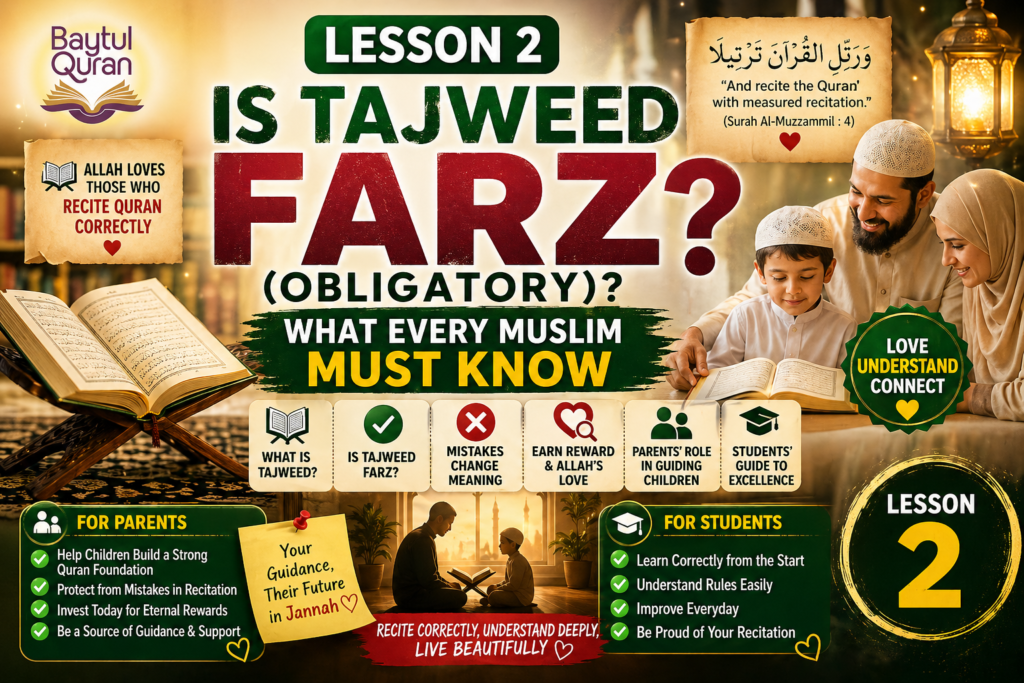
Introduction
Here is a question that has quietly unsettled Muslim hearts for generations: If I have been reciting the Quran my whole life without proper Tajweed, have I been sinning?
It is an honest question. And it deserves an honest, complete, and compassionate answer not a one-line fatwa, and not a vague reassurance that everything is fine.
The reality is that Tajweed is not a bonus feature of Quran recitation. It is not reserved for scholars, Huffaz, or professional Qaris. The ruling on Tajweed in Islam is clear, it is ancient, and it is unanimous among the scholars, and every Muslim deserves to understand it fully.
In this article, we go deep into the Islamic ruling on Tajweed. We will cover what the Quran itself says, what the Prophet ﷺ demonstrated through his own recitation, what Imam Ibn Al-Jazari declared in his famous verse, how scholars distinguish between different levels of obligation, and most importantly, what this ruling practically means for you, your children, and for non-Arabs and new Muslims navigating this question today.
This is the article you needed before anyone else explained Tajweed to you.
📋 IN THIS ARTICLE:
- What Does “Obligatory” Mean in Islamic Law?
- What the Quran Says About Tajweed
- What the Prophet ﷺ Demonstrated
- Fard Ayn vs Fard Kifayah The Critical Distinction
- Imam Ibn Al-Jazari’s Famous Ruling
- What Scholars Say About Reciting Without Tajweed
- The Practical Ruling for Non-Arabs and New Muslims
- What This Means for You and Your Family Today
- Frequently Asked Questions
- Conclusion
What Does “Obligatory” Mean in Islamic Law?
Before we discuss the ruling on Tajweed specifically, it is worth grounding ourselves in what Islamic scholars mean when they use the word Fard obligatory.
In Islamic jurisprudence (Fiqh), actions are divided into five categories:
- Fard / Wajib —> Obligatory. Leaving it without excuse is sinful.
- Mustahabb / Sunnah —> Recommended. Doing it earns reward; leaving it earns no sin.
- Mubah —> Permitted. Neither rewarded nor punished.
- Makruh —> Disliked. Doing it earns no reward; leaving it earns reward.
- Haram —> Forbidden. Doing it is sinful.
When scholars declare something Fard, they are not speaking lightly. They are placing it in the highest category of Islamic obligation, the same category as Salah, fasting in Ramadan, and paying Zakat.
So when we say that Tajweed is obligatory, this is precisely the category being referred to.
💡 DID YOU KNOW?
Islamic scholars further divide Fard into two types:
Fard Ayn —> obligatory on every individual Muslim, and Fard Kifayah —> obligatory on the community collectively. Understanding which category Tajweed falls into changes everything.
What the Quran Says About Tajweed
The obligation of Tajweed does not begin with the scholars. It begins with the direct command of Allah (SWT) in the Quran itself.
📖 QURAN:
“And recite the Quran with measured recitation (tarteel).” Surah Al-Muzzammil, 73:4
The word used here, tarteel, is not a casual suggestion. It is a direct divine command in the imperative form. The great Quranic commentators, including Ibn Kathir and Al-Qurtubi, explained tarteel as reciting the Quran slowly, clearly, and with each letter given its full right, which is precisely the definition of Tajweed.
This verse alone establishes that the manner of Quran recitation is not left to personal preference. Allah (SWT) specified how His Book should be recited. That specification is Tajweed.
There is a second verse that the scholars reference:
📖 QURAN:
“Those to whom We gave the Book recite it as it truly deserves to be recited.” Surah Al-Baqarah, 2:121
The phrase “as it truly deserves to be recited,” یَتْلُوْنَهٗ حَقَّ تِلَاوَتِهٖؕ (yatloonahu haqqa tilawatih) is understood by scholars as referring to recitation with Tajweed, with understanding, and with acting upon its commands. Tajweed is the first and foundational layer of giving the Quran its true right in recitation.
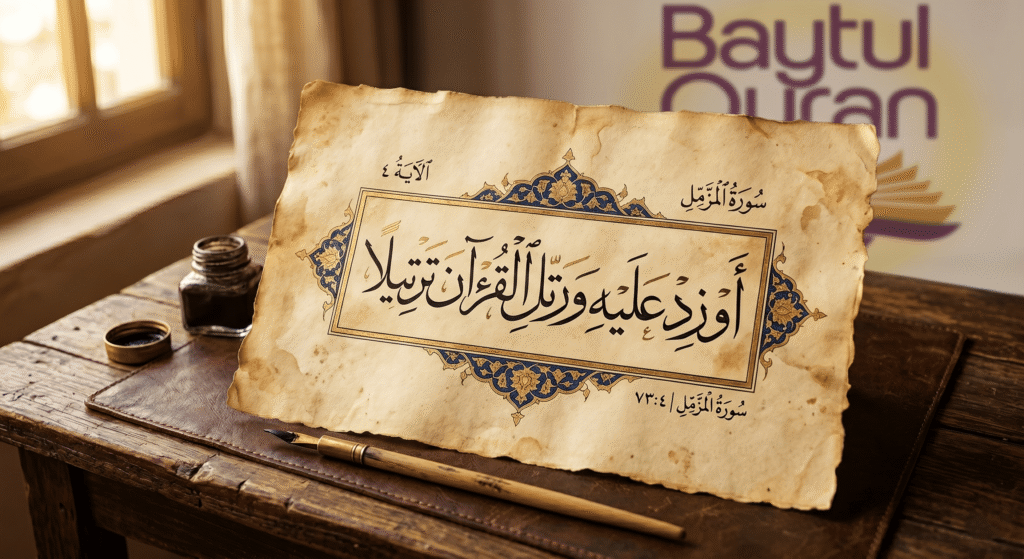
“Recite the Quran with measured recitation.” The divine command that forms the foundation of Tajweed’s obligation.
What the Prophet ﷺ Demonstrated
The Quran commanded tarteel. The Prophet ﷺ showed us what that looks like in practice.
The companions of the Prophet ﷺ described his recitation in detail. Sayyidah Aisha (RA) was asked about how the Prophet ﷺ recited the Quran. She said:
“He would recite a verse, prolonging it, then he would recite another, prolonging it.”
Every rule of Tajweed we know today, the elongations, the nasalisations, the precise articulation points, trace back to the Prophet’s own recitation, which he received directly from Jibreel (AS), who received it from Allah (SWT).
This is the concept of tawatur, the mass-transmitted, unbroken chain of Quranic recitation that has been passed from teacher to student, generation to generation, in an unbroken line for over 1400 years. Tajweed is not a later invention or scholarly addition. It is the living preservation of how the Quran was first recited.
📖 HADITH
“The one who is proficient in reciting the Quran will be with the noble, righteous angels.” Sahih Muslim 798
The word maahir used in this hadith, translated as “proficient,” refers specifically to one who recites with skill and correctness, which the scholars understand as recitation with Tajweed.
Fard Ayn vs Fard Kifayah The Critical Distinction
This is the most important distinction in the entire discussion of Tajweed’s obligation, and it is the one that most Muslims have never had clearly explained to them.
Islamic scholars divide the obligation of Tajweed into two separate levels:
Level One Fard Kifayah: Knowing the Rules of Tajweed
Learning Tajweed as a formal science, understanding the rules, their names, their categories, and their theoretical basis is Fard Kifayah. This means it is a collective obligation on the Muslim community.
As long as a sufficient number of qualified Tajweed scholars and teachers exist in the community, the obligation is fulfilled collectively. Not every Muslim is required to become a Tajweed scholar or memorise every rule by name.
Level Two Fard Ayn: Applying Tajweed in Recitation
Applying Tajweed correctly when reciting the Quran is Fard Ayn. This means it is an individual obligation on every single Muslim man or woman, Arab or non-Arab, scholar or layperson.
Every Muslim who recites the Quran is obligated to apply Tajweed to the best of their ability. This is not negotiable. It is not waived by being a non-Arab. It is not waived by being a beginner. It is an ongoing personal obligation that every Muslim must sincerely strive to fulfil.
⚠️ COMMON MISTAKE
Many Muslims hear that Tajweed is “Fard Kifayah” and conclude it is therefore optional for them personally. This is a serious misunderstanding. The Fard Kifayah applies only to mastering the theoretical science. Applying Tajweed in your own recitation is Fard Ayn, personal and non-negotiable.
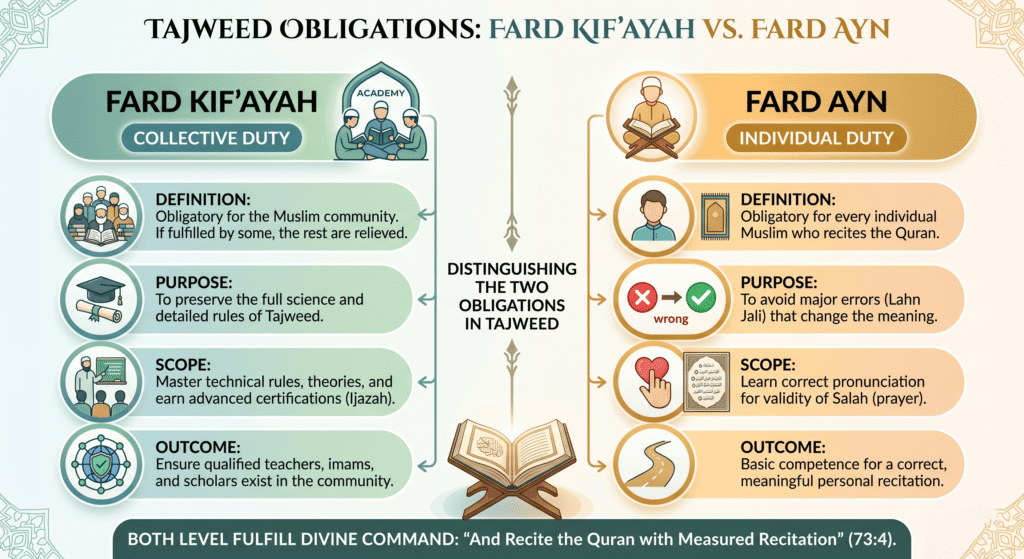
Understanding the difference between these two levels of obligation is the key to understanding the Islamic ruling on Tajweed.
Imam Ibn Al-Jazari’s Famous Ruling
No discussion of the Islamic ruling on Tajweed is complete without Imam Ibn Al-Jazari and his famous verse that every student of the Quran eventually encounters.
Imam Muhammad Ibn Al-Jazari (1350–1429 CE) was one of the greatest Quran scholars in Islamic history. He was the foremost authority on the Ten Qiraat, author of the landmark works Al-Nashr fil Qiraat Al-Ashr and Al-Muqaddimah Al-Jazariyyah, and a scholar whose authority on Quranic sciences remains unmatched to this day.
In his famous poem Al-Jazariyyah, a foundational text studied in every serious Quran institute in the world, he wrote the following verse on the obligation of Tajweed:
📖 IBN AL-JAZARI
AL-JAZARIYYAH وَالأَخْذُ بِالتَّجْوِيدِ حَتْمٌ لازِمُ
مَنْ لَمْ يُجَوِّدِ القُرْآنَ آثِمُ “And applying Tajweed is an absolute necessity. Whoever does not apply Tajweed to the Quran has sinned.” Imam Ibn Al-Jazari, Al-Muqaddimah Al-Jazariyyah
Read those words again. “Whoever does not apply Tajweed to the Quran has sinned.”
This is not a minor scholarly opinion. This is the declared position of the greatest Quran scholar of the last millennium, and it represents the consensus of Islamic scholarship on this question.
Imam Ibn Al-Jazari then immediately adds a crucial and compassionate qualification because he was not only a scholar, but a teacher who understood the journey of the student:
“Because with it, with Tajweed, did Allah reveal the Quran, and thus did it reach us from Him.”
The obligation of Tajweed is rooted in the Quran itself. The Quran was revealed with Tajweed. It was transmitted with Tajweed. And it must be recited with Tajweed because anything less is a departure from how Allah (SWT) chose to send His Word to humanity.
What Scholars Say About Reciting Without Tajweed
Ibn Al-Jazari’s ruling is clear, but what do contemporary and classical scholars say in more practical terms? And what exactly constitutes a punishable error?
The scholars make a consistent and important distinction between two categories of recitation error:
Al-Lahn Al-Jali —> The Grave Error
Al-Lahn Al-Jali refers to a clear, obvious mistake that changes the meaning of the Quran. Examples include:
- Pronouncing the letter ض (Daad) as a ظ (Dha) in a context where it changes meaning
- Changing a short vowel (harakat) so that the grammatical meaning of a verse is altered
- Replacing one Arabic letter with a completely different one due to incorrect articulation
The ruling: Forbidden. All four major schools of Islamic jurisprudence agree that committing Al-Lahn Al-Jali deliberately is sinful. Some scholars add that leading others in Salah while committing such errors can invalidate the prayer of those following.
Al-Lahn Al-Khafi —> The Hidden Error
Al-Lahn Al-Khafi refers to subtle errors in the application of Tajweed rules, such as slightly shortening a Madd that should be elongated, or not applying full Ghunnah where the meaning of the Quran is not changed.
The ruling: Disliked (Makruh) but not sinful at the same level. This is the area where sincere effort and ongoing learning fulfil the obligation. A Muslim who is genuinely striving to apply Tajweed correctly, making small imperfections along the way, is not in the category of one who is sinning.
💡 DID YOU KNOW?
Many scholars note that the sin described by Ibn Al-Jazari applies to one who recites without Tajweed while having the ability to learn it. The Muslim who genuinely cannot access proper Tajweed education but sincerely tries is in a completely different position in the eyes of Allah (SWT).
Book a free trial Tajweed class. “If you are concerned about the level of your own recitation or your child’s, the most practical first step is to book a free trial Tajweed class with a certified teacher who can identify exactly where improvements are needed.”
🌟 READY TO FULFIL YOUR OBLIGATION?
Join hundreds of students all over the world learning the Quran online with certified teachers.✅ Free trial class no commitment ✅ Expert teachers with Ijazah ✅ Flexible timings for your timezone 👉 Book Your Free Trial on WhatsApp —> +923008737779 Or visit: baytulquran.com
The Practical Ruling for Non-Arabs and New Muslims
This is perhaps the most sensitive and most frequently misunderstood aspect of the entire discussion, and it affects the majority of Muslims living in the UK, USA, Australia, and Europe.
Does the obligation of Tajweed apply to non-Arabs?
The answer from the scholars is: Yes but with mercy, understanding, and a realistic pathway.
The obligation does not disappear because Arabic is not your mother tongue. But the scholars are clear that the standard of accountability is tied to one’s ability and access to learning. Allah (SWT) says in the Quran:
📖 QURAN
“Allah does not burden a soul beyond that which it can bear.” Surah Al-Baqarah, 2:286
Based on this principle, the scholars outline the following practical ruling for non-Arabs and new Muslims:
1. The obligation exists, but so does the pathway. A non-Arab Muslim is obligated to make a sincere, sustained effort to learn correct Tajweed. The obligation is not to be instantly perfect, it is to genuinely try, to seek a qualified teacher, and to keep improving.
2. During the learning journey, Allah rewards the effort. The famous hadith of the Prophet ﷺ applies here directly: “The one who recites the Quran and struggles with it will have two rewards.” Sahih Muslim. Every difficult sound, every corrected letter, every hour spent in Tajweed class is an act of worship being rewarded by Allah (SWT).
3. Deliberate neglect is different from genuine inability. The scholar who is sinning is not the new Muslim who cannot yet pronounce the letter ع (Ayn) correctly. The one described as sinning is the Muslim who has the means to learn, has access to qualified teachers, and deliberately chooses not to make any effort whatsoever.
4. New Muslims have a period of learning. Scholars universally acknowledge that new Muslims have a grace period in which they are learning the basics of Islam. Tajweed is part of their ongoing journey, not a standard they must meet before they are permitted to recite.
QUICK TIP
If you are a non-Arab Muslim concerned about your Tajweed, start with Makharij, the articulation points of Arabic letters. Correct letter origins are the single most impactful first step for any non-native Arabic speaker.
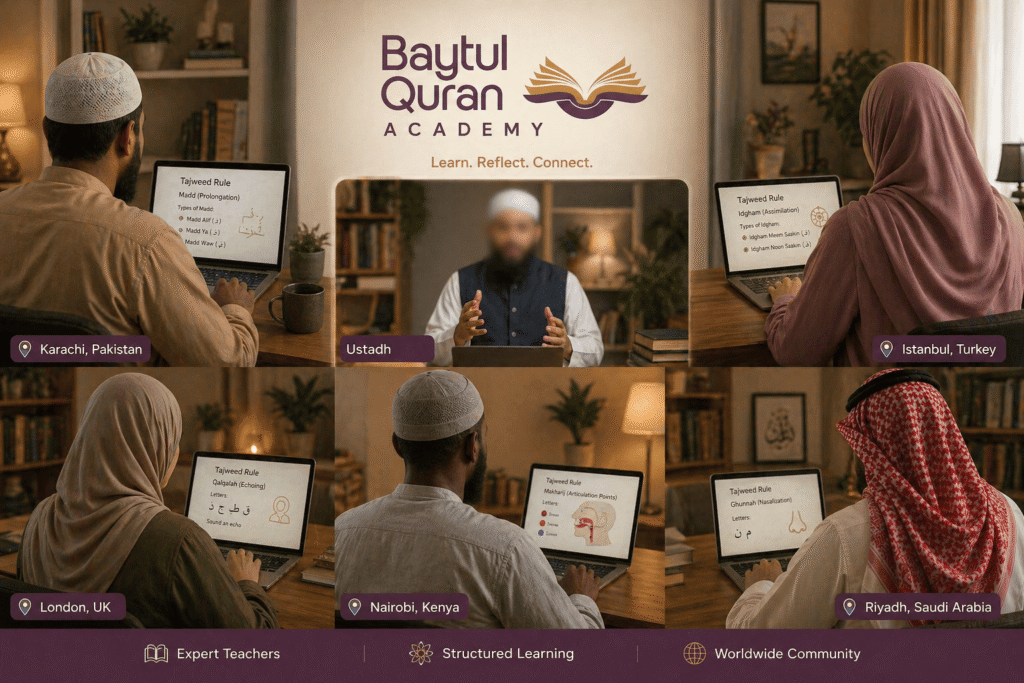
The obligation of Tajweed applies to every Muslim, and the journey to fulfil it is open to everyone, regardless of background.
The Hadith on rewards for struggling with Quran recitation : The virtue of the one who is skilled in reciting Qur’an and the one who falters in reciting
What This Means for You and Your Family Today
We have covered the ruling. Now let us talk about what it actually means for real Muslim families living in the West today.
If you are a parent: the most important Quran education decision you will ever make for your child is not which school they attend or which career they pursue. It is whether they learn to recite the Word of Allah (SWT) correctly. A child who learns Tajweed properly from a young age carries that connection to the Quran for the rest of their life. A child who learns to recite without Tajweed may spend decades later trying to undo ingrained mistakes.
If you are an adult: It is never too late. The fact that you are reading this article is itself evidence of the sincerity in your heart. Thousands of adult Muslims in their 30s, 40s, 50s, and beyond have transformed their Quran recitation through structured Tajweed classes. The journey is longer than starting young, but every step of it is worship.
If you are already reciting daily: Ask yourself honestly: have you ever had your recitation evaluated by a qualified teacher with Ijazah? Many Muslims recite Quran for decades and never have a single session of proper correction. One evaluation session with a qualified teacher can reveal errors you have been making your entire life — and give you a clear roadmap to correct them.
Learn about our certified teachers at Baytul Quran Academy. “At Baytul Quran Academy, all our teachers hold Ijazah and are trained to identify and gently correct recitation errors at every level from absolute beginners to those with years of Quran study behind them.”
View our Tajweed courses details and fees. “If you are ready to take that step for yourself or your child, view our Tajweed course details and fees and remember that your first 3 classes are always free.”
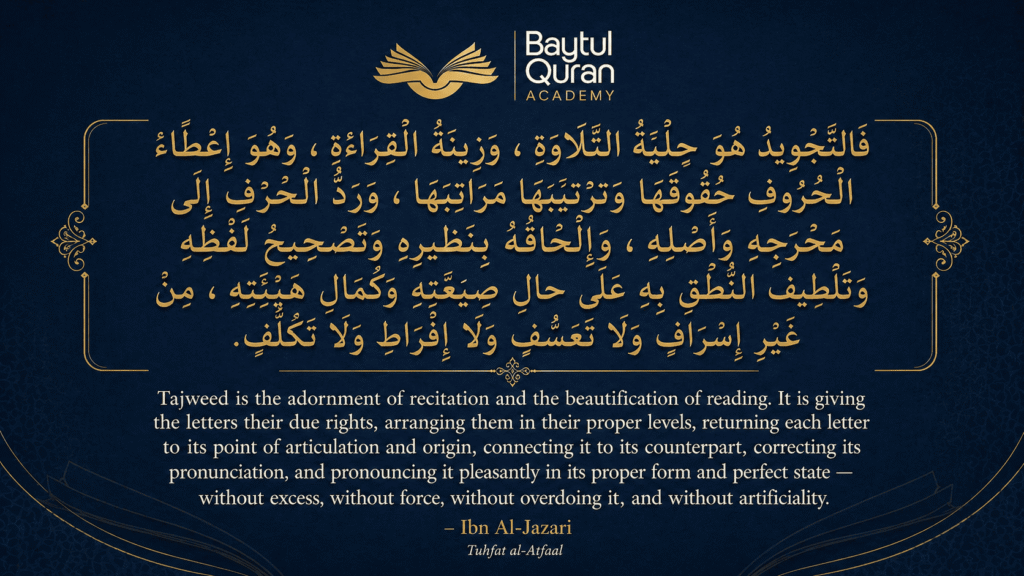
The words of Imam Ibn Al-Jazari, the greatest Quran scholar of the last millennium, leave no ambiguity on the ruling of Tajweed.
The four major schools of Islamic jurisprudence on Quran recitation, according to IslamQA, one of the most trusted Islamic fatwa resources globally, for scholarly backing on the ruling of Tajweed
Frequently Asked Questions
Q: Is Tajweed obligatory (Fard) for every Muslim? A: Yes, applying Tajweed in your Quran recitation is Fard Ayn, meaning it is an individual obligation on every Muslim. This is the unanimous position of Islamic scholars across all four major schools of jurisprudence, supported by the direct Quranic command in Surah Al-Muzzammil and the famous ruling of Imam Ibn Al-Jazari. The obligation is to make a sincere, sustained effort to learn and apply Tajweed not to be perfect from day one.
Q: What is the difference between Fard Ayn and Fard Kifayah in Tajweed? A: Learning Tajweed as a formal academic science is Fard Kifayah, a collective community obligation fulfilled when qualified scholars exist. But applying Tajweed correctly in your personal recitation of the Quran is Fard Ayn, an individual obligation on every Muslim. Many people confuse these two levels, mistakenly concluding that Tajweed is optional for them personally. It is not.
Q: What did Imam Ibn Al-Jazari say about reciting without Tajweed? A: In his foundational text Al-Muqaddimah Al-Jazariyyah, Imam Ibn Al-Jazari wrote clearly: “And applying Tajweed is an absolute necessity; whoever does not apply Tajweed to the Quran has sinned.” He followed this by explaining that the obligation exists because the Quran was revealed with Tajweed and reached us through an unbroken chain of correct recitation. This ruling is considered the definitive scholarly statement on the obligation of Tajweed.
Q: Does the Tajweed obligation apply to non-Arabs and new Muslims? A: Yes, but with an important nuance. The obligation applies to all Muslims regardless of background, but the standard of accountability is proportional to ability and access. A non-Arab or new Muslim who is sincerely striving to learn correct Tajweed is fulfilling their obligation. The Prophet ﷺ promised a double reward for the one who struggles with recitation. Deliberate and complete neglect of Tajweed despite having access to teachers is what the scholars describe as sinful. You can begin your journey today with a free trial class at Baytul Quran Academy.
Q: If I have been reciting without Tajweed for years, what should I do? A: Make the intention to correct your recitation, seek a qualified teacher with an Ijazah as soon as possible, and begin the journey of improvement. Do not be paralysed by past errors. Allah (SWT) judges intention and effort. The fact that you are asking this question is already a sign of sincerity. Many students at Baytul Quran Academy come to us after years of reciting without Tajweed and see transformative improvement within months of structured classes.
Q: Can reciting without Tajweed invalidate my Salah? A: Scholars distinguish between errors that change meaning (Al-Lahn Al-Jali) and subtle errors (Al-Lahn Al-Khafi). Deliberate, meaning-changing errors in Salah can affect its validity according to many scholars, particularly for the Imam leading a congregation. Subtle Tajweed imperfections do not invalidate Salah but remain obligations to work toward correcting. A qualified teacher can assess your specific recitation and give you a clear, personalised ruling on this.
Conclusion
The Islamic ruling on Tajweed is not a matter of scholarly debate or personal interpretation. It is a question that has been answered clearly, consistently, and unanimously across fourteen centuries of Islamic scholarship from the direct command of Allah (SWT) in Surah Al-Muzzammil, to the unambiguous declaration of Imam Ibn Al-Jazari, to the consensus of every major school of Islamic jurisprudence.
Tajweed is obligatory in Islam. Applying it in your recitation is a personal, individual duty Fard Ayn on every Muslim who recites the Quran.
But this ruling is not meant to burden you. It is meant to motivate you. Every step you take toward learning Tajweed is an act of worship. Every corrected letter is a gift to yourself, to your children, and to the generations of Muslims who will learn from the example you set. The Prophet ﷺ promised special honour to those who are proficient in the Quran and double reward to those who struggle sincerely along the way.
Alhamdulillah, the path is open. The teachers are here. The first 3 classes are free.
May Allah (SWT) grant us all the ability to recite His Book as it was meant to be recited. Ameen.
📖 BEGIN YOUR QURAN JOURNEY TODAY Taught Expert Teachers
✦ Tajweed
✦ Hifz
✦ Noorani Qaida
✦ Tafseer
✦ Quran Reading
All over the world
💬 WhatsApp: +44 7842 064721 || +923008737779
🌐https://baytulquran.com/ 📱 @baytulquran_1
First 3 classes are FREE. Always.