Series Navigation: Lesson 1: What Is Tajweed? The Complete Beginner’s Guide https://baytulquran.com/what-is-tajweed/ Lesson 2: Is Tajweed Obligatory in Islam? What Every Muslim Must Know https://baytulquran.com/is-tajweed-obligatory-in-islam/ Lesson 3: You are here Makhaarij Al-Huroof for Beginners
Makhaarij Al-Huroof for Beginners
INTRODUCTION
Your child has been going to Quran class for months. They can get through the pages. They recognise the letters. Their teacher says they are making progress. But something still does not sound quite right, and you cannot put your finger on what it is.
Here is what is almost certainly happening. Your child is reading Arabic letters, but not necessarily producing them from the right place. And that difference, between reading a letter and truly articulating it, is exactly what Makhaarij Al-Huroof is about.
Makhaarij Al-Huroof, the exit points of Arabic letters, is the science of where every single Arabic letter originates inside the human mouth and throat. It is not an advanced topic reserved for scholars or professional Qaris. It is, in fact, the very first thing a serious Tajweed education addresses, because everything else in Tajweed, the rules of Noon Sakinah, Madd, Ghunnah, Qalqalah, all of it rests on this foundation. If the letters themselves are coming from the wrong place, no amount of rule-learning will produce correct recitation.
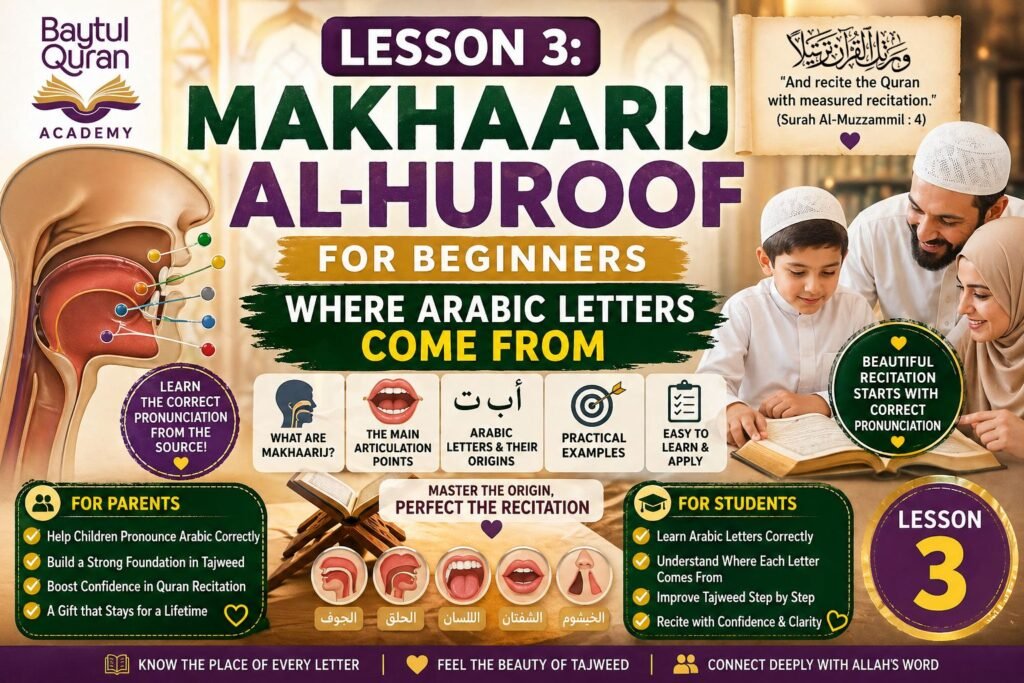
In this lesson, which is the third in our ongoing Tajweed series for Muslim families, we are going to cover exactly what Makhaarij Al-Huroof means, why it matters so deeply, how the five main articulation zones work, what the most common mistakes sound like, and how your family can begin correcting them today, insha’Allah.
Let us start from the very beginning.
IN THIS ARTICLE:
- What Does Makhaarij Al-Huroof Mean?
- Why Makhaarij Comes Before Everything Else in Tajweed
- The Five Main Articulation Zones Explained
- The Most Commonly Confused Letter Pairs
- How to Identify Your Own Articulation Mistakes
- What Makhaarij Means for Your Child’s Quran Education
- Frequently Asked Questions
WHAT DOES MAKHAARIJ AL-HUROOF MEAN?
The word Makhaarij is the plural of Makhraj, which comes from the Arabic root kh-r-j, meaning to exit or to emerge. Al-Huroof simply means the letters. So Makhaarij Al-Huroof translates directly as the exit points of the letters, or more precisely, the articulation points of the Arabic letters.
Every single letter of the Arabic alphabet has a specific, defined location in the human vocal tract from which it is supposed to emerge. That location might be deep in the throat, at the back of the tongue, at the tip of the tongue, between the teeth, or at the lips. The scholars of Tajweed identified and catalogued all of these points with extraordinary precision over centuries of scholarship, creating a complete phonetic map of the Arabic language that predates modern linguistics by more than a thousand years.
This is genuinely remarkable when you think about it. In a time before scientific instruments or phonetics as an academic discipline, Muslim scholars were mapping the exact position of the tongue, the degree of throat constriction, and the precise lip shape required for each Arabic letter. They did this because the Quran demanded it. The Word of Allah deserved nothing less than complete accuracy.
When we talk about Makhaarij Al-Huroof for beginners, we are not asking students to memorise complex anatomical diagrams from day one. We are asking them to begin developing awareness of where sound comes from in their own mouths and throats, and to start building the muscle memory that correct Tajweed requires.
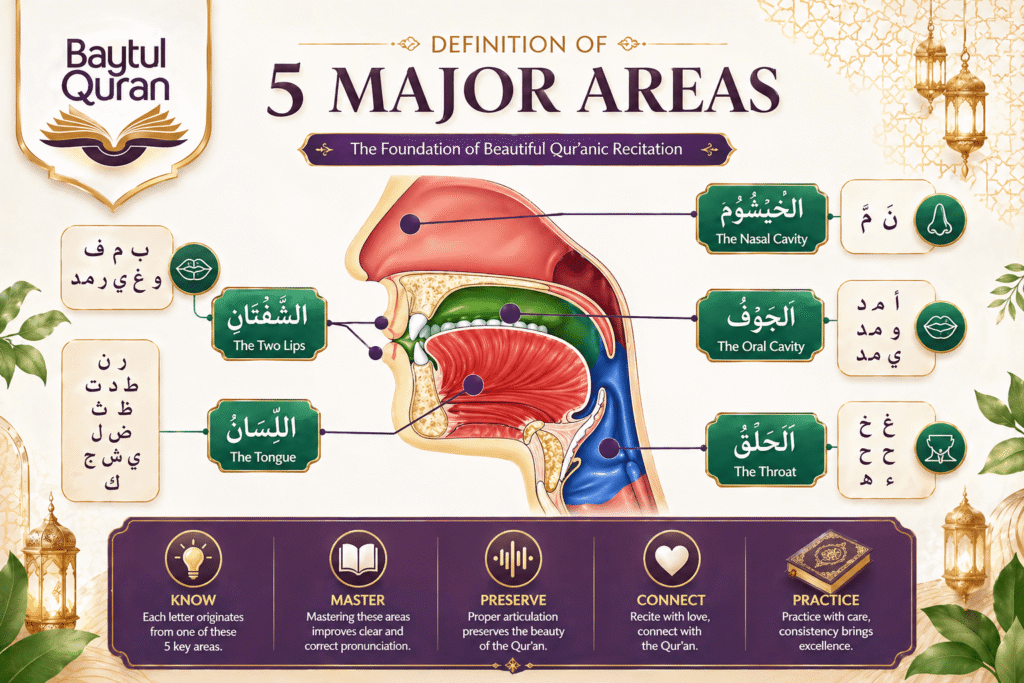
The scholars of Tajweed mapped the entire phonetic system of Arabic with extraordinary precision. This is the map every student begins with.
WHY MAKHAARIJ COMES BEFORE EVERYTHING ELSE IN TAJWEED
This is the question that many parents ask when they first enrol their children in Tajweed classes. Why are we spending so much time on letter sounds before we even get to the rules?
The answer becomes clear the moment you understand what the Tajweed rules actually do. Rules like Idghaam, Ikhfa, Iqlab, and Madd all describe what happens to letters in specific contexts. But if the letters themselves are not being produced correctly in the first place, applying rules on top of them is like building a house on a cracked foundation. The structure might look fine from a distance. But it will not hold.
Consider a simple example. The Arabic letter ق (Qaaf) is produced from the back of the tongue touching the soft palate, deep in the mouth. The letter ك (Kaaf) is produced from the same area but slightly further forward, with a different degree of contact. To an untrained English-speaking ear, these two letters sound very similar. But in the Quran, substituting one for the other changes the meaning entirely. The rule of Ikhfa applied to a Qaaf, and the Ikhfa applied to a Kaaf produces completely different sounds. If a student has never been taught the correct Makhraj of Qaaf, they will apply rules correctly in theory but produce incorrect recitation in practice.
Furthermore, many of the most beautiful characteristics of Tajweed, including the resonant depth of letters like غ (Ghain) and خ (Kha), the firm precision of ط (Taa) and ض (Daad), and the distinctive echo of Qalqalah letters, are only achievable when the Makhraj is correct. A student who masters Makhaarij first will find that many Tajweed characteristics begin to emerge naturally in their recitation, almost without deliberate effort.
This is precisely why Imam Ibn Al-Jazari placed the study of Makhaarij at the very opening of his foundational text Al-Muqaddimah Al-Jazariyyah, before any discussion of rules or characteristics. He understood, as every serious Tajweed scholar understands, that the letters come first. Everything else follows.
“I personally always tell parents,” says Qari Muhammad Abdullah of Baytul Quran Academy, “that if your child can produce every Arabic letter correctly from its proper Makhraj, they are already halfway to beautiful Tajweed. The rules are important, but the letters are the foundation of the foundation.”
THE FIVE MAIN ARTICULATION ZONES EXPLAINED
The scholars of Tajweed identified 17 specific articulation points across the human vocal tract, but these 17 points are organised into 5 main zones. Understanding these five zones gives every beginner a clear, manageable map to begin working with.
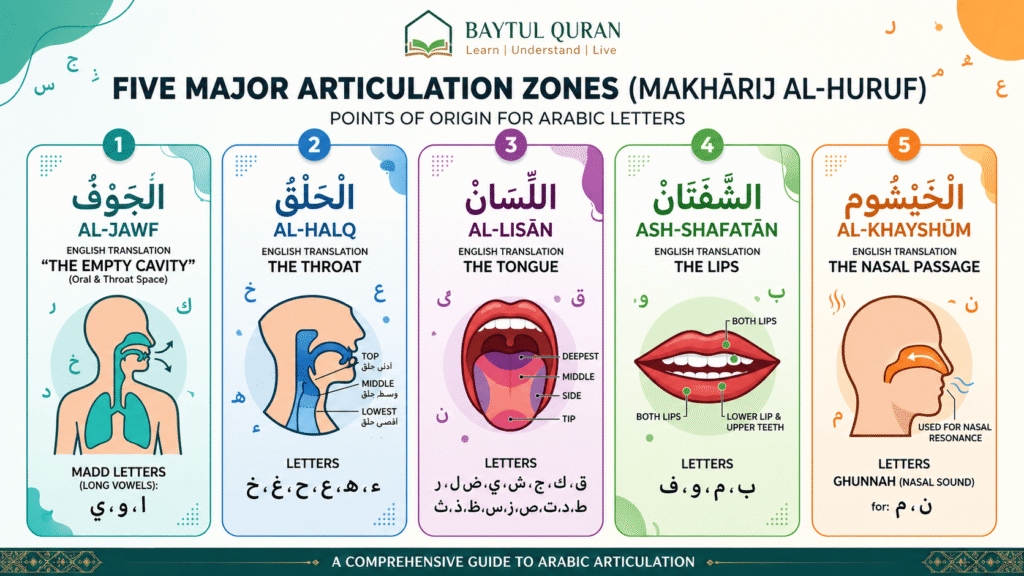
Five zones. Seventeen precise points. Twenty-nine letters. This is the complete map of Arabic articulation.
ZONE ONE: AL-JAWF (THE EMPTY SPACE)
Al-Jawf refers to the open empty space of the mouth and throat. This zone produces what are known as the letters of natural extension, the three Madd letters: Alif (أ when extended), Waaw (و), and Yaa (ي) when they appear as long vowels.
These letters do not involve contact between any two parts of the mouth or throat. They emerge from the open resonant space itself, which is why they carry a naturally elongated, flowing quality. Understanding Al-Jawf helps students appreciate why these letters have a different feel from all other Arabic letters and why the rules of Madd (elongation) apply specifically to them.
ZONE TWO: AL-HALQ (THE THROAT)
Al-Halq, the throat zone, contains six letters produced at three specific levels of the throat. These six letters are among the most challenging for non-Arab learners because English has no equivalent sounds.
The deepest throat letters are Hamzah (ء) and Haa (ه), produced at the very base of the throat. The middle throat produces Ayn (ع) and Haa (ح), which require a specific constriction that has no counterpart in any European language. The upper throat produces Ghain (غ) and Kha (خ), which involve a distinctive rasp produced near the top of the throat.
For non-Arab students, the throat letters represent the steepest learning curve in all of Makhaarij study. A common and significant error is replacing the deep Haa (ح) with the lighter Haa (ه), or softening the Ayn (ع) into a simple glottal stop. These are precisely the kinds of mistakes that a qualified Tajweed teacher identifies and corrects in the early stages of a student’s education.
ZONE THREE: AL-LISAAN (THE TONGUE)
Al-Lisaan, the tongue, is the most complex and productive zone in Arabic phonetics. No fewer than 18 of the 29 Arabic letters are produced using various parts of the tongue in contact or near-contact with different parts of the mouth. The scholars divided the tongue zone into 10 distinct articulation points, ranging from the very back of the tongue near the throat to its tip.
Some important examples within this zone include the following. The letter Qaaf (ق) is produced from the very back of the tongue against the soft palate, deep in the mouth. The letter Kaaf (ك) comes from a position slightly further forward along the same surface. The letters Jeem (ج), Sheen (ش), and Yaa (ي) as a consonant are all produced from the middle of the tongue against the hard palate. The letters Noon (ن), Laam (ل), and Raa (ر) come from the tip and blade of the tongue in slightly different positions. The interdental letters Thaa (ث), Thal (ذ), and Dhal (ظ) are produced with the tongue tip between or just behind the front teeth.
For English-speaking students, many tongue letters feel deceptively familiar because English also uses the tongue extensively. However, the precise positions are different, and subtle errors in tongue placement produce letters that sound close to the correct sound but are not, in fact, the correct Arabic letter. This is the hidden danger of Makhaarij errors for native English speakers.
ZONE FOUR: AL-SHAFATAAN (THE LIPS)
Al-Shafataan refers to the two lips, which produce four Arabic letters. The letter Fa (ف) is produced from the inner edge of the lower lip touching the upper front teeth. The letters Ba (ب) and Meem (م) are produced from both lips coming together completely, with the key difference being that Meem carries a nasal quality (Ghunnah) while Ba does not. The Waaw (و) as a consonant is produced from both lips rounding slightly without touching.
The lip letters are generally the easiest zone for beginners to master because the movements are visible in a mirror. This makes them excellent letters to begin Makhaarij practice with, as students can physically see whether their articulation is correct.
ZONE FIVE: AL-KHAYSHOOM (THE NASAL PASSAGE)
Al-Khayshoom refers to the nasal passage and produces what is known as Ghunnah, the nasal resonance that characterises the letters Noon (ن) and Meem (م) in specific Tajweed contexts. This is not a separate letter but a characteristic quality that passes through the nasal passage when these letters appear in certain conditions.
Ghunnah is one of the most recognisable and beautiful qualities of Quranic recitation. When you hear a skilled Qari recite, and you notice that warm, resonant nasal hum on certain sounds, that is Ghunnah emerging from Al-Khayshoom. Developing this quality requires students to consciously redirect sound through the nasal passage while maintaining the correct tongue and lip position for the letter.
THE MOST COMMONLY CONFUSED LETTER PAIRS
Understanding zones is one thing. Knowing specifically which letters most students confuse is where Makhaarij study becomes practically powerful. The following pairs are the ones that Tajweed teachers correct most frequently, particularly with students from English-speaking backgrounds.
Haa (ح) and Haa (ه): Both are transliterated as “H” in English, which immediately explains the problem. The deep Haa (ح) requires a firm constriction in the middle throat that produces a warm, pushed sound. The lighter Haa (ه) is a simple breathy sound like the English H. Confusing them can change the meaning of Quranic words entirely.
Ayn (ع) and Hamzah (أ): The Ayn requires a distinctive constriction of the middle throat that produces a unique, slightly strained quality. Many non-Arab students replace it with a simple glottal stop (Hamzah), which is a completely different letter. This is one of the most widespread Makhaarij errors among Western Muslim communities.
Qaaf (ق) and Kaaf (ك): As discussed earlier, both come from the back tongue area but at slightly different points. Native English speakers tend to produce both from roughly the same position, collapsing the distinction between them.
Saad (ص) and Seen (س): Both are S-type sounds but Saad (ص) is an emphatic letter produced with the tongue raised toward the roof of the mouth, giving it a deeper, fuller quality. Seen (س) is a clean, light sibilant. Using Seen where Saad is required, or vice versa, is an extremely common error that changes Quranic meaning.
Tha (ث), Thal (ذ), Dha (ظ): These three interdental letters are absent from virtually every non-Arab language and are consistently among the hardest sounds for beginners to master. Without a teacher physically demonstrating the tongue position, most students will substitute an S, Z, or D sound respectively.
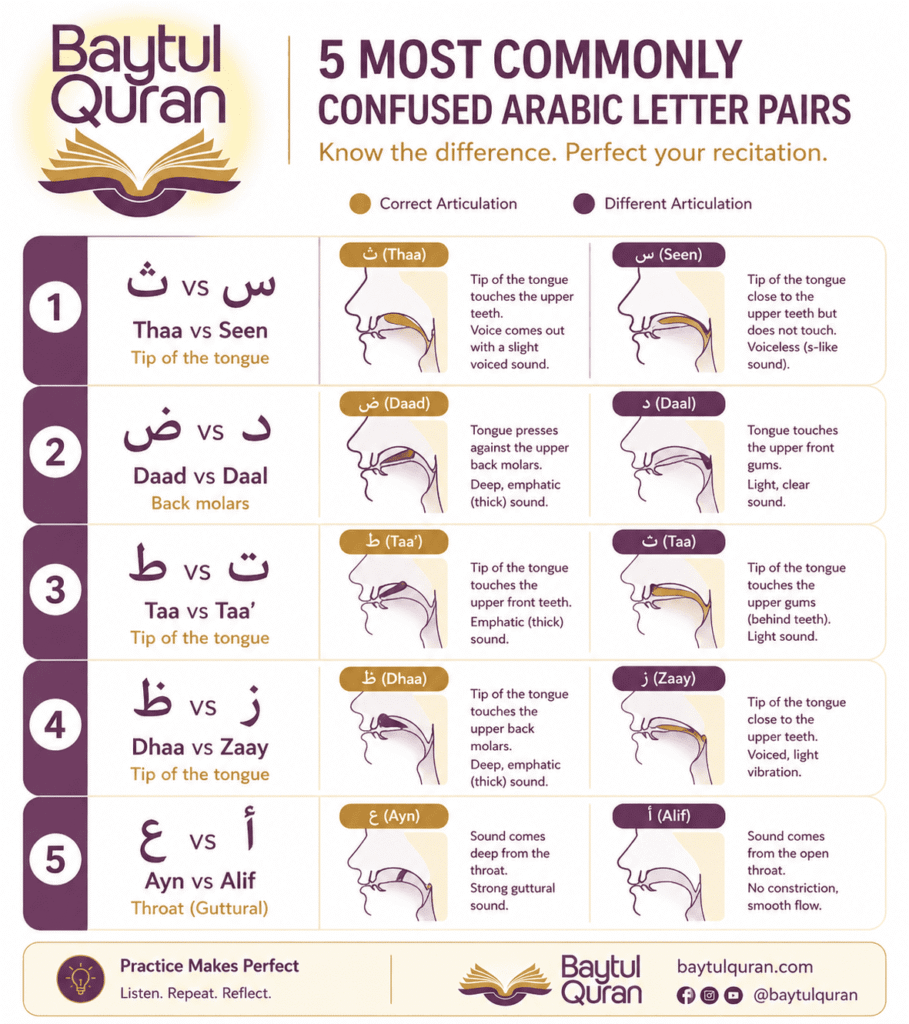
These are the letter pairs that catch most beginners. A qualified teacher can identify and correct these errors within a few sessions.
HOW TO IDENTIFY YOUR OWN ARTICULATION MISTAKES
Many Muslim parents and adult students carry Makhaarij errors they have never identified, simply because they have never had anyone trained to listen. Here are the most practical ways to begin assessing your own recitation.
The first step is to record yourself. Use your phone to record yourself reciting a short Surah you know well, then listen back with full attention. Most people are shocked at how different their recitation sounds on recording compared to how it sounds in their own head. Focus specifically on the throat letters and ask yourself honestly whether the depth and quality of those sounds is present.
The second step is to compare with a reference. Listen to a certified Qari, ideally someone whose recitation you know has been checked and approved through Ijazah. Qari Mahmoud Khalil Al-Husary is widely considered the gold standard for clear, measured Tajweed recitation and is freely available on YouTube. Play a verse, then recite the same verse, then compare. Over time, your ear will begin to detect the gaps.
The third and most effective step is to get a qualified teacher to listen. No recording, no comparison exercise, and no amount of self-study replaces the feedback of a living, qualified teacher who can hear exactly where your Makhraj is off and physically demonstrate the correct position. This is why Tajweed has always been a teacher-to-student discipline and why the chain of transmission matters so deeply in Islamic scholarship.
💡 A useful exercise for beginners: Place your hand in front of your mouth while reciting throat letters. You should feel warm air for Haa (ه) but almost no air for the deep Haa (ح). If both produce the same amount of breath, your throat letters need attention.
WHAT MAKHAARIJ MEANS FOR YOUR CHILD’S QURAN EDUCATION
As a parent, you might be wondering at this point what all of this means practically when choosing a Quran teacher or academy for your child.
The answer is straightforward. When evaluating any Quran teacher or programme, ask specifically whether Makhaarij is taught as part of the Tajweed curriculum and at what stage it is introduced. A programme that skips Makhaarij entirely or treats it as an advanced topic is building on an incomplete foundation. Your child may become fluent at moving through pages of Quran, but the quality and correctness of their recitation will always have a ceiling imposed by unaddressed Makhaarij errors.
At Baytul Quran Academy, Makhaarij Al-Huroof is introduced in the very early stages of Tajweed study, following the completion of Noorani Qaida. Our certified teachers, all of whom hold Ijazah, spend dedicated time on each student’s articulation before progressing to rule-based Tajweed study. This ensures that when a student reaches the rules of Noon Sakinah, Madd, or Qalqalah, their letters are already emerging from the correct positions and the rules can be applied with genuine accuracy.
The difference this makes is audible. Within months of correct Makhaarij training, students begin producing Arabic sounds that they previously could not even approximate. For children especially, whose vocal tracts and ears are highly adaptable, this progress can be rapid and deeply satisfying.
Explore our structured Tajweed programme for children and adults. “If you would like your child’s Makhaarij assessed by a certified teacher, you can explore our structured Tajweed programme for children and adults and book a free first 3 classes with no commitment required.”
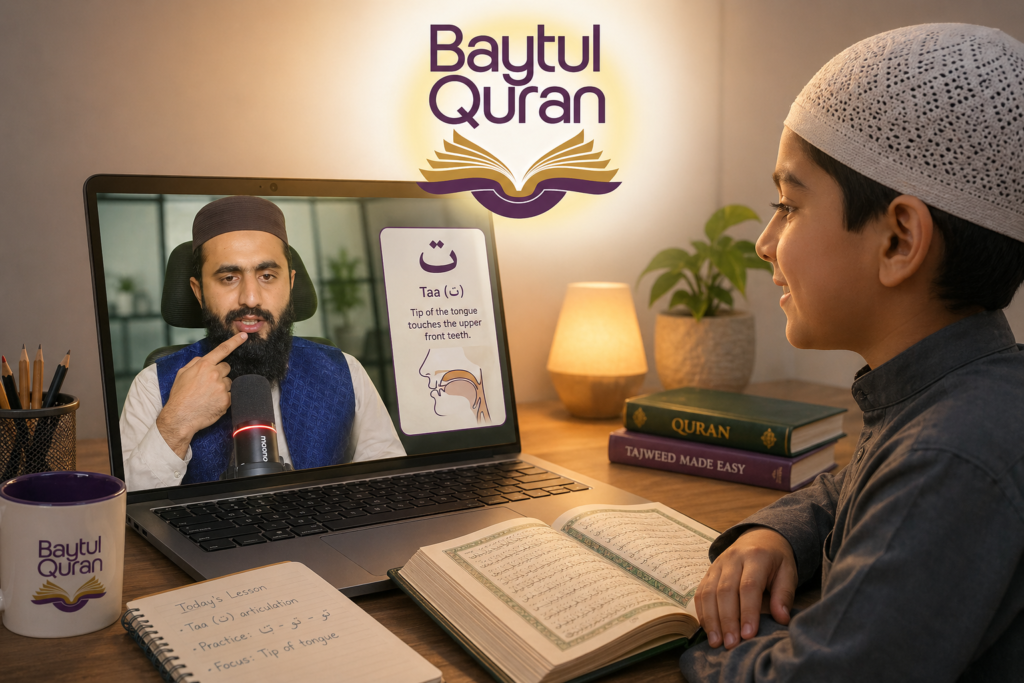
A qualified teacher demonstrating Makhaarij in a live session makes all the difference. This is something no app or video can fully replace.
🌟 READY TO START YOUR QURAN JOURNEY?
Join hundreds of students across the UK, USA and all over the world, learning Quran online with certified teachers.
✅ Free trial classes no commitment ✅ Expert teachers with Ijazah ✅ Flexible timings for your timezone
👉 Book Your Free Trial on WhatsApp
Or visit: baytulquran.com
FREQUENTLY ASKED QUESTIONS
Q: What are Makhaarij Al-Huroof in Tajweed? A: Makhaarij Al-Huroof are the precise exit points or articulation points of the Arabic letters, meaning the specific locations inside the mouth, throat, and nasal passage from which each Arabic letter is produced. There are 17 specific articulation points organised into 5 main zones. Mastering Makhaarij is the essential foundation of correct Quran recitation and the starting point of any serious Tajweed education.
Q: Why is learning Makhaarij important before other Tajweed rules? A: Because all Tajweed rules describe what happens to letters in specific contexts. If the letters themselves are not being produced from the correct articulation point, applying rules on top of them will not produce correct recitation. Makhaarij training ensures the foundation is solid before rule-based study begins. At Baytul Quran Academy, we address Makhaarij in the earliest stages of every student’s Tajweed journey.
Q: What are the 5 main articulation zones in Arabic? A: The five main zones are Al-Jawf (the open oral cavity, producing the long vowel letters), Al-Halq (the throat, producing six letters across three levels), Al-Lisaan (the tongue, producing 18 letters across 10 articulation points), Al-Shafataan (the lips, producing four letters), and Al-Khayshoom (the nasal passage, producing the Ghunnah quality of Noon and Meem).
Q: Which Arabic letters are hardest for non-Arabs to pronounce correctly? A: The most challenging letters for non-Arab learners are consistently the throat letters, particularly Ayn (ع), deep Haa (ح), Ghain (غ), and Kha (خ), as these sounds have no equivalent in English or most European languages. The emphatic letters Saad (ص), Daad (ض), Taa (ط), and Dha (ظ) are also consistently difficult, as is the interdental group of Tha (ث), Thal (ذ), and Dhal (ظ). A qualified teacher can identify and correct these specifically for each student.
Q: Can I learn Makhaarij Al-Huroof online, or do I need an in-person teacher? A: Makhaarij can absolutely be learned effectively in online one-to-one classes with a qualified teacher. In fact, many students find that the close-up view of the teacher’s mouth on screen is clearer and more instructive than sitting across a table. The key requirement is a live, interactive session where the teacher can hear you recite, identify your specific errors, and demonstrate the correct articulation in real time. Pre-recorded videos alone are not sufficient. At Baytul Quran Academy, all our online classes are live, interactive, and taught by certified teachers with an Ijazah.
Q: How long does it take to master Makhaarij Al-Huroof? A: For children starting young, correct Makhaarij can be established within a few months of consistent classes and daily practice. For adults, particularly those who have been reciting with incorrect habits for years, it may take six months to a year to fully correct all articulation points, as unlearning ingrained muscle memory takes time. However, students typically notice significant improvement in their recitation quality within the first few weeks of focused Makhaarij work. You can begin with a free trial class at Baytul Quran Academy and see the difference immediately.
CONCLUSION
Makhaarij Al-Huroof is not a difficult concept. It is simply the answer to a question that every reciter needs to ask: where exactly is this letter supposed to come from?
The scholars of Islam answered that question with extraordinary precision fourteen centuries ago, and their answer has been passed down through an unbroken chain of teachers and students all the way to the present day. Every certified Tajweed teacher you sit with, every Qari you listen to, every child who recites the Quran beautifully and correctly, is the living product of that chain.
For your child, learning Makhaarij Al-Huroof early is one of the most powerful investments you can make in their Quran education. It sets a standard of accuracy that will carry through every Surah they memorise, every prayer they lead, and every recitation they make for the rest of their life. For adults returning to correct their own recitation, the journey through Makhaarij is humbling, deeply rewarding, and transformative in ways that go far beyond pronunciation.
The mouth and throat that Allah (SWT) gave you were designed, among all their purposes, to recite His Words correctly. Makhaarij is simply learning to use that gift as it was meant to be used.
May Allah grant us all the tawfeeq to recite His Book as it deserves to be recited. Ameen.
📖 BEGIN YOUR QURAN JOURNEY TODAY Taught Expert Teachers
✦ Tajweed
✦ Hifz
✦ Noorani Qaida
✦ Tafseer
✦ Quran Reading
All over the world
💬 WhatsApp: +44 7842 064721 || +923008737779
🌐https://baytulquran.com/ 📱 @baytulquran_1
First 3 classes are FREE. Always.

One Response