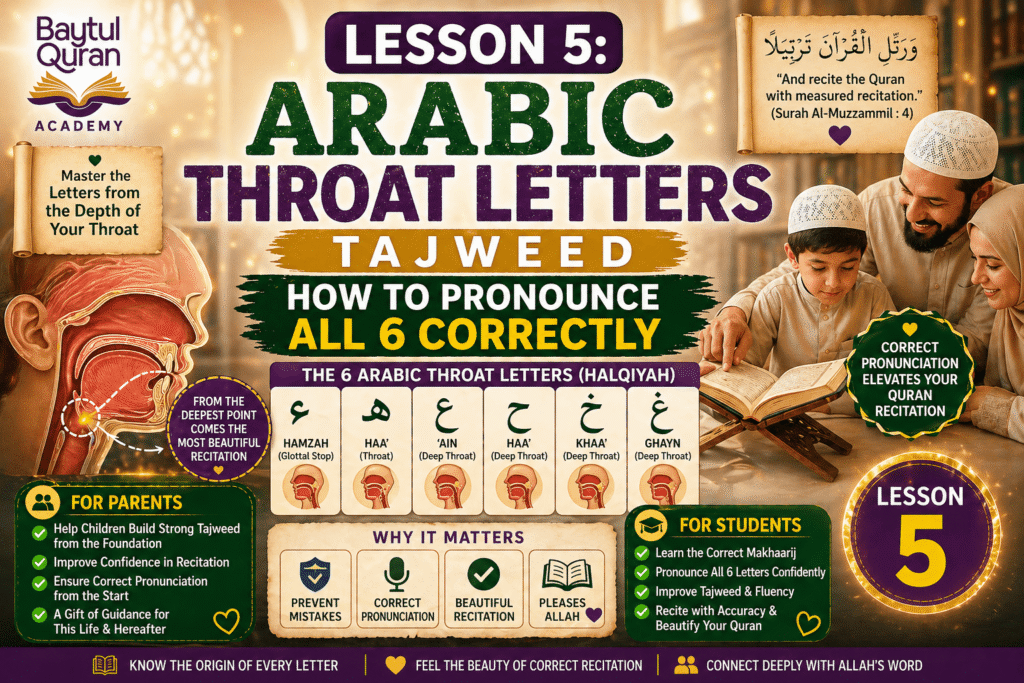
Series Navigation: Lesson 1: What Is Tajweed? —> https://baytulquran.com/what-is-tajweed/ Lesson 2: Is Tajweed Obligatory in Islam? —> https://baytulquran.com/is-tajweed-obligatory-in-islam/ Lesson 3: Makhaarij Al-Huroof —> https://baytulquran.com/makhaarij-al-huroof-for-beginners/ Lesson 4: Sifaat Al-Huroof —> https://baytulquran.com/sifaat-al-huroof-tajweed-guide/ Lesson 5: You are here —> Arabic Throat Letters Tajweed
INTRODUCTION
There is one moment that almost every non-Arab Muslim experiences when they begin serious Tajweed study. Their teacher asks them to produce the letter Ayn (ع), and they open their mouth, make a sound that feels completely reasonable to them, and watch their teacher gently shake their head and say, not quite.
That moment is not a failure. It is actually the beginning of real Tajweed progress. Because the throat letters, the six letters known as Huroof Al-Halq, are the honest test of whether a student is truly producing Arabic or producing an approximation of Arabic. And for most non-Arab learners, these six letters have been approximated their entire lives without anyone pointing it out.
This is Lesson 5 in our ongoing Tajweed series for Muslim families, and it is the most practically hands-on lesson we have covered so far. In the previous lessons we explored what Tajweed is, why it is obligatory, how Makhaarij maps the origin of every Arabic letter, and how Sifaat defines the qualities each letter carries. Now we go deeper into the throat itself and work through each of the six throat letters one by one, understanding exactly where they come from, what they should sound like, what the most common mistakes are, and how to begin correcting them.
These six letters are ء (Hamzah), ه (Ha), ع (Ayn), غ (Ghain), ح (deep Ha), and خ (Kha). Master these and you will have solved the hardest phonetic challenge in Arabic for non-native speakers. Everything else in Tajweed becomes significantly easier once the throat letters are correct.
Let us go through them together, one by one.
IN THIS ARTICLE:
- What Are Huroof Al-Halq and Why Are They So Difficult?
- The Three Levels of the Throat
- Letter One —> Hamzah (ء)
- Letter Two —> Ha (ه)
- Letter Three —> Ayn (ع)
- Letter Four —> Ghain (غ)
- Letter Five —> the Deep Ha (ح)
- Letter Six —> Kha (خ)
- How to Practice Throat Letters at Home
- Frequently Asked Questions
WHAT ARE HUROOF AL-HALQ AND WHY ARE THEY SO DIFFICULT?
Huroof Al-Halq simply means the letters of the throat. Al-Halq is the Arabic word for throat, and these six letters are called throat letters because all six are produced from somewhere inside the throat rather than from the tongue, teeth, or lips.
In the framework of Makhaarij that we studied in Lesson 3, Al-Halq is one of the five main articulation zones. It is the zone that most non-Arab students find hardest, and the reason is straightforward. English, like most European languages, produces almost no consonant sounds from inside the throat. The deepest English consonant is arguably the H sound, and even that is produced at the very opening of the throat rather than deep inside it.
Arabic, by contrast, has six distinct consonant sounds produced at three different levels of the throat. That means Arabic uses a part of the human vocal anatomy that English-speaking people have simply never been trained to use for speech. The muscles are there. The anatomy is there. But the neural pathways for controlled, precise throat articulation have never been developed because English never required them.
This is why these letters feel so foreign to non-Arab learners. It is not that the sounds are impossible. It is that the muscles needed to produce them have been sitting unused for speech purposes since childhood. With the right teacher, the right exercises, and consistent practice, every single one of these letters is learnable. Many students at Baytul Quran Academy who came to us unable to produce a single correct throat letter have gone on to recite with genuinely beautiful Halq articulation within a few months of focused study.
The key is understanding each letter individually, deeply and practically, which is exactly what this lesson provides.
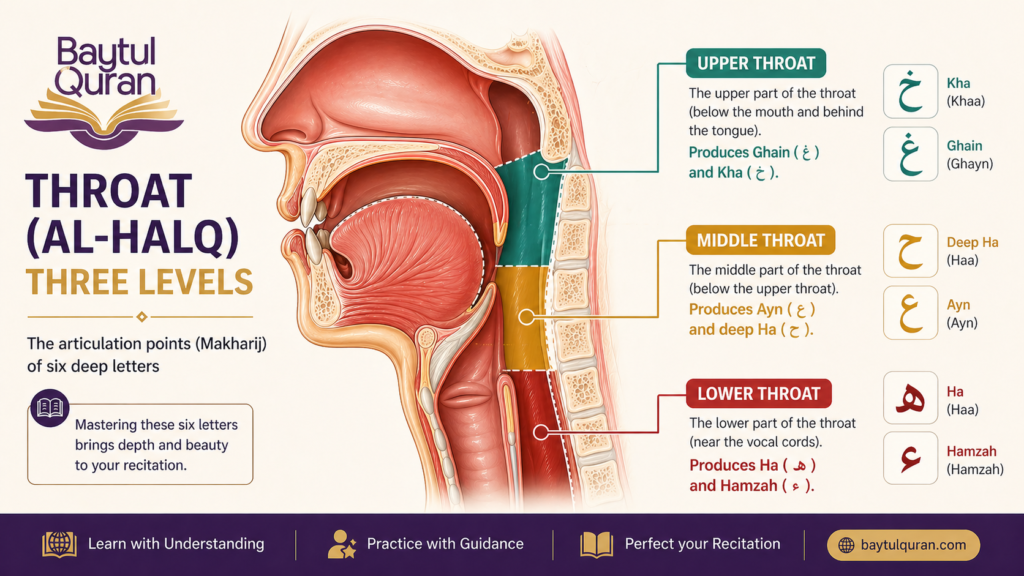
Three levels. Six letters. This is the map of the most challenging articulation zone for non-Arab learners of Tajweed.
THE THREE LEVELS OF THE THROAT
Before we examine each letter individually, it helps enormously to understand the spatial organisation of Al-Halq. The scholars of Tajweed divided the throat zone into three levels, each producing two letters.
The lowest level is the deepest part of the throat, near the base where the throat meets the chest. This level produces Hamzah (ء) and the light Ha (ه). These are the easiest of the six throat letters for non-Arabs to approximate, though even these are often produced incorrectly.
The middle level is the central section of the throat, involving a constriction of the pharynx, which is the tube-like structure at the back of the throat. This level produces Ayn (ع) and the deep Ha (ح). These are consistently the hardest letters for non-Arab learners and require the most focused practice.
The upper level is the area at the very top of the throat near where it meets the back of the mouth. This involves the uvula, which is the small dangling piece of tissue at the back of the soft palate that you can see when you open your mouth wide in a mirror. This level produces Ghain (غ) and Kha (خ). These letters have equivalents in several European languages, which makes them somewhat more accessible than the middle throat letters.
Understanding this three-level structure immediately gives students a mental map to work with. Rather than thinking of six separate and confusing sounds, they can think of three pairs, each produced at a specific depth in the throat.
LETTER ONE —> HAMZAH (ء)
Hamzah is produced from the lowest, deepest part of the throat. It is what linguists call a glottal stop, which means it is produced by the complete closing and then opening of the glottis, the space between the vocal cords deep in the throat.
In terms of sound, Hamzah is the small catch or stop in the throat that you produce in English when you say the word “uh-oh.” That tiny stop between the two syllables, that momentary closing of the throat, is a glottal stop. That is Hamzah.
Every Arabic word that begins with a vowel sound actually begins with a Hamzah. When you say the word “Allah” in Arabic, the opening sound is a Hamzah followed by the vowel. This is why the correct Arabic pronunciation of Allah has a distinct onset rather than simply beginning with a vowel sound the way it might in English.
The most common mistake students make with Hamzah is simply omitting it, particularly when it appears in the middle of a word. They slide through the position where Hamzah should occur without producing the glottal closure, which makes the word sound smeared rather than precise. A qualified teacher will train students to feel the closing and opening of the glottis clearly and deliberately until it becomes automatic.
A useful exercise for Hamzah is to say the English phrase “butter” in a strong Cockney or London accent, where the double T in the middle is replaced by a glottal stop. That throat catch, exaggerated and made more deliberate, is the physical sensation of Hamzah.
LETTER TWO —> HA (ه)
The light Ha (ه) is also produced from the lower throat area, very close to where Hamzah is produced, but with a key difference. While Hamzah involves a complete closure and stop of the throat, Ha (ه) involves the glottis remaining open with a free flow of air passing through it. There is no closure, no stop, just a clean rush of air from the deep throat.
In terms of Sifaat from our previous lesson, Ha (ه) carries the characteristic of Hams, which means breathiness. The sound is essentially a deep, clean H sound originating from inside the throat rather than from the mouth opening.
The English H sound is a reasonable starting approximation for Ha (ه), but it is typically produced too far forward, at the mouth opening rather than deep in the throat. The correct Ha (ه) has a depth and resonance to it that the English H does not carry.
The most common mistake is producing Ha (ه) from the mouth opening rather than from inside the throat, which results in a thinner, lighter sound that lacks the correct depth. Students can practice by placing their hand on their throat and trying to feel the vibration or warmth of the sound coming from lower down rather than from the lips or front of the mouth.
It is also important to distinguish Ha (ه) clearly from the deep Ha (ح), which we will cover shortly. These two letters are both transliterated as H in English, which means English-speaking students often conflate them entirely. They are completely different letters produced at different levels of the throat with completely different qualities.
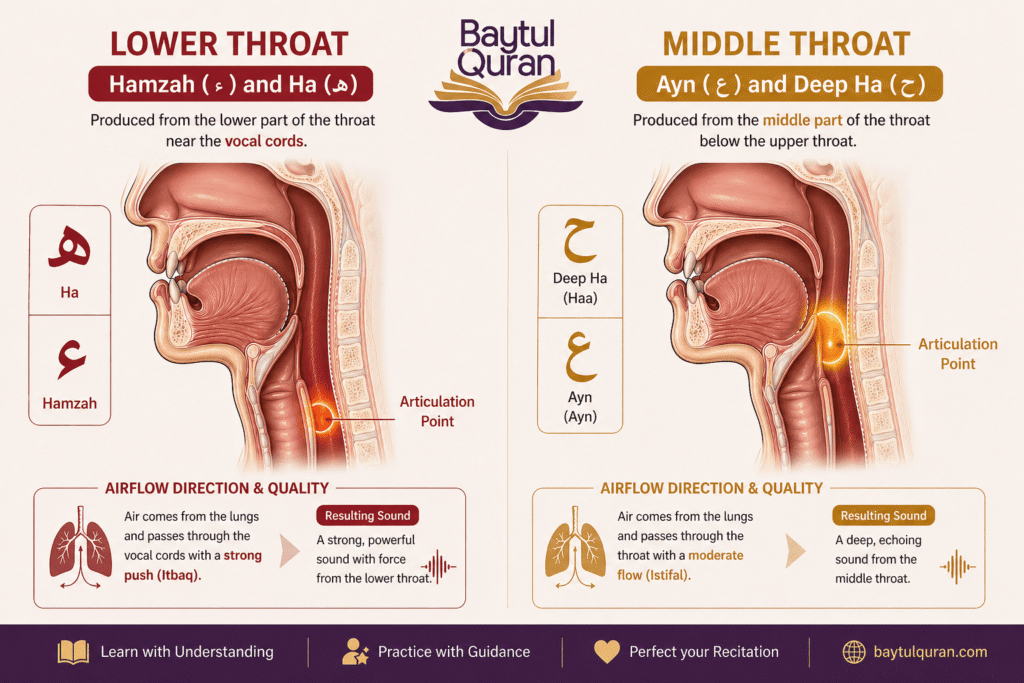
The difference between these two levels of the throat is the difference between four completely distinct Arabic letters. A teacher can make this feel and sound clear within a single session.
LETTER THREE —> AYN (ع)
Here we arrive at the letter that most non-Arab Muslims find the most challenging in the entire Arabic alphabet. Ayn (ع) is produced from the middle level of the throat through a specific constriction of the pharynx while the vocal cords are vibrating fully.
In linguistic terms, Ayn is a voiced pharyngeal fricative. The pharynx, that tube-like structure in the middle of the throat, narrows significantly during the production of Ayn, creating a distinctive constricted quality, and the voice is switched on simultaneously. The result is a sound that has no equivalent in English, French, German, Spanish, or most other widely spoken languages. It is genuinely unique to Arabic and a small number of Semitic and Middle Eastern languages.
The quality of correct Ayn is often described as a strained, constricted, slightly throaty vowel sound. Some teachers describe it as sounding like a person in mild discomfort, because the constriction of the pharynx produces a quality that English speakers associate with effort rather than ordinary speech. But for native Arabic speakers, this constriction is completely natural and effortless.
The most common mistakes with Ayn fall into three categories. The first is replacing Ayn entirely with a glottal stop, Hamzah, which is the most widespread error among non-Arab Muslims. The Ayn is simply omitted or replaced with a simple vowel onset, and the letter disappears entirely from the recitation. The second mistake is producing Ayn from the back of the tongue rather than from the pharynx, creating a sound that resembles Ghain rather than Ayn. The third mistake is producing the pharyngeal constriction without voicing, which creates the deep Ha (ح) rather than Ayn.
A practical exercise that many teachers use for Ayn involves asking students to produce a long “aaah” vowel sound and then, while maintaining that sound, gradually constrict the middle of the throat as if trying to slow the airflow. The point at which the vowel takes on a constricted, strained quality is approaching the correct position for Ayn. From there, a qualified teacher refines the position through repeated demonstration and correction.
The importance of getting Ayn correct cannot be overstated. Ayn appears in some of the most frequently recited words and phrases in Islam. The word for knowledge (علم), the word for world (عالم), the word for servant of Allah (عبد الله), and the opening of Surah Al-Fatiha itself contains Ayn in the word نَعْبُدُ. Reciting these words without a correct Ayn changes their phonetic character significantly.
LETTER FIVE —> THE DEEP HA (ح)
The deep Ha (ح) is produced from the middle level of the throat, the same level as Ayn, but with a crucial difference. Where Ayn is voiced, meaning the vocal cords vibrate during its production, the deep Ha (ح) is voiceless. The pharynx constricts in almost exactly the same way as for Ayn, but the voice is switched off entirely and only air passes through.
This makes the deep Ha (ح) a voiceless pharyngeal fricative in linguistic terms. The sound it produces is a strong, warm, pressed rush of air from the middle throat, quite different from the lighter breathy quality of the upper Ha (ه).
A helpful way to understand the relationship between these letters is to think of them in pairs. Ayn (ع) and deep Ha (ح) are produced from the same middle throat position, with Ayn being voiced and deep Ha being voiceless. Similarly, Ghain (غ) and Kha (خ) are produced from the same upper throat position, with Ghain being voiced and Kha being voiceless. This paired structure makes the six throat letters much easier to learn because you are really learning three positions, each with a voiced and voiceless version.
The most common mistake with deep Ha (ح) is replacing it with the lighter Ha (ه). Because both are transliterated as H in English, students who have not been carefully taught the difference will use the same light English-style H sound for both letters. This is a significant Tajweed error that changes the identity of the letter entirely. The deep Ha (ح) appears in words of enormous importance in Quranic recitation, including the name of the Prophet ﷺ himself, Muhammad (محمد), where the deep Ha carries a warmth and depth that the lighter Ha cannot provide.
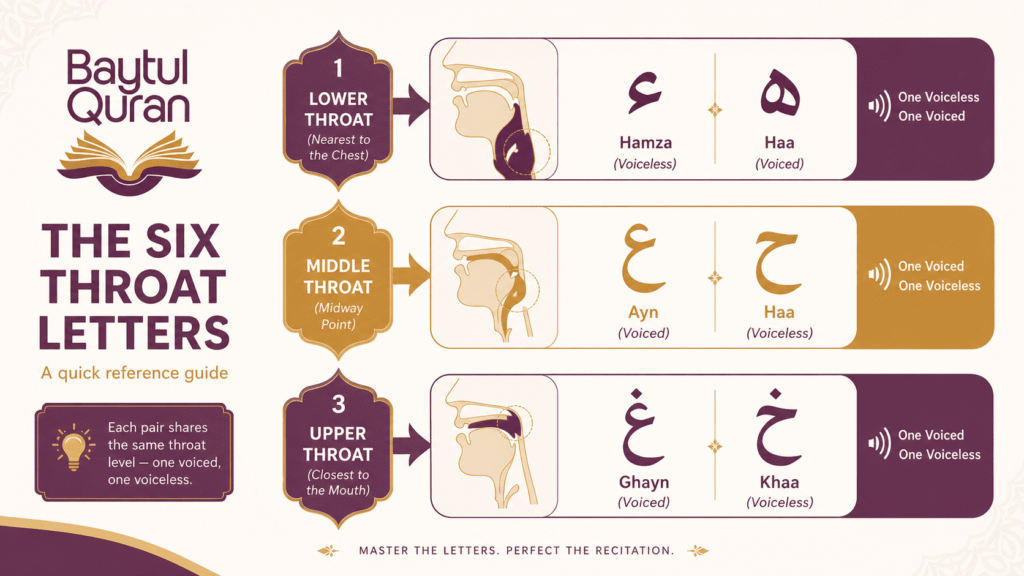
Three positions. Six letters. Two from each level, one voiced and one voiceless. Once you see this structure, the throat letters become far less overwhelming.
LETTER FOUR —> GHAIN (غ)
Moving up to the upper level of the throat, we arrive at Ghain (غ). Ghain is produced from the uvular area, the region at the very top of the throat near where the soft palate ends and the throat begins, and it is a voiced sound meaning the vocal cords are vibrating during its production.
The good news for English-speaking students is that Ghain has a close relative in several European languages. The French R in words like “Paris” or “rouge” is produced from very close to the same position as Ghain. The Arabic Ghain is essentially a voiced uvular sound, and students who speak French, German, or certain dialects of Portuguese will find this letter significantly more accessible than the middle throat letters.
For students without this background, Ghain is often described as sounding like a gentle gargling sound produced from the back of the throat, or like the sound you might make when you are gargling water. This is a rough approximation, but it gives students the right general area to aim for before a teacher refines the precise position.
The most common mistake with Ghain is producing it from the back of the tongue rather than from the uvular area, creating a sound that resembles an Arabic Gayn or a heavy G sound rather than the correct voiced uvular quality. Another common mistake is confusing Ghain with Ayn because both involve the throat and both are voiced. The key difference is position. Ayn is middle throat with pharyngeal constriction. Ghain is upper throat at the uvula. They feel and sound quite different once the correct positions are established.
In terms of Sifaat, Ghain carries the characteristic of Jahr (full voicing), Rakhawah (free airflow), Isti’la (tongue elevation), and Istifaal at its specific zone. These characteristics give Ghain its distinctive deep, rumbling, flowing quality.
LETTER SIX —> KHA (خ)
Kha (خ) completes the six throat letters and is the voiceless partner of Ghain (غ) at the upper throat level. While Ghain is produced at the uvula with full voicing, Kha is produced at the same position but with the voice switched off, allowing only air to pass through the uvular constriction.
The sound of Kha is one that English speakers sometimes encounter in borrowed words. The Scottish pronunciation of the word “loch” as in Loch Ness, or the Welsh pronunciation of certain words, contains a sound that is reasonably close to Kha. The German “Bach” or the Spanish “j” sound in words like “jota” also approximate Kha. Students who have exposure to any of these languages will find Kha relatively approachable.
For students without this background, the most effective starting approach is to begin with Ghain if the teacher has already established that, and then simply remove the voicing. The position stays the same. The uvular constriction stays the same. The only change is that the voice switches off, and the result is Kha rather than Ghain.
The most common mistake with Kha is producing it from the back of the tongue as a heavy K sound rather than from the uvula. This produces a sound that resembles an emphatic K rather than the correct uvular friction of Kha. Another common mistake is producing it too far back, creating an exaggerated scraping sound rather than the measured uvular friction the letter requires.
In terms of Sifaat, Kha carries Hams (breathiness), Rakhawah (free airflow), and Isti’la (elevation), giving it that distinctive dry, rasping, airy quality that makes it sound so different from any English consonant.
HOW TO PRACTICE THROAT LETTERS AT HOME
Understanding throat letters intellectually is genuinely useful. But the real work happens in daily practice, and the following approach is what our teachers at Baytul Quran Academy recommend to students working on Huroof Al-Halq.
The first step is to isolate each letter completely before working on it in context. Take one letter, for example Ayn (ع), and spend five minutes in a single practice session doing nothing but producing that letter alone with the three vowel sounds, Ayn with Fathah, Ayn with Kasrah, Ayn with Dammah. Repeat each combination slowly, feel the physical sensation in the throat, and try to hold the position between repetitions to develop muscle memory.
The second step is to listen carefully and repeatedly to a certified Qari reciting verses that are rich in the letter you are practicing. Qari Mahmoud Khalil Al-Husary is the recommended reference for this. Play the audio, then pause, then attempt to reproduce the exact quality you heard, then play again and compare. This cycle of listen, attempt, and compare is one of the most powerful tools available to self-studying students.
The third step, and the one that makes the real difference, is to record yourself and listen back critically. Most students are genuinely surprised by what they hear on recording. The letter they thought they were producing clearly often sounds significantly different when played back. This self-assessment is valuable but has its limits, which leads to the fourth step.
The fourth step is to get regular correction from a qualified teacher. There is genuinely no substitute for this. A live teacher hears nuances in your throat letter production that no recording, no app, and no self-assessment can detect. They can demonstrate the correct sound directly, place their own voice alongside yours, and give you specific, personalised feedback that no resource can replicate.
Book a free trial class with a certified Tajweed teacher. “If you are ready to work on your throat letters with proper guidance, you can book a free trial class with a certified Tajweed teacher at Baytul Quran Academy today, with no commitment required.”
Learn more about our Tajweed programme. “To learn more about our Tajweed programme and the qualified teachers who deliver it, visit our about page and see why hundreds of students across the UK, USA, and Australia trust Baytul Quran Academy with their Quran education.”
🌟 READY TO START YOUR QURAN JOURNEY?
Join hundreds of students across the UK, USA and all over the world, learning Quran online with certified teachers.
✅ Free trial classes no commitment ✅ Expert teachers with Ijazah ✅ Flexible timings for your timezone
👉 Book Your Free Trial on WhatsApp
Or visit: baytulquran.com
Qari Muhammad Abdullah demonstrating all six throat letters one by one in a clear, close-up video. For each letter he shows the approximate throat position, produces the letter correctly with all three vowel sounds, then demonstrates the most common mistake and contrasts it with the correct sound. The tone is patient, encouraging, and practical.
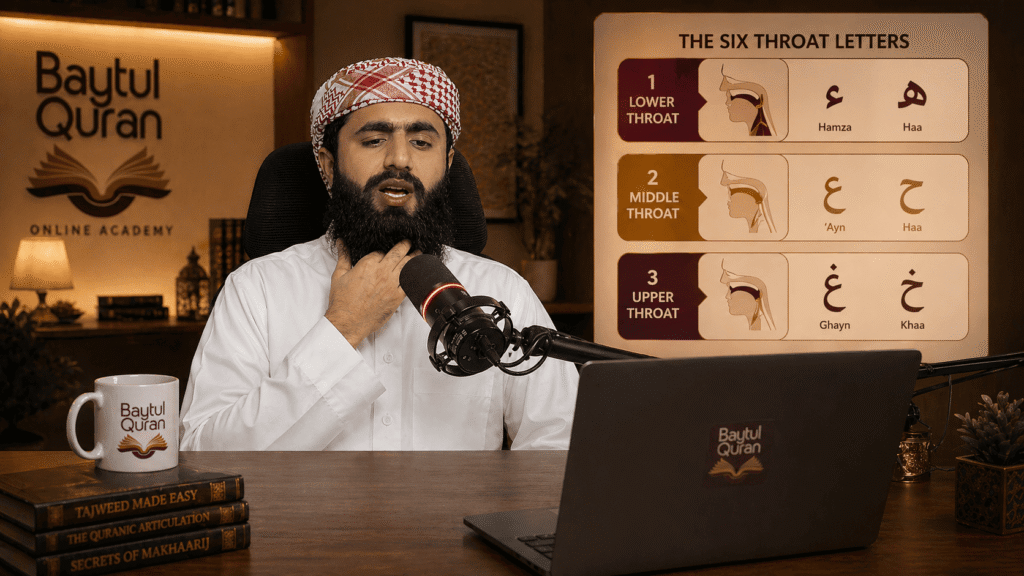
One qualified teacher demonstrating a throat letter clearly is worth months of self-study. This is why the teacher-student relationship is at the heart of Tajweed education.
FREQUENTLY ASKED QUESTIONS
Q: What are the Arabic throat letters in Tajweed? A: The Arabic throat letters, known as Huroof Al-Halq, are the six letters produced from inside the throat rather than from the tongue, teeth, or lips. They are Hamzah (ء), light Ha (ه), Ayn (ع), Ghain (غ), deep Ha (ح), and Kha (خ). They are organised into three pairs across three levels of the throat. These six letters are consistently the most challenging for non-Arab learners and represent the most important articulation work for any student serious about correct Tajweed recitation.
Q: Why is Ayn (ع) so difficult for non-Arabs to pronounce? A: Ayn is difficult because it requires a specific constriction of the pharynx, the middle section of the throat, combined with full voicing of the vocal cords. This produces a sound that has absolutely no equivalent in English or most European languages. The muscles required for this articulation have simply never been trained for speech in non-Arab learners. With a qualified teacher demonstrating the correct position and providing consistent correction, most students begin producing an acceptable Ayn within several weeks of focused practice.
Q: What is the difference between Ha (ه) and Ha (ح) in Arabic? A: These are two completely different letters despite both being transliterated as H in English. Ha (ه) is a light, breathy sound produced from the lower throat with free airflow, similar to but deeper than the English H. Deep Ha (ح) is a voiceless pharyngeal sound produced from the middle throat with a specific constriction that creates a warm, pressed rush of air quite unlike anything in English. Confusing these two letters is one of the most common Tajweed errors among non-Arab Muslims and can only be properly corrected with the guidance of a qualified teacher.
Q: How long does it take to learn correct throat letter pronunciation? A: For most non-Arab students working with a qualified teacher, a basic acceptable production of all six throat letters can be developed within two to four months of consistent classes and daily home practice. Reaching a genuinely refined and beautiful quality for the harder letters like Ayn and deep Ha typically takes six months to a year. Children who begin young can develop these sounds much more naturally. Adults need patience and consistency, but the progress is genuinely achievable and deeply rewarding. You can begin with a free trial class at Baytul Quran Academy to assess your current level.
Q: Can I learn throat letters from YouTube videos alone? A: YouTube videos are a useful supplementary resource but cannot replace a qualified teacher for throat letter work. The reason is that throat letter production errors are extremely subtle and require a trained ear to detect. A video can show you approximately where the sound should come from and what it should sound like in general, but it cannot hear your specific errors, identify the precise adjustment needed, and guide your muscle memory in real time. One-to-one sessions with a certified Tajweed teacher are essential for this work.
Q: Is it sinful to recite Quran with incorrect throat letters? A: As covered in Lesson 2 of this series, scholars distinguish between clear errors that change meaning, known as Al-Lahn Al-Jali, and subtle errors that do not change meaning, known as Al-Lahn Al-Khafi. Throat letter errors that completely replace one letter with another, such as replacing Ayn with Hamzah or replacing deep Ha with light Ha in a context where meaning changes, fall into the more serious category. The obligation on every Muslim is to make a sincere, sustained effort to learn and correct these errors. The Muslim who is genuinely trying to improve is fulfilling their obligation, and Allah rewards the effort. What is sinful is knowing about the obligation and choosing to make no effort whatsoever.
CONCLUSION
The six throat letters of Arabic are not obstacles. They are invitations, invitations to develop a part of your voice and your physical self that has been waiting to be used for this exact purpose.
When you finally produce a correct Ayn, when you feel the pharyngeal constriction and hear that distinctive quality emerge from your own throat for the first time, something genuinely moves. It is not just phonetic progress. It is the feeling of connecting more completely to the Words of Allah (SWT) as they were meant to be recited, in the language they were revealed in, with the sounds that Jibreel (AS) carried from above the seven heavens to the heart of the Prophet ﷺ.
Every throat letter you master is a step closer to that connection. Every correction you accept from your teacher is an act of worship. And every moment you spend practicing these sounds, even if they feel awkward and unfamiliar, is a moment in which you are taking seriously the honour of reciting the Quran.
That is not a small thing. That is one of the most beautiful things a Muslim can do.
May Allah (SWT) grant every reader the ability to recite His Words correctly, clearly, and beautifully. Ameen.
📖 BEGIN YOUR QURAN JOURNEY TODAY Taught Expert Teachers
✦ Tajweed
✦ Hifz
✦ Noorani Qaida
✦ Tafseer
✦ Quran Reading
All over the world
💬 WhatsApp: +44 7842 064721 || +923008737779
🌐https://baytulquran.com/ 📱 @baytulquran_1
First 3 classes are FREE. Always.

One Response