INTRODUCTION
If someone told you that 18 out of the 29 letters of the Arabic alphabet come from a single organ, you might think that would make things easier. Surely if they all come from the same place, they cannot be that different from each other?
The tongue, as it turns out, is one of the most complex and versatile articulators in the human body. It has a tip, a blade, sides, a middle, and a back, and it can touch the teeth, the area just behind the teeth, the hard palate, and the soft palate. Arabic exploits every single one of these positions to produce 18 completely distinct consonant sounds, each one precise, each one meaningful, and each one carrying a defined place in the Tajweed system.
Series Navigation: Lesson 1: What Is Tajweed? —> https://baytulquran.com/what-is-tajweed/ Lesson 2: Is Tajweed Obligatory in Islam? —> https://baytulquran.com/is-tajweed-obligatory-in-islam/ Lesson 3: Makhaarij Al-Huroof —> https://baytulquran.com/makhaarij-al-huroof-for-beginners/ Lesson 4: Sifaat Al-Huroof —> https://baytulquran.com/sifaat-al-huroof-tajweed-guide/ Lesson 5: Arabic Throat Letters —> https://baytulquran.com/arabic-throat-letters-tajweed/ Lesson 6 Part 1: You are here — Arabic Tongue Letters Pronunciation
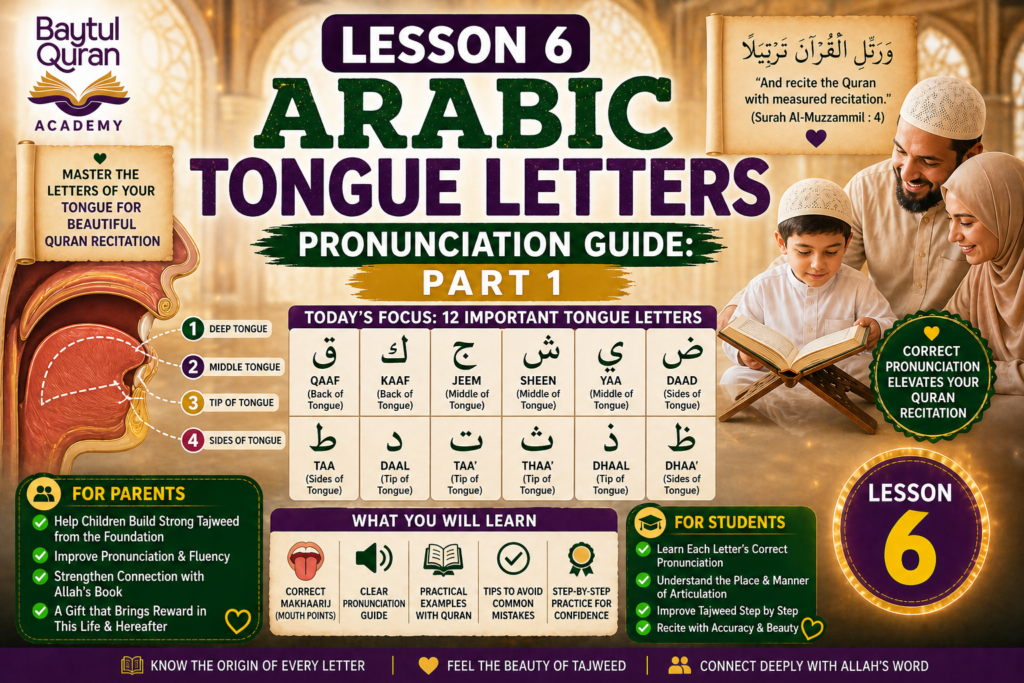
Welcome to Lesson 6, and welcome to the world of Huroof Al-Lisaan, the tongue letters of Arabic.
Because 18 letters is a significant number to cover thoroughly, this lesson is divided into two parts. Part 1, which you are reading now, covers the letters produced from the back and middle of the tongue and the letters produced from the tip and blade of the tongue, including the tongue tip letters and the dental letters. Part 2 will cover the remaining tongue letters including the lateral letters, the nasal tongue letter, and the subtle distinctions between letters that feel similar but are phonetically quite different.
Together, the two parts of this lesson will give you a complete, practical map of every tongue letter in Arabic, how it is produced, what it should sound like, what the most common mistakes are, and how to begin correcting them. This is the kind of thorough breakdown that most Quran students never receive, and it makes an enormous difference to recitation quality when studied properly.
Let us begin.
IN THIS ARTICLE:
- Why the Tongue Is the Most Important Articulator in Arabic
- How the Tongue Is Divided in Tajweed
- Back of Tongue Letters —> Qaaf (ق) and Kaaf (ك)
- Middle of Tongue Letters —> Jeem (ج), Sheen (ش), and Yaa (ي) as Consonant
- Tongue Tip and Upper Gum Letters —> Daad (ض)
- Tongue Blade Letters —> Taa (ط), Daal (د), and Taa (ت)
- Dental Letters —> Thaa (ث), Dhaal (ذ), and Dha (ظ)
- What Is Covered in Part 2
- How to Practice Tongue Letters Effectively
- Frequently Asked Questions
WHY THE TONGUE IS THE MOST IMPORTANT ARTICULATOR IN ARABIC
Before we go through each letter individually, it is worth pausing to appreciate what makes the tongue so central to Arabic phonetics.
In Lesson 3 we learned that Al-Lisaan, the tongue, is one of the five main Makhaarij zones, and that it contains 10 specific articulation points. Those 10 points are spread across the full length of the tongue from its very back near the throat all the way to its very tip. Each point involves the tongue making contact or near-contact with a specific corresponding surface of the mouth, whether that is the soft palate, the hard palate, the gum ridge behind the upper teeth, or the upper teeth themselves.
What makes this remarkable is the precision involved. Two letters can be produced from positions that are only a few millimetres apart on the tongue and yet sound completely different because of the exact contact point, the degree of closure, and the Sifaat the letter carries. This precision is what distinguishes correct Arabic Tajweed from approximate Arabic pronunciation, and it is exactly why teacher-guided learning matters so much for these letters.
For non-Arab learners, the tongue letters fall into several categories of difficulty. Some feel immediately familiar because English uses similar tongue positions. Others feel completely foreign because the English tongue never moves to those positions for speech. Understanding which category each letter falls into helps students know where to focus their greatest effort.
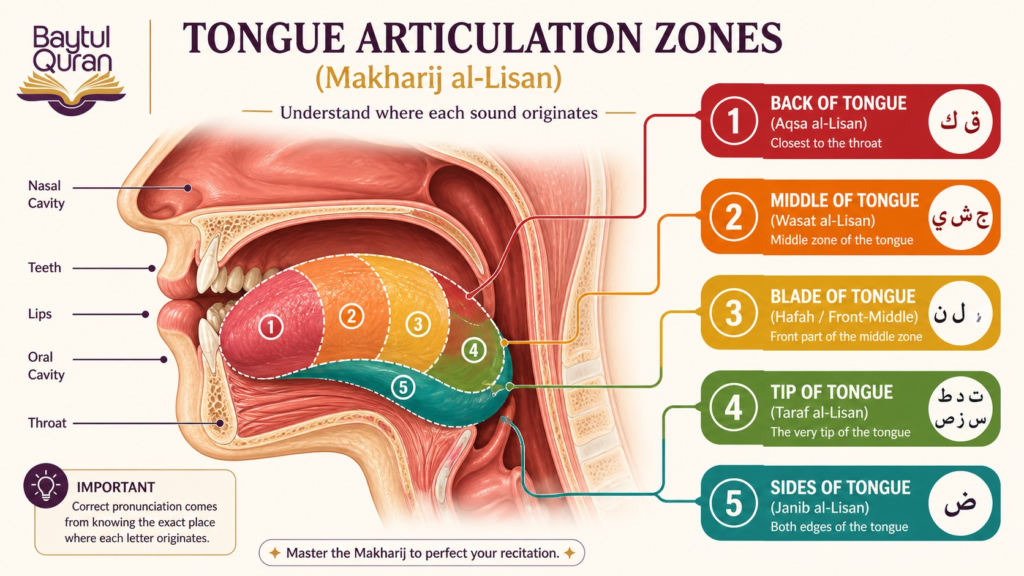
The tongue is the most complex articulator in Arabic. Understanding its zones is the key to understanding all 18 tongue letters.
HOW THE TONGUE IS DIVIDED IN TAJWEED
The scholars of Tajweed identified 10 specific articulation points within Al-Lisaan. Rather than listing all 10 at once, which can feel overwhelming for beginners, it is more practical to group them into the natural positions of the tongue that correspond to the letters we will study.
The back of the tongue produces letters when it contacts or approaches the soft palate at the back of the roof of the mouth. This gives us Qaaf and Kaaf.
The middle of the tongue produces letters when it rises toward the hard palate, the firm section of the roof of the mouth. This gives us Jeem, Sheen, and the consonant Yaa.
The side edge of the tongue, specifically where it meets the upper back molars, gives us Daad, which is one of the most unique and technically demanding letters in all of Arabic.
The blade of the tongue, meaning the flat area just behind the tip, contacting the gum ridge just behind the upper front teeth, gives us the emphatic Taa, regular Daal, and regular Taa.
The tip of the tongue contacting the upper front teeth themselves gives us the three dental letters, Thaa, Dhaal, and Dha.
Now let us go through each group in detail.
BACK OF TONGUE LETTERS — QAAF (ق) AND KAAF (ك)
These two letters are produced from the back section of the tongue, but at slightly different positions, and this difference is what makes them two distinct letters rather than variations of the same sound.
QAAF (ق)
Qaaf is produced when the very back of the tongue rises to make full contact with the soft palate, the soft flexible section at the very back of the roof of the mouth. The contact is complete, meaning airflow is fully stopped before the letter is released. Qaaf also carries the Sifah of Qalqalah from our Lesson 4, which means it produces a slight echoing bounce when it appears with a Sukoon.
In terms of Sifaat, Qaaf carries Jahr (full voicing), Shiddah (complete stop), Isti’la (elevation), Itbaaq (sealing), and Ismaat (requires deliberate effort). This combination of characteristics gives Qaaf a deep, resonant, authoritative quality that is immediately recognisable in skilled recitation.
The most common mistake with Qaaf is producing it from too far forward on the tongue, creating a sound that resembles a heavy English K rather than the deep, back-tongue Qaaf. English speakers are trained to produce K sounds from the middle-back tongue area, which is actually the position for Kaaf in Arabic. True Qaaf requires pushing that contact point further back, to where the tongue meets the soft palate rather than the hard palate.
A useful exercise is to open the mouth wide, observe the soft palate at the very back of the mouth in a mirror, and try to feel the back of the tongue making contact specifically with that soft section. The resulting sound when the tongue releases from that contact point is approaching the correct Qaaf.
KAAF (ك)
Kaaf is produced just a little further forward than Qaaf, where the back of the tongue contacts the area where the hard palate meets the soft palate. The contact is also complete, making Kaaf a stop consonant like Qaaf, but the position is slightly more forward which produces a significantly lighter, higher quality sound.
In terms of Sifaat, Kaaf carries Hams (breathiness), Shiddah (complete stop), Istifaal (tongue low), Infitaah (open), and Ismaat. The presence of Hams and Istifaal in Kaaf versus the Jahr and Isti’la in Qaaf is precisely what makes these two letters sound so different despite coming from nearby positions.
The most common mistake with Kaaf is making it sound too similar to Qaaf by producing it too far back, or making it sound like the English K, which is generally a reasonable approximation but can lack the precise forward positioning and breathiness that correct Kaaf requires.
The clearest way to understand the Qaaf-Kaaf distinction is to produce Qaaf and then, on the next attempt, bring the back of the tongue slightly forward along the palate before making contact. The change in sound quality from deep and heavy to lighter and cleaner is the distinction between the two letters.
MIDDLE OF TONGUE LETTERS JEEM (ج), SHEEN (ش), AND YAA (ي) AS CONSONANT
Moving forward along the tongue, we arrive at the middle section, which rises toward the hard palate to produce three letters.
JEEM (ج)
Jeem is produced when the middle of the tongue makes full contact with the hard palate, completely stopping the airflow before releasing it. Jeem is a voiced letter, meaning the vocal cords vibrate during its production, and it carries the characteristic of Qalqalah from Lesson 4, meaning it produces an echoing bounce when appearing with Sukoon.
The English sound closest to Jeem is the J in words like “joy” or the DG sound in “judge.” However, the Arabic Jeem is produced with the middle of the tongue making firmer, fuller contact with the hard palate than the English J typically requires. In some Arabic dialects Jeem is pronounced differently, particularly the Egyptian dialect where it sounds like a hard G. However, in Quranic Tajweed the classical Jeem described above is the correct standard.
The most common mistake is using the dialectal pronunciation rather than the classical Jeem, or producing the contact too far forward with the blade rather than the middle of the tongue.
SHEEN (ش)
Sheen is produced from the same general area as Jeem, the middle tongue toward the hard palate, but crucially without complete contact. Instead of fully touching the palate and stopping the airflow, the middle tongue approaches the hard palate closely enough to create friction but not full closure. This means Sheen is a fricative rather than a stop.
Sheen also carries the unique Sifah of Tafashshi from our Lesson 4, meaning the sound spreads widely across the mouth during production, filling the oral cavity with a diffuse rushing sound. This spreading quality is what gives Sheen its characteristic fullness and is what distinguishes it from the narrower, more focused hiss of Seen.
The English SH sound is a reasonable approximation of Sheen, but the Arabic Sheen is typically produced with the tongue slightly higher and with a fuller, more spread quality. English speakers who focus on consciously spreading the sound across the width of the mouth rather than directing it narrowly will find their Sheen improving quickly.
YAA (ي) AS CONSONANT
The consonant Yaa, as opposed to the long vowel Yaa, is produced from the same middle tongue and hard palate area as Jeem and Sheen, but with even less closure. The tongue approaches the palate very loosely without making firm contact, creating a smooth gliding sound rather than either a stop or a friction sound.
The English Y sound in words like “yes” or “yellow” is the closest English equivalent and is a reasonable approximation. The key is to ensure that the Yaa is produced from the middle tongue rather than the front or tip, and that it has a smooth, gliding quality without any harshness or friction.
The most common mistake is confusing the consonant Yaa with the long vowel Yaa, which is produced from the open oral cavity as a Madd letter rather than from the middle tongue contact. A teacher will help students feel the difference between the two clearly.
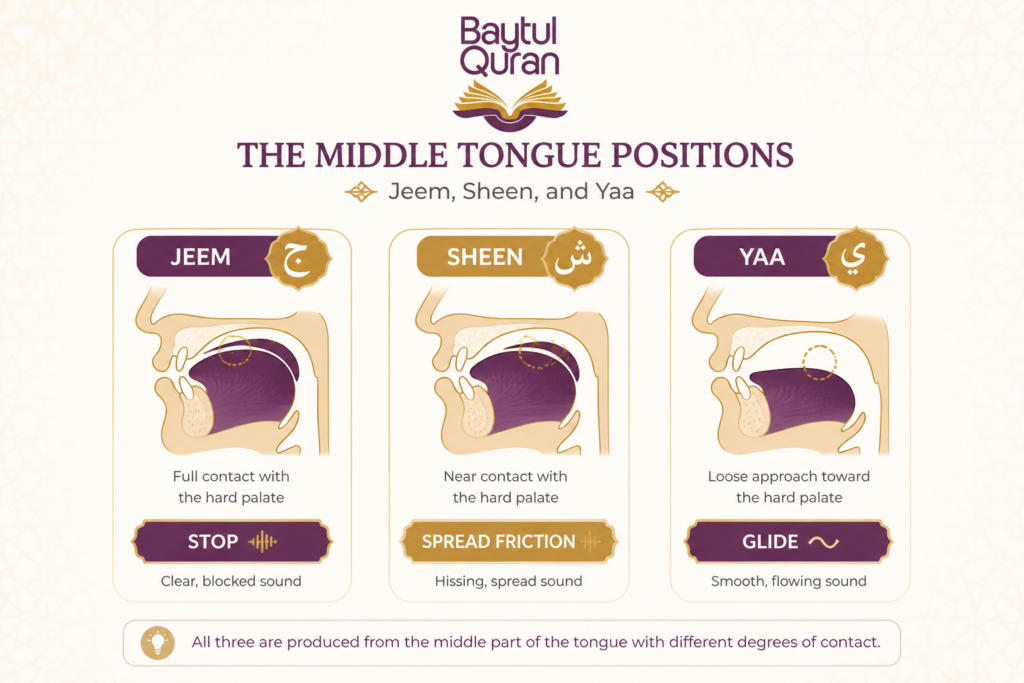
Three letters, one zone, three completely different degrees of tongue-to-palate contact. This is the precision that Tajweed demands.
TONGUE TIP AND SIDE LETTERS DAAD (ض)
Daad deserves its own dedicated section because it is genuinely one of the most unique and technically demanding letters in all of Arabic. The Prophet ﷺ is reported in narrations to have described the Arabs as the people of the Daad, and Arabic itself is sometimes called Lughat Al-Daad, the language of Daad. This tells you something about how distinctive and important this letter is.
Daad is produced from the side edge of the tongue, specifically where the tongue edge meets the upper back molars and the gum area around them. The tongue presses outward against the back teeth and gums on one or both sides, creating a unique lateral closure that produces Daad’s distinctive emphatic quality. Daad also carries the Sifah of Istitaalah from Lesson 4, which means the sound elongates along the side of the tongue during production rather than being produced at a single point.
In terms of Sifaat, Daad carries Jahr (voicing), Rakhawah (airflow continues), Isti’la (elevation), Itbaaq (sealing), and Istitaalah (lateral elongation). This combination of characteristics makes Daad the heaviest, most complex letter in Arabic and the one that takes the longest to master for non-Arab learners.
The most common mistakes with Daad are numerous. Many students replace it with a simple emphatic D sound, which resembles Taa (ط) rather than Daad. Others produce it without the lateral elongation, making it sound thin and clipped. Others produce it without Isti’la and Itbaaq, making it sound like a plain D rather than the heavy emphatic letter it is.
Correct Daad requires a teacher to demonstrate the lateral tongue position physically and to guide the student through the sensation of pressing the tongue edge outward while simultaneously raising the back of the tongue and producing the voicing. This is genuinely not a letter that can be self-taught from descriptions alone.
TONGUE BLADE LETTERS TAA (ط), DAAL (د), AND TAA (ت)
Moving to the blade of the tongue, which is the flat area just behind the very tip, we find three letters that are all produced by the tongue blade making contact with the gum ridge just behind the upper front teeth. This area is called the alveolar ridge and is the same area English uses for its T, D, N, and L sounds, which is why these three Arabic letters are more accessible to English speakers than the throat letters or Daad.
However, there are important differences that students must not overlook.
TAA (ط) THE EMPHATIC TAA
The emphatic Taa is produced from the tongue blade contacting the alveolar ridge, but with a set of Sifaat that make it sound completely different from any English T. Taa carries Jahr (voicing), Shiddah (complete stop), Isti’la (elevation), and Itbaaq (sealing). The combination of these characteristics gives Taa a deep, heavy, full quality that is one of the most striking sounds in Arabic.
The most important distinction to understand is that Taa (ط) is an emphatic letter while regular Taa (ت) is a non-emphatic letter, and confusing the two is a significant Tajweed error. The emphatic Taa (ط) also carries Qalqalah, giving it an echoing bounce when appearing with Sukoon.
When reciting the emphatic Taa, the back of the tongue rises simultaneously with the blade making contact at the alveolar ridge. This double action, front contact plus back elevation, is what creates the distinctive full, rounded quality of the letter.
DAAL (د) THE REGULAR DAL
Daal is produced from the same tongue blade and alveolar ridge position as the emphatic Taa, but with completely different Sifaat. Daal carries Jahr (voicing), Shiddah (complete stop), Istifaal (tongue low), and Infitaah (open). The absence of Isti’la and Itbaaq means Daal is a plain, non-emphatic D sound, lighter and more forward than the emphatic Taa.
The English D sound is a reasonable approximation of Arabic Daal, with the main difference being that Arabic Daal is produced with the tongue blade slightly further back on the alveolar ridge than the typical English D. Daal also carries Qalqalah, producing an echoing quality when it appears with Sukoon.
The most common mistake is confusing Daal with Daad (ض), which is a completely different letter despite both sounding like D-type sounds to English ears. Daad comes from the side of the tongue with emphatic qualities. Daal comes from the blade of the tongue as a plain consonant. A qualified teacher can make this distinction immediately audible and clear.
TAA (ت) THE REGULAR TAA
Regular Taa is produced from the same tongue blade and alveolar ridge position, this time with Hams (breathiness), Shiddah (complete stop), Istifaal, and Infitaah. The combination of Hams and the non-emphatic characteristics gives regular Taa a light, clean, crisp quality that is the lightest of the three letters in this group.
The English T sound is a close approximation of Arabic Taa, though the Arabic letter is produced with slightly more precision and consistency of position than the English T, which varies significantly between accents and positions within a word.
The most critical thing for students is to keep regular Taa (ت) and emphatic Taa (ط) completely distinct. These are two different letters with different Sifaat, different sounds, and different meanings when substituted for each other in Quranic words.
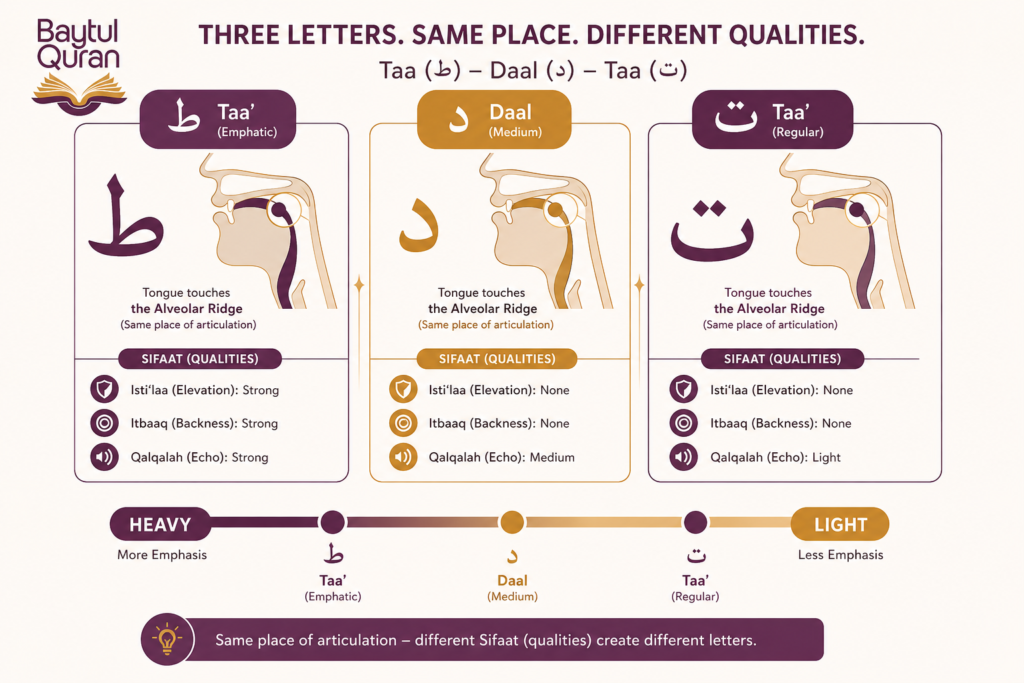
Three letters, one contact zone, but completely different characters. The Sifaat make all the difference here.
DENTAL LETTERS THAA (ث), DHAAL (ذ), AND DHA (ظ)
We now arrive at three letters that are consistently among the hardest for English-speaking students to master, not because they require extreme muscular effort, but because they require a tongue position that English simply does not use for any of its consonants.
The dental letters are produced by placing the very tip of the tongue against or between the upper front teeth. In linguistics, this is called an interdental or dental articulation, and the resulting sounds have a characteristic soft, slightly fuzzy quality that is completely unlike any standard English consonant.
THAA (ث)
Thaa is produced with the tip of the tongue touching the edge of the upper front teeth while air flows freely through the contact, creating friction. Thaa carries Hams (breathiness), Rakhawah (free airflow), Istifaal, and Infitaah. The result is a voiceless dental fricative with a soft, airy, slightly lispy quality.
The closest English sound to Thaa is the TH in words like “think,” “three,” or “thank.” If you say “think” and pay attention to where your tongue goes, you will feel it touching or approaching the upper front teeth. This is exactly the Makhraj of Thaa. For students who can already produce the English TH sound correctly, Thaa is one of the more accessible dental letters.
The most common mistake is replacing Thaa with an S sound, which is the instinctive substitution for speakers of many languages including Urdu, Hindi, and several Arabic dialects. This is a clear Tajweed error that must be corrected.
DHAAL (ذ)
Dhaal is the voiced partner of Thaa. It is produced from exactly the same tongue-to-upper-teeth position as Thaa, but with the voice switched on, meaning the vocal cords are vibrating during production. This gives Dhaal a buzzing, voiced quality compared to the breathy voiceless quality of Thaa.
The closest English sound is the TH in words like “this,” “that,” “the,” and “there.” If you say the word “this” and feel the buzzing vibration of your voice while your tongue touches your upper teeth, you are producing a sound very close to correct Dhaal.
The most common mistake is replacing Dhaal with a Z sound, which again is the instinctive substitution for many non-Arab learners. Students should practice the word “the” in English first to get the physical sensation of voiced dental friction, then transfer that sensation to Arabic Dhaal.
DHA (ظ)
Dha is the emphatic dental letter and is in many ways the most challenging of the three dental letters, combining the interdental tongue position with the emphatic Sifaat of Isti’la and Itbaaq. Dha is produced with the tongue tip at the upper front teeth, as with Thaa and Dhaal, but simultaneously the back of the tongue rises toward the soft palate, creating the heavy, full, emphatic quality that distinguishes Dha from plain Dhaal.
In terms of Sifaat, Dha carries Jahr (voicing), Rakhawah (free airflow), Isti’la (elevation), and Itbaaq (sealing), making it the heaviest and most complex of the three dental letters.
The most common mistake is producing Dha as a plain Dhaal without the emphatic elevation, which removes its distinctive heavy quality entirely. Another common mistake is confusing Dha (ظ) with Daad (ض), because both are heavy voiced letters. However, Daad comes from the side of the tongue with lateral elongation, while Dha comes from the tongue tip at the upper teeth. They are produced from completely different locations despite both carrying emphatic qualities.
Distinguishing Daad and Dha is considered one of the marks of advanced Tajweed skill and is something that even many Arab speakers struggle with in certain dialects. A qualified teacher with Ijazah will be precise about this distinction and will not accept one in place of the other.
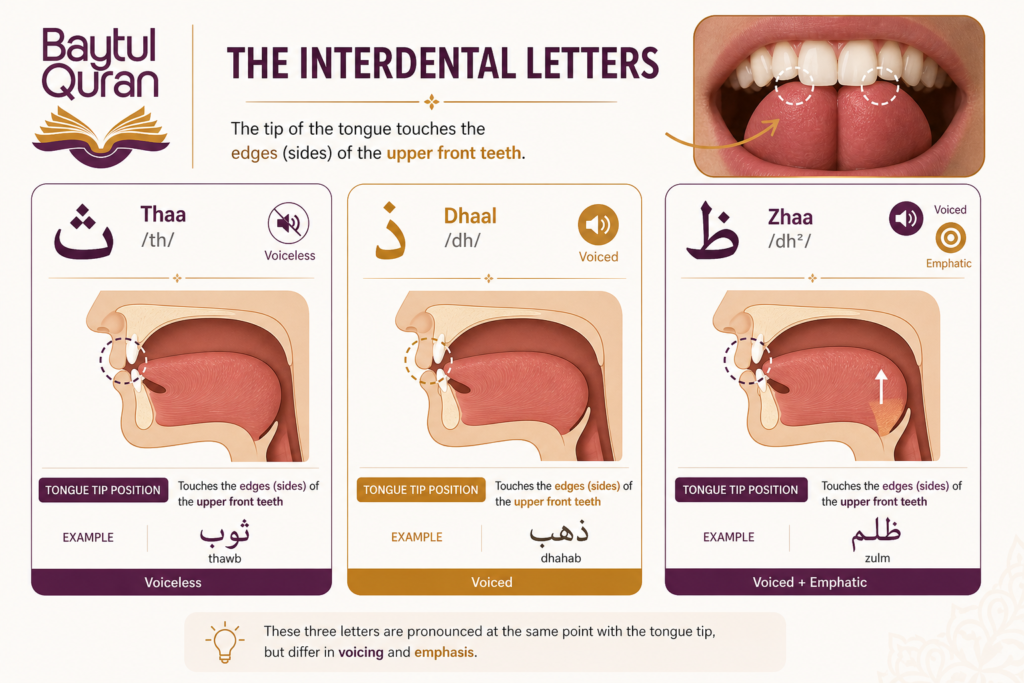
The tongue barely moves between these three letters. But the Sifaat make them three completely distinct Arabic letters with distinct meanings.
WHAT IS COVERED IN PART 2
This lesson has covered eight of the 18 tongue letters in detail. Specifically we have covered Qaaf, Kaaf, Jeem, Sheen, consonant Yaa, Daad, emphatic Taa, Daal, regular Taa, Thaa, Dhaal, and Dha that is 12 letters.
Part 2 will complete the remaining six tongue letters, which are Noon (ن), Raa (ر), Laam (ل), Seen (س), Za (ز), and Saad (ص). These letters come from the tongue tip and blade area in slightly different positions and carry some of the most distinctive Sifaat in all of Arabic, including Safeer (whistling), Takreer (the vibrating quality of Raa), and the emphatic-versus-plain distinction between Seen and Saad.
Part 2 also covers the practical exercises and common error patterns specific to these remaining letters, as well as a complete summary of all 18 tongue letters together so students have a single reference to work from.
Book a free trial Tajweed class at Baytul Quran Academy. “If you would like a qualified teacher to assess your tongue letter articulation personally, you can book a free trial Tajweed class at Baytul Quran Academy with no commitment required.”
Learn about our certified Tajweed teachers. “To learn more about the qualified teachers who guide our students through every stage of this journey, visit our about page.”
HOW TO PRACTICE TONGUE LETTERS EFFECTIVELY
The tongue letters require a different practice approach from the throat letters we covered in Lesson 5. Because the tongue is visible and its movements can be observed, students have a significant advantage in self-monitoring their articulation. Here is the most effective practice method for this group of letters.
Begin by practicing in front of a mirror. For the dental letters especially, you should be able to see your tongue tip touching your upper front teeth. If you cannot see this contact, you are not producing the letter correctly. Use the mirror as immediate visual feedback.
Practice letters in minimal pairs. A minimal pair is two letters that are produced from very similar positions but are distinct, such as Qaaf and Kaaf, or regular Taa and emphatic Taa. Alternating between the two in a single practice session trains both the muscle memory and the ear to feel and hear the difference simultaneously.
Record yourself reading short Quranic phrases that are rich in the letters you are targeting. Listen back critically and compare with a certified Qari’s recitation of the same phrases. The ear is a powerful tool once it is trained to listen precisely.
Most importantly, attend regular sessions with a qualified teacher who can give you real-time correction. Tongue letter errors are subtle enough that self-assessment will always have limits, and a qualified teacher will hear things in your recitation that no recording or mirror can reveal.
🌟 READY TO START YOUR QURAN JOURNEY?
Join hundreds of students across the UK, USA and all over the world, learning Quran online with certified teachers.
✅ Free trial classes no commitment ✅ Expert teachers with Ijazah ✅ Flexible timings for your timezone
👉 Book Your Free Trial on WhatsApp
Or visit: baytulquran.com
FREQUENTLY ASKED QUESTIONS
Q: What are the Arabic tongue letters in Tajweed? A: The Arabic tongue letters, known as Huroof Al-Lisaan, are the 18 letters of Arabic that are produced using different parts of the tongue. They are the largest group of Arabic letters by articulation zone, coming from 10 specific points along the tongue from its very back to its very tip. Part 1 of this lesson covers Qaaf, Kaaf, Jeem, Sheen, consonant Yaa, Daad, emphatic Taa, Daal, regular Taa, Thaa, Dhaal, and Dha. Part 2 covers the remaining six tongue letters including Noon, Raa, Laam, Seen, Zay, and Saad.
Q: What is the difference between Qaaf and Kaaf in Arabic? A: Both Qaaf and Kaaf are produced from the back of the tongue, but at slightly different positions. Qaaf is produced from the very back of the tongue contacting the soft palate, giving it a deep, heavy, resonant quality with full voicing and the characteristic of Qalqalah. Kaaf is produced slightly further forward where the hard and soft palates meet, giving it a lighter, breathier quality. Confusing these two letters is a common mistake among non-Arab learners and can change the meaning of Quranic words. A qualified teacher can make this distinction immediately clear and audible.
Q: Why is Daad considered the hardest Arabic letter? A: Daad is considered the most uniquely Arabic letter because it is produced from the side edge of the tongue against the upper back molars, a position used by virtually no other language in the world. It also carries a complex combination of Sifaat including Isti’la, Itbaaq, and the unique characteristic of Istitaalah, which means the sound elongates laterally along the tongue. This combination of an unusual articulation point and complex sound qualities makes Daad the letter that takes the longest to master for non-Arab learners, and it is the letter most often cited as the mark of advanced Tajweed skill.
Q: What are the dental letters in Arabic and how do I pronounce them? A: The three dental letters are Thaa (ث), Dhaal (ذ), and Dha (ظ). They are produced with the tip of the tongue touching or approaching the upper front teeth. Thaa is the voiceless version, similar to the English TH in “think.” Dhaal is the voiced version, similar to the TH in “this.” Dha is the emphatic version, produced from the same tongue-to-teeth position but with the back of the tongue raised simultaneously, giving it a heavy, full quality. All three are commonly mispronounced by non-Arab learners who substitute S, Z, and D sounds respectively.
Q: How do I tell the difference between emphatic and non-emphatic Arabic letters? A: Emphatic letters, also called heavy letters or Mufakhkham letters, carry the Sifaat of Isti’la (elevation of the back tongue) and in some cases Itbaaq (sealing of the palate). When you produce an emphatic letter, you should feel the back of the tongue rising toward the soft palate simultaneously with the main articulation. The result is a fuller, heavier, more rounded sound quality compared to the lighter, cleaner quality of non-emphatic letters. The clearest pairs to compare are emphatic Taa (ط) versus regular Taa (ت), and Saad (ص) versus Seen (س), which we will cover in Part 2.
Q: Can I learn Arabic tongue letter pronunciation online? A: Yes, absolutely. Online one-to-one Tajweed classes are highly effective for tongue letter work because the close-up view of the teacher’s mouth on screen often makes tongue position more visible than sitting across a room in person. The essential requirement is a live, interactive session where the teacher can hear your recitation, identify your specific errors, and demonstrate the correct position in real time. At Baytul Quran Academy, all our classes are live, one-to-one, and taught by certified teachers with Ijazah. Your first class is completely free with no commitment required.
CONCLUSION
The tongue letters of Arabic are not a single challenge. They are a collection of twelve distinct challenges, each with its own precise position, its own combination of Sifaat, and its own common error pattern. And yet, by the time a student has worked through them systematically with a qualified teacher, they discover something surprising: the tongue that once felt clumsy and imprecise in Arabic becomes an instrument of remarkable precision and beauty.
This is the gift of Tajweed study. It does not just improve your pronunciation. It transforms your relationship with every single letter of the Quran. And when every letter is correct, when every tongue movement is precise and every sound quality is present, the recitation that emerges is not just technically accurate. It is genuinely beautiful in a way that reflects the beauty of the Words themselves.
Part 2 of this lesson will complete the remaining six tongue letters and give you the full picture of Huroof Al-Lisaan. Until then, practice the letters covered today with consistency and patience, and remember that every correctly produced Arabic letter is an act of worship that Allah (SWT) sees and rewards.
May Allah grant us all the ability to recite His Book with precision, beauty, and love. Ameen.
📖 BEGIN YOUR QURAN JOURNEY TODAY Taught Expert Teachers
✦ Tajweed
✦ Hifz
✦ Noorani Qaida
✦ Tafseer
✦ Quran Reading
All over the world
💬 WhatsApp: +44 7842 064721 || +923008737779
🌐https://baytulquran.com/ 📱 @baytulquran_1
First 3 classes are FREE. Always.

One Response